What follows is an investment write-up I recently put together for an investment club I'm a member of. I've made some slight tweaks since the original posting on 2/2/10. For those of you that have followed TILB, you probably know that I have something of a problem with the FDIC and the way it handles assisted transactions. I decided to do some research and figure out how to exploit the opportunity so that I could at least recoup my share of the economic devestation the FDIC wreaks upon our society. There are other good banks available as well.
As a disclaimer: 1) I may not ever make another disclaimer again but you should assume the factset of this disclaimer is always true; 2) I own shares in First Citizens BancShares so consider me very biased; 3) Do your own work. If you buy or sell this based on some random write-up you found on the internet, you are taking very real, independent risk. You absolutely should not rely on my work or views to be accurate or current; 4) I may increase, decrease or entirely exit my stake in this business (or any other investment opportunity) at anytime I want without informing anyone; 5) Please recognize this is a bank being recommended in the middle of an ongoing credit contraction, so use a double dollop of caution.
-----------------------------------------------------------------
First Citizens Bancshares, Inc. - $172/share - Groundhog Day 2010 - Ticker FCNCA/B
Over the past few months, I've been migrating my portfolio from some of the juicier stuff offered twelve to eighteen months ago into conservative, stable investments that offer long-term double digit return potential albeit perhaps at the expense of not being short-term multi-baggers.
First Citizens BancShares is a family-controlled Raleigh, North Carolina based bank holding company (BHC) that just acquired its third loss-share via an FDIC assisted transaction. It trades for 1.1x stated book, though I suspect book will accrete faster than normal over the next few years implying today's purchase price is really at or slightly below book. I've been an owner since this fall and it seems more clear to me now than ever that this conservatively managed bank is exceedingly well positioned to expand its deposit franchise both organically and via acquisition (the latter method being self evident, at this point). I believe downside is fairly limited.
The BHC refers to itself as "BancShares" and is a holding company that operates two primary brands: First-Citizens Bank & Trust (FCB) as well as IronStone Bank a federally chartered thrift ("IronStone" - a solid sounding name if there ever was one - not simply iron, not simply stone, but ironstone). In any case, BancShares is a well positioned BHC with a long track record - it's more important brand, FCB, was founded in 1898.
The FCB arm has been the acquirer in each of the three FDIC assisted transactions - Temecula Valley Bank, CA on 7/17/09, Venture Bank, WA on 9/11/09 and First Regional Bank, CA on 1/19/10. I believe most FDIC assisted transaction are low risk and most offer attractive upside.
By my tally, only two banks have participated in more than three FDIC assisted transactions since the onset of the crisis, both of which are privately controlled banks based in Minnesota (each getting four deals). Not only has FCB acquired three failed banks, it has done so in an incredibly risk-averse manner. It has acquired $4.54 billion of assets (before acquisition accounting fair value markdowns) but did so with loss-sharing agreements with the FDIC covering 88% of those acquired assets, significantly limiting BancShare's downside. This compares to less than 80% coverage for the typical loss-share backed transaction.
Along with those $4.54 billion in assets, BancShares acquired $4.1 billion of deposits and deepened its footprint in two geographies that it was already involved with: Southern California and Washington's Puget Sound counties. Both face obvious cyclical headwinds but have long-term secular tailwinds. Also, each is likely to be an ongoing epicenter of bank failure, leading to incremental opportunity for FCB. [As a brief aside, I think the Pacific Northwest is going to be the Georgia of 2010]
The acquisition of $4.5 billion of assets and $4.1 billion of deposits compares to its June 30, 2009 balance sheet of $17.3 billion of assets and $14.4 billion of deposits. This means BancShares added around 25% to each assets and deposits during the past seven months (June 30th is used because it's the last balance sheet that predates any of the three transactions). This was all accomplished without raising any new capital or taking on much in the way of incremental risk.
To show you the limit of what can happen, the FDIC assisted East West Bank of Pasadena, CA in acquiring United Commercial Bank in November 2009. East West had $12.5 billion of assets and about $10.5 billion of deposits beforehand and added $10.2 billion of assets and $7.5 billion of deposits (with $7.7 billion of loss-sharing). East West Bank thus added 82% and 71% to assets and deposits, respectively. That implies that from the perspective of the FDIC, BancShares has ample flexibility to continue acquiring.
BancShares has not paid a deposit premium for any of the acquired failed institutions.
Capitalization: 8.76 million A shares and 1.68 million B shares with identical economic value, but class B holding 16 votes per share. The overwhelming majority of equity is tangible equity.
Family Controlled: The Holding family controls and runs FCB. They and their family and trusts continue to own well in excess of BancShares votes. They pay themselves fairly - only three employees received over $1 million in total compensation during 2008, none received over $2 million. Two of those employees, Lewis Holding (Chairman & CEO $1.9 million) and James Hyler Jr. (Vice Chairman and COO $1.1 million) retired in early 2009 after 40 and 25 years of service, respectively. Frank Holding Jr. ($0.6 million and 25 years of service) was named Chairman and CEO. His father is the Executive Vice Chairman and has 40 years of service ($1.9 million). Neither retiring executive received any sort of unusual retirement benefits. With a $1.8 billion market cap and insiders owning more than half of it, it's fairly clear that they make money when we do: through building and distributing value to shareholders. No golden parachutes exist.
The company has not issued new shares in many years.
Well Capitalized: If the fact that in the past seven months the FDIC has allowed BancShares to make three acquisitions - including one last week - doesn't provide a hint that BancShares is well capitalized, then nothing will.
BancShares refused TARP money and is considered well capitalized by virtually every objective standard. The company ended 2008 with 13.2% Tier 1 capital ratio, 15.5% total risk based capital ratio and 9.9% leverage capital ratio. According to a recent 8-K, 2009 ended with 13.3%, 15.6% and 9.5%. The FCB subsidiary was 12.7%, 15.1% and 8.7%. Each of these is well in excess of the minimum requirement to be considered well-capitalized (6%, 10% and 5%). While all details haven't yet been released by BancShares about the most recent acquisition (First Regional Bank on 1/29/10), I expect it will not meaningfully negatively impact either BancShares' overall or FCB's specific capitalization scores. BancShares also has a TCE ratio in excess of 8% (calculated before the most recent transaction).
BancShares continues to increase allowances for losses faster than chargeoffs are coming through, despite the fact that both metrics have begun moderating on a quarter over quarter basis, creating some hope that the worst is behind BancShares. The conservative reserving and modest trend improvement both provide hope for reserve release at some point in the future.
Statements like the following one, from a recent 10-Q, provide a qualitative reflection on management's conservative approach [emphasis added]:
"Financial institutions frequently focus their strategic and operating emphasis on maximizing profitability and measure their relative success by reference to profitability measures such as return on average assets or return on average shareholders' equity. Historically, we have placed primary emphasis upon asset quality, balance sheet liquidity and capital conservation, even when those priorities may be detrimental to short-term profitability."
Operating Performance: Over the past fifteen years, BancShares has earned approximately a 10% ROE. That average has been pulled down somewhat by the last several years as the bank was around an 11.5% ROE business for many years through 2000. BancShares earned $11.08 in CY09 vs. $8.73 in CY08, however $6.12 of 2009 was due to acquisition gains from the two 2009 transactions. Book value is approximately $150 per share (tangible book value is about $140 per share).
Chargeoffs in 2009 on non-loss-share assets was 0.56% vs. 0.40% in 2008, though it declined modestly in Q409 at 0.50% vs. 0.62% in Q408. Provisions grew to $77 million vs. $66 million in 2008.
PPOP in 2009 was around $154 million off from $205 million in 2008. Much of this decline is to be expected because as BancShares takes over more troubled assets and new banks, it increases its cost structure. Initially, however, it does not proportionally increase its interest income due to the fact that a large portion of those acquired assets are non-earning assets until they are worked out and the cash is redeployed into earning assets. PPOP in the fourth quarter was somewhat higher than the 2009 annualized rate at $48 million (or $192 million annualized). I expect that over time, it will continue to grow.
Recurring profitability, over time, will expand substantially as the $4.5 billion of assets acquired is redeployed without new equity needing to be raised. More accurately, the fair value of the assets acquired is closer to $3.5-4.0 billion (we don't yet have that detail for First Regional Bank), so the redeployment opportunity is probably more like $3.5-4 billion. In essence, BancShares has increased its loan portfolio and deposit franchise without needing to raise fresh equity. In fact, the growth has come without any meaningful change in BancShares risk metrics because each transaction has been immediately and substantially accretive to book value (described below in the Assisted Transaction section). As such, incremental spread will accrete undiluted to owners. This will improve returns to equity substantially. Over time, I'd expect an incremental $40-50 million of annual income (and growing) from these acquisitions.
I estimate that BancShares could earn in excess of $25 per share on a normalized basis in three years as assets grow from $21 billion and equity grows to over $2 billion. Upside optionality exists in the form of further assisted transactions, faster deployment of excess capital, sustainably higher NIM, and better than expected charge-off experience which releases reserves back to owners.
Steep Yield Curve: While my assumptions do not project substantial NIM spread percentage expansion, it is clearly quite possible. The yield curve is approximately as steep as it has ever been and the lending environment remains very favorable to lenders. This combination amounts to a great environment for banks to operate in, at least for new business. Legacy business obviously remains a challenge for most players as they deal with the less attractive book of assets from the several years leading up to the crisis. As older loans mature and cash is redeployed in a more attractive lending environment, it seems reasonable to expect that this roll leads to average profitability growing over time, even if the size of the asset base stayed the same. I expect that assets will continue to grow as BancShares continues to deploy some of its excess capital and it hunts for additional transactions.
Integration Risk: As with most banks that are larger than $10 billion of assets, BancShares has some history with acquisition and integration. Since 1990, but excluding the three recent assisted transaction, BancShares has acquired nine companies. It wisely stopped buying banks in 2003 as quality and price both degraded. Rather than acquire overpriced banks during the past ten years, BancShares has focused on organic growth of FCB and it has developed its IronStone brand growing it from its founding in 1997 to a $2.1 billion thrift today. I believe the BancShares management team will comfortably manage the integration of the FDIC assisted transactions.
How Does An Assisted Transaction Work: When an FDIC-insured depository institution fails, the FDIC typically conducts an auction to find the highest bidder (actually, to find the "least costly" solution). Some people bid for the entire bank including all assets and liabilities while others bid on pieces. The FDIC seeks to minimize losses to its Deposit Insurance Fund (DIF). This is the normal process.
Historically bidders want to avoid buying bad assets for two reasons: 1) they require management, so there's a personnel cost; and 2) they tie up capital that could otherwise be productively deployed in performing assets. However, during the ongoing crisis, the FDIC was finding that so many bidders were excluding such a large number of assets from their bids that the FDIC began promoting an option to buyers called a "loss-share" agreement where the FDIC covers 80% of losses up to a pre-determined threshold and then 95% of losses beyond that threshold.
In practice this works approximately as follows: the FDIC sets a loss threshold for bidding purposes. This is the threshold where the loss-share triggers from 80% to 95%. For example, on a $100 million asset bank, if we expect losses to the portfolio of $35 million and the loss threshold for bidding purposes is set at $20 million, then the FDIC will absorb losses calculated as 80% x $20 + 95% x ($35 - $20) = $30.25 million (we'll round to $30). Further, because capital is tied up in these troubled loans and resources must be focused on working out those loans, the bidder needs to charge their bid for those carrying costs. Those might be $11 million. As such, the bidder will take the banks pre-existing reserves as its "equity" (call it $10 million for this example), subtract $35 million of losses and $11 million of carrying costs, then add back the FDIC's loss share of $30 million for a total bid of negative $6 million (+$10 of beginning equity - $35 - $11 + $30 = -$6 million). If we were to win the bid, the FDIC would cut us a check for $6 million to take over the bank (and loss-sharing reimbursements would come over time as realized).
All of this is fine, but it still leaves the newly acquired bank with zero equity. A financial buyer (which these days comes in the form of a blind pool) might have to overcapitalize the bank with fresh capital, but a strategic buyer can take its existing capital and apply it to the newly acquired bank. In any case, for BancShares we could assume they'd need to contribute/tie-up $10 million of capital to acquire this hypothetical bank which would make it well capitalized. In essence, they buy this bank at 1.0x book with book being the newly contributed or assigned capital.
This is attractive for a variety of reasons. Importantly, the carry cost asset (the $11 million in our example) is based on a number of assumptions about how long it will take to liquidate bad assets, what the opportunity cost of that capital is, the resources needed to manage those assets, discount rate, etc. The bidder will generally be conservative in this assessment. In the extreme case, if the buyer were to liquidate all of the bad assets for zero, the book value would immediately increase by $6 million (60%) as we'd lose $5 million on the bad assets after the loss-share but we'd accrue the $11 million carry cost asset in its entirety.
This extreme scenario will never happen because the FDIC is both your partner in the assets, your source of future attractive deals, and a key regulator. As such, you would never completely screw them. However, you can see that even if the loss-share portfolio performs extremely poorly, it may actually be a positive event for BancShares. The result is that it is highly likely that the acquisition will end up being at less than book value and that the bank will be overcapitalized and capable of making attractive loans in a lending-friendly environment.
Actual Assisted Transactions:
Temecula Valley Bank - On July 17, 2009, FCB acquired Temecula Valley Bank (TVB) from the FDIC in an assisted transaction. TVB operated eleven branches in Southern California (San Diego and Temecula Valley east of SD). Prior to being shut down, TVB had $1.38 billion of assets and $0.97 billion of deposits (this excludes $304 million of brokered deposits the FCB refused). FCB purchased the $1.4 billion of assets at a $135 million discount. Day one, FCB wrote down the carrying value of the loan portion of TVB's asset portfolio from $1.21 billion to $0.86 billion and its REO from $66 million to $58 million. The bulk of the remaining assets were cash or cash-like, readily marked investment securities and a small amount of "other" assets.
No cash was paid by either FCB or the FDIC at closing. In essence, this was a zero bid. Losses are 100% FCB's on the first $193 million, then split 80/20 FDIC/FCB until losses meet $464 million and then are 95% absorbed by the FDIC thereafter (i.e., the loss threshold set by the FDIC was at $464 million). The term of the loss-share on residential assets is ten years, whereas non-resi real estate is five years with respect to loss-sharing and eight years with respect to loss recoveries. FCB recorded a $103 million loss-share receivable at the time of acquisition and in the first two and a half months identified $32 million in net losses to submit to the FDIC.
In summary, when the net assets of TVB were adjusted upward for the $103 million loss-share offset by the marking of the existing assets an liabilities, FCB records a $58 million "gain" which is effectively $58 million of equity that FCB can use to support the $856 million of loan assets that FCB acquired. FCB likely needed to use another $30 million of its capital to support those assets.
Venture Bank - On September 11, 2009, FCB acquired Venture Bank (VB) from the FDIC in an assisted transaction. VB was located in Seattle/Olympia Washington and operated eighteen branches. Prior to being shut down, Venture Bank had $0.85 billion of assets and $0.71 billion of deposits that FCB inherited (as well as $57 million of other liabilities). FCB purchased the $0.85 billion of assets at a $110 million discount. Day one, FCB wrote down the carrying value of VB's loan book from $650 million to $456 million and its REO from $52 million to $43 million. The bulk of the remaining assets were cash and cash-like investments, investment securities that are easily marked, a small amount of "other" assets.
The FDIC paid to FCB $19.4 million of cash at closing (a "negative" bid). The loss-share was tighter on VB as well. All losses are shared 80/20 FDIC/FCB until losses meet $235 million and then are 95% absorbed by the FDIC thereafter (i.e., the loss threshold set by the FDIC was at $464 million). The term of the loss-share on residential assets is ten years, whereas non-resi real estate is five years with respect to loss-sharing and eight years with respect to loss recoveries. FCB recorded a $139 million loss-share receivable at the time of acquisition and in the first nineteen days identified $8 million in net losses to submit to the FDIC.
In summary, when the net assets of VB were adjusted upward for the $139 million loss-share and the $19 million in cash from the FDIC, FCB records a $46 million "gain" which is effectively $46 million of equity that FCB can use to support the $456 million of loan assets that FCB acquired, meaning that very little to no new capital is required for FCB to take on VB. Further, the faster FCB can put losses to the FDIC, the faster it frees up its capital and resources for productive redeployment.
First Regional Bank - On January 29, 2010 FCB acquired First Regional Bank (FRB) from the FDIC in an assisted transaction. BancShares has not released in-depth detail on the FRB acquisition yet. The basics are that FRB was located in Los Angeles, CA and operated thirteen locations. Prior to being shut down, First Regional had $2.17 billion of assets and $1.87 billion of deposits that FCB inherited. $2.0 billion of the assets were acquired with loss-sharing. Regionally, this fits in with FCB's Temecula Valley Bank acquisition, giving them ample opportunity to continue an in-fill branch strategy or to acquire other contiguous bank footprints.
Return Opportunity: I'm sure nobody follows my write-ups particularly closely, but those that re-read them will notice I am not a fan of valuation targets. However, recognizing most VIC members want something tangible, I'll note the following.
Over the past 15 years, FCNCA has generally traded at a price to book of between 1.1x and 1.9x, creating a valuation arbitrage between the capital BancShares is deploying in FDIC assisted transactions and the market valuation multiple it receives on its book.
Given our acquisition price is at or near book value, it is difficult for me to imagine that over an extended period of time, our shareholder returns lag the returns on equity that BancShares generates. If the bank did no further transactions and were simply to generate 10% ROEs for the next five years, our return would be about 60%. Further, if the P/B were to expand from 1.1x to 1.5x, that would add an incremental 36% to the return. Combined, it seems reasonable that our total return over the next five years will be around 100% or a 15% annualized return. I believe this is achievable with low downside risk and substantial upside optionality from things like the attractive lending environment that prevails, improved scale leading to cost efficiency, "winner" banks receiving premium valuations and potential future attractive acquisitions.
Risks:
Integration: while I believe this is very manageable, it is of course a real risk. It is mitigated from a portfolio standpoint by the loss-shares with the FDIC. This means that the primary integration risk is around the "distraction" element of integration.
Underperformance: BancShares generated below average economic returns during the six years leading up to the crisis. While the conservatism which led to those below average returns during the boom has allowed them to be aggressive when others were licking their wounds, it is clearly possible that below average returns persist.
Macro: Everyday leads to further de-risking of the "macro" as some amount of legacy loans mature or amortize and new, more attractively underwritten loans replace them. However, clearly the macro risk remains heightened for all banks. One further mitigant is that given BancShare's relatively strong balance sheet, the macro "risk" also is "opportunity" for the survivor/winner banks as marketshare becomes available and assisted transactions become increasingly juicy.
-----------------------------------------------------------------
Post Script:
FCB pioked up yet another (its 4th) assisted transaction this weekend when four more banks failed. Two were not acquired by anyone and two were acquired by strategic buyers.
Fortunately, FCB was one of the strategic buyer, acquiring Sun American Bank in Boca Raton, FL (with 12 branches scattered across Boca, Palm Beach and Miami-Dade/Broward)
Link to FCB's press release on the acquisition.
This deal is FCB's fourth FDIC assisted transaction in the past eight months and second this year.
As of Dec. 31, 2009, Sun American Bank reported total assets of $536 million, loans of $424 million and total deposits of $443 million.
The FDIC and First-Citizens Bank & Trust Company entered into a loss-share transaction on $433.0 million of Sun American Bank's assets.
Also, we still haven't had much detail released on the First Regional Bank acquisition. A few sprinkles were covered in the recently filed 10-K, but nothing worth mentioning.
-----------------------------------------------------------------
Let me know what you think and remember, invest at your own peril. I probably know nothing about investing, so you probably should ignore me.
Showing posts with label FDIC. Show all posts
Showing posts with label FDIC. Show all posts
Sunday, March 07, 2010
Tuesday, December 22, 2009
FDIC's Booty From Failed Banks Includes "Marijuana-Reeking Tour Bus"
TILB is so pleased the FDIC has socialized the capitalist function that depositors should play: it enables banks to make such unusually wonderful loans. We wish that instead of selling or auctioning properties off, the FDIC undertook a lottery system. Even better, a "dibs" system. Dibs on the eight foot palm tree!
[HT: TW]
Marijuana-Reeking Tour Bus, Red Ferrari Are FDIC’s Crisis Booty
2009-12-22 05:01:01.0 GMT
By James Sterngold
Dec. 22 (Bloomberg) -- The financial crisis that popped the
real estate bubble and pushed U.S. bank failures to a 17-year
high landed the Federal Deposit Insurance Corp. a rapper’s tour
bus that reeked of marijuana.
“It smelled so bad of pot after one tour that they had to
completely pull out most of the interior and replace it,” said
Jerry Jenkins, who sold the bus at Penny Worley Auctioneers
after the FDIC acquired it in the collapse of an Atlanta bank.
“By the time we got it, it was almost brand-new.”
Worley Auctioneers, based in Maineville, Ohio, has the FDIC
to thank for the bus, not to mention a red 2001 Ferrari, an
eight-foot palm tree and stacks of unwanted office furniture --
the detritus of 140 banks closed by the agency this year. Worley
Auctioneers, Rick Levin & Associates and Tranzon Asset
Strategies, the three firms hired by the FDIC to sell
furnishings from shuttered branches and warehouses stuffed with
repossessed collateral, are having a banner year.
The FDIC has reaped $6.2 million from the sale of so-called
other assets in 2009, six times the total last year, according
to the agency. While that’s a sliver of the $38.3 billion of
failed bank assets that the FDIC held as of Sept. 30, any cash
is useful after the surge in crippled lenders sent the FDIC’s
deposit insurance fund into the red.
“Business has been good,” said Penny Worley, who opened
her firm in 1993. “This can be a daunting task, because there
are so much and so many different things. There’s an occasional
Dali. There are rare gold coins.”
ATM Machine, Microwaves
Worley’s Web site offers a snapshot:
-Laptops, desk chairs and an ashtray, complete with
stubbed-out cigarettes, from First Priority Bank of Bradenton,
Florida, which failed in August 2008, and Freedom Bank, also in
Bradenton, shut three months later.
-A Diebold ATM machine -- empty, presumably -- courtesy of
Cooperative Bank of Wilmington, North Carolina, shuttered in
June 2009.
-Ten refrigerators, plus assorted toasters and microwave
ovens, from Vineyard Bank, the Rancho Cucamonga, California-
based lender that lost more than $100 million last year as
builders defaulted on construction loans. It was shut in July [TILB readers should be quite familiar with Vineyard].
Then there was the tour bus, acquired by Omni National Bank
in repossession from a leasing company before the Atlanta-based
lender went bust in March, Jenkins said. The vehicle, which
sported 12 coffin-like bunks, each with flat-panel televisions,
sold for $310,000 to a company in Nashville, Tennessee, that
leases buses to touring musicians.
Drive-Away Purchase
Financial assets such as real-estate loans are sold
separately through auctions that can involve complex financing
and profit-sharing arrangements. “Other assets” sales are as
straightforward as old-fashioned live auctions.
When the electronic hammer comes down, a process conducted
online, the deal is done and the auctioneers try to get the
merchandise, and the customers, out the door as swiftly as
possible. “PLEASE DO NOT BID if you are unable to remove your
items during the scheduled removal times,” the auction company
warns bidders.
“People get what we call auction frenzy,” Jenkins said.
“We don’t want to give them a week to think about it
afterwards, so items usually have to be picked up within one
day.”
Most come prepared. That was the case with the Ferrari, a
360 Spider F1 with 27,363 miles that sold earlier this year. The
buyer paid $61,000 for a car that New Frontier Bank of Greeley,
Colorado, had repossessed from an auto dealer that had defaulted
on a loan. The buyer arrived on a red-eye flight, paid cash, and
drove away, Jenkins said.
Drag-Racing Truck
New Frontier, which cost the insurance fund $670 million,
also left the FDIC with a 1,000-horsepower drag-racing Chevrolet
pickup truck, and almost 1,000 milking cows. Sales from assets
of other failed banks have included armored trucks, industrial
equipment and Thomas H. Benton lithographs. The palm tree
fetched $105.
The savings-and-loan and banking crisis of the 1980s
produced even more unusual auctions, said Tom Moran, the FDIC’s
resolutions and closing manager, based in Dallas. Back then, the
FDIC ended up with items that ranged from yachts, antiques and
luxury homes to paintings and sculptures, he said.
“I personally went in and found safety deposit boxes with
things like collector-type guns,” Moran said.
Some of the one-of-a-kind items can provide special
challenges. The FDIC is trying to unload a framed 10-by-70-foot
watercolor mural by California artist Millard Sheets, Moran
said, a sort of graphic history of California. It was seized
when PFF Bank and Trust, a $3.7 billion bank in Pomona,
California, failed in November 2008, leaving the insurance fund
with $700 million in losses.
“It’s framed right to the wall, and we’re not sure how to
get it off and protect it,” Moran said. “This is going to take
a unique-type buyer.”
*T
For Related News and Information:
Stories on FDIC: NI FDIC
Stories on bank failures: NI BANKFAIL
On the credit crisis: NI CRUNCH BN
Rescue programs: RESQ
Stories on banks: NI BNK
Today’s top financial stories: FTOP
*T
--Editors: Alec McCabe, William Ahearn.
To contact the reporter on this story:
James Sterngold in New York at +1-212-617-4946 or
jsterngold2@bloomberg.net
To contact the editor responsible for this story:
Alec D.B. McCabe at +1-212-617-4175 or
amccabe@bloomberg.net.
[HT: TW]


Friday, November 06, 2009
Two Enormous Weekends Of Bank Failures And The Response Is???
Crickets.
Sheila is getting good at her job. She's managed to drag this bank failure parade on for so long that we've collectively become numb to it. Nobody cares anymore. For instance, last weekend (10/30/09), we lost a $19 billion BHC (nine separate banks!) and nary a word was written about it.
This weekend, we lost another five banks including an $11 billion San Francisco based bank that caters to Asian Americans called United Commercial Bank (as an aside, check this out from earlier this week for a good laugh!). In addition to being a good sized bank, it actually has an international presence with a Chinese partner and branches in Hong Kong and Shanghai. What will the press say about this?
More crickets.
The Fourth Estate does not seem capable of simple arithmetic, as they rarely (never?) report the aggregate losses incurred since the end of the prior quarter, instead preferring to lean on the FDIC's quarterly reporting as their crutch. These are some hawkshaw pressmen if we've ever seen them!
So we will do the math for you.
In the five weekends since the end of last quarter (i.e., beginning on Friday October 2nd), we have suffered 25 failures with a total estimated loss to the FDIC deposit insurance fund (DIF) of $4.8 billion. During that period, the FDIC has managed to place the vast majority of failed assets at acquiring banks by entering into expensive loss-sharing agreements. In fact, the FDIC has entered into loss-sharing agreements during those five weekends covering $23.8 billion of assets.
But it has not been able to put all of the assets of failed banks to the acquiring banks, even with the incentive of loss-sharing agreements. The FDIC takes ownership of these residual assets. As you might imagine, an asset that someone won't acquire even when virtually all of the risk of loss is taken off the table is a wee bit more toxic than your average bear. The FDIC has inherited $2.7 billion of these assets in the past five weeks alone.
But, who really cares?
Crickets.
Sheila is getting good at her job. She's managed to drag this bank failure parade on for so long that we've collectively become numb to it. Nobody cares anymore. For instance, last weekend (10/30/09), we lost a $19 billion BHC (nine separate banks!) and nary a word was written about it.
This weekend, we lost another five banks including an $11 billion San Francisco based bank that caters to Asian Americans called United Commercial Bank (as an aside, check this out from earlier this week for a good laugh!). In addition to being a good sized bank, it actually has an international presence with a Chinese partner and branches in Hong Kong and Shanghai. What will the press say about this?
More crickets.
The Fourth Estate does not seem capable of simple arithmetic, as they rarely (never?) report the aggregate losses incurred since the end of the prior quarter, instead preferring to lean on the FDIC's quarterly reporting as their crutch. These are some hawkshaw pressmen if we've ever seen them!
So we will do the math for you.
In the five weekends since the end of last quarter (i.e., beginning on Friday October 2nd), we have suffered 25 failures with a total estimated loss to the FDIC deposit insurance fund (DIF) of $4.8 billion. During that period, the FDIC has managed to place the vast majority of failed assets at acquiring banks by entering into expensive loss-sharing agreements. In fact, the FDIC has entered into loss-sharing agreements during those five weekends covering $23.8 billion of assets.
But it has not been able to put all of the assets of failed banks to the acquiring banks, even with the incentive of loss-sharing agreements. The FDIC takes ownership of these residual assets. As you might imagine, an asset that someone won't acquire even when virtually all of the risk of loss is taken off the table is a wee bit more toxic than your average bear. The FDIC has inherited $2.7 billion of these assets in the past five weeks alone.
But, who really cares?
Crickets.
Wednesday, October 28, 2009
Seven Bank Failures - Sheila, Sheila, Sheila
Well, after a few weeks of sitting on their hands costing tax payers money, the FDIC decided to continue slowly doing their job and shut seven more banks this past Friday.
You may say, "TILB, they shut seven banks, how can you say they are slowly doing their job?" Well, it was three months ago that - using some simple back of the envelope math - we predicted 250 banks would close in the ensuing 15 months. That would have meant about 300 failures through October of 2010(obviously with more to come afterwards), which was well above consensus.
Since then, loan performance has worsened and we've learned that the FDIC has ramped its staff by 10,000 - 15,000 employees. We suspect they will not sit idly be as a total waste of taxpayer money (simply a partial waste). Our current view is that ultimately we could have closer to 1,000 failures than 500, with several hundred (500+ coming before the end of 2010). It is our opinion that one dark, cold Friday, rather than the 3-6 weekly failures we've become accustomed to over the past few months (itself a step function up from the 1-2 we were used to pre-June 09), we will witness 10-15 failures. That should serve as a clarion call that it is go-time.
In any case, this was one of the largest failure weeks in nearly two decades (measured by number of banks). Seven failures.
So, let's go to this week's stats:
Red Jersey of Shame Leaderboard - Florida picks up three points, Georgia one and Illinois one. Cali picked up one last week. As an aside, much like Bill Poole, Illinois's state banking regulator is SHAMEFUL, he should be ashamed!:
Georgia 20, Illinois 17, California 10, Florida 9.
Weekly Failure Summary:
Actually, the loss sharing agreements, while massive gifts to their recipients are not totally crazy (just mostly crazy). It basically equates to the FDIC paying the asset acquiror to manage the assets so that the FDIC doesn't have to. The FDIC already has $40-50 billion of inherited toxic assets to deal with, so it's basically giving sweetheart deals to acquirors to avoid adding to its already overwhelming burden. As an aside, this is in essence one of the reasons that banks are choosing not to foreclose on effectively defaulted CRE assets (in addition to defering the magnitude of the writedown): it allows the banks to outsource the property management while they get their own house in order.
Green shoots.
You may say, "TILB, they shut seven banks, how can you say they are slowly doing their job?" Well, it was three months ago that - using some simple back of the envelope math - we predicted 250 banks would close in the ensuing 15 months. That would have meant about 300 failures through October of 2010(obviously with more to come afterwards), which was well above consensus.
Since then, loan performance has worsened and we've learned that the FDIC has ramped its staff by 10,000 - 15,000 employees. We suspect they will not sit idly be as a total waste of taxpayer money (simply a partial waste). Our current view is that ultimately we could have closer to 1,000 failures than 500, with several hundred (500+ coming before the end of 2010). It is our opinion that one dark, cold Friday, rather than the 3-6 weekly failures we've become accustomed to over the past few months (itself a step function up from the 1-2 we were used to pre-June 09), we will witness 10-15 failures. That should serve as a clarion call that it is go-time.
In any case, this was one of the largest failure weeks in nearly two decades (measured by number of banks). Seven failures.
So, let's go to this week's stats:
Red Jersey of Shame Leaderboard - Florida picks up three points, Georgia one and Illinois one. Cali picked up one last week. As an aside, much like Bill Poole, Illinois's state banking regulator is SHAMEFUL, he should be ashamed!:
Georgia 20, Illinois 17, California 10, Florida 9.
Weekly Failure Summary:
Partners Bank, FLSo, another ho-hum week: seven failures, continued ugly trending in loss levels, more obfuscating loss sharing agreements, etc.
Assets: $66mm, FDIC Losses: $28.6mm, Losses as a Percentage of Assets: 43.7%
American United Bank, GA
Assets: $111mm, FDIC Losses: $44mm, Losses as a Percentage of Assets: 39.6%
Hillcrest Bank Florida, FL
Assets: $83mm, FDIC Losses: $45mm, Losses as a Percentage of Assets: 54.2% (that's not a typo)
Flagship National Bank, FL
Assets: $190mm, FDIC Losses: $59mm, Losses as a Percentage of Assets: 31.1%
Bank of Elmwood, WI
Assets: $327mm, FDIC Losses: $101mm, Losses as a Percentage of Assets: 30.9%
Riverview Community Bank, MN
Assets: $108mm, FDIC Losses: $20mm, Losses as a Percentage of Assets: 18.5%
First DuPage Bank, IL
Assets: $279mm, FDIC Losses: $59mm, Losses as a Percentage of Assets: 21.1%
Straight Average Losses as a Percentage of Assets: 34.2%
Weighted Average Losses as a Percentage of Assets: 30.6%
Actually, the loss sharing agreements, while massive gifts to their recipients are not totally crazy (just mostly crazy). It basically equates to the FDIC paying the asset acquiror to manage the assets so that the FDIC doesn't have to. The FDIC already has $40-50 billion of inherited toxic assets to deal with, so it's basically giving sweetheart deals to acquirors to avoid adding to its already overwhelming burden. As an aside, this is in essence one of the reasons that banks are choosing not to foreclose on effectively defaulted CRE assets (in addition to defering the magnitude of the writedown): it allows the banks to outsource the property management while they get their own house in order.
Green shoots.
Friday, October 23, 2009
Sheila Spreads Calm And Sweet Words
This is too f'ing funny. "In short, we cannot run out of money." "For the insured the depositors, a bank failure is a non-event." Love it!
She also lays the groundwork for borrowing from the Treasury.
From the FDIC's website:
Man, we're gonna miss this crisis when it's finally past us in 2017 or so. The unintentional comedy meter is just so high these days.
For instance, watch how her head bobs and weaves with every word. Also, watch and listen to the big "I know I'm lying to you" gulp she takes a 1:20 when she tries to say that we won't have as many failures as the S&L crisis.
Hilarious.
She also lays the groundwork for borrowing from the Treasury.
From the FDIC's website:
Man, we're gonna miss this crisis when it's finally past us in 2017 or so. The unintentional comedy meter is just so high these days.
For instance, watch how her head bobs and weaves with every word. Also, watch and listen to the big "I know I'm lying to you" gulp she takes a 1:20 when she tries to say that we won't have as many failures as the S&L crisis.
Hilarious.
Friday, October 16, 2009
Let The Pigeons Loose: We Got A Bank Failure
After the FDIC decided - apparently - to give its people a few weeks off despite a backlog of several hundred banks, we finally have a another official bank failure: San Joaquin Bank in California. Every week the FDIC chooses to relax at home and not takeout banks costs the U.S. taxpayers another few hundred million dollars. But, as we noted yesterday, nobody seems to care about the government's wasteful ways.
San Joaquin Bank had $775 million of assets and $103 million of estimated losses (including a big loss-sharing agreement).
Link to the press release.
Sorry, but we just have to mention again how much we dislike the FDIC. Fuckers.
San Joaquin Bank had $775 million of assets and $103 million of estimated losses (including a big loss-sharing agreement).
Link to the press release.
Sorry, but we just have to mention again how much we dislike the FDIC. Fuckers.
Tuesday, September 29, 2009
Guest Post: Max Headroom Brings The Rage To The FDIC
As your source for all things FDIC, we bring you a guest post from long time friend of TILB - Max Headroom - on the ongoing debacle that is the public "option" for deposit insurance. Don't worry though, we are sure a health care public option would be far sounder and less costly. The public options in mortgages (Fannie and Freddie) and deposit insurance (FDIC) are probably the outliers. Something as simple as healthcare (i.e., 16% of GDP and with all sorts of personal and moral decisions) would likely be much simpler.
In any case, Max brings the anger on the news the FDIC is going to borrow $45 billion from the banking system to support the banking system and that it expects to incur $100 billion of insured losses before all is said and done. Enjoy:
In any case, Max brings the anger on the news the FDIC is going to borrow $45 billion from the banking system to support the banking system and that it expects to incur $100 billion of insured losses before all is said and done. Enjoy:
I can’t believe this isn’t getting more press. But I’ve been saying this for about 12 months now; finally the FDIC admits that it is a full-on insolvent sh!t show. It just ramped its loss estimates to $100 bn from merely $70 bn – that’s nearly an increase of 50% mind you – and says it will “go negative” this month (never mind the massive liabilities it has taken on and guaranteed too). So it officially has no money; actually, it officially has negative money.Preach it M-M-M-Max.
But this is the shocker - to pay for this debacle, i.e. to do its job and protect depositors, Sheila is recommending that banks pay in advance 3 years of insurance premiums totaling $45 billion. What would you do if Allstate called you up and told you to pay 3 years of auto premiums in advance? An appropriate “go eff yourself” would no doubt be the response.
So while our “healthy” banks – which is hard for me to say with a straight face – continue to struggle (though not lend, i.e. do their job), our gubbernment chooses to further hinder their return to solvency (and hence lending) by placing this new $45 billion burden upon them. Keep in mind, this is direct thievery from the banks’ shareholders and can be seen as a penalty for prudence (or more correctly for being less insolvent).
“I do think this is a good balance,” Chairman Sheila Bair told reporters, and requires the industry to “step up” to spread the financial hit to banks (socialism, there, I said it).
Really, Sheila? You think that “stepping up” and stealing $45 billion from Americans to pay for your incompetency is “a good balance”? I recommend you “step down”, Sheila. You are a colossal failure of the largest proportions, only rivaled by AIG, US fiscal policy, and the Fed’s monetary policy. You are the Queen Joke of regulation in a time when it is really hard to be one because you are surrounded by so many regulatory jesters. Thanks, Sheila, for doing your part to destroy America.
Reversal of TARP
Best line of the morning from a friend of ours that runs Directive 10-289, "the FDIC forcing banks to lend it $36 billion is just a reversal of TARP."
Indeed, albeit unevenly meted out.
Indeed, albeit unevenly meted out.
FDIC Contemplates Making Banks Prepay $36 Billion In insurance Premiums
Seriously?
Lajuan Williams-Dickerson, is this true? Can it be?
We are skeptics but even TILB never saw this coming.
According to this story, the FDIC is contemplating asking, nay, forcing its insureds (banks) to prepay three years worth of insurance premiums. When we posted last week about the rumors the FDIC might rob the rich banks to pay the poor banks, we thought "maybe one quarter's worth of fees". But three years?
Wow.
We can't even get our mind around the balls that Sheila Bair must have dangling. She must f'ing hate Tim Geithner. Pure hate. She apparently prefers further imperiling the entire banking system to asking him to provide the FDIC with fresh cash that he (the Treasury) is legally bound to provide.
And why?
Ego is almost certainly the answer.
As long time TILB readers know, the issue the FDIC is facing is multifold:
- The Deposit Insurance Fund (DIF) is negative. It brings in maybe $200-250 million of "revenue" per week but losses have substantially exceeded that. Using the FDIC's own numbers, we put the DIF at negative $1 billion before Georgian Bank's failure this weekend ripped another $892 million (perhaps $670 million net of revenue) out of the FDIC's already negative coffers. Our estimate is that the FDIC's Deposit Insurance Fund now has worse than negative $1.5 billion in its equity position (unless the FDIC chooses to fraudulently manipulates its reserving, which now is clearly on the table - TILB is basically expecting it at this point);
- Much of the negative position is caused by reserving, so while the FDIC is insolvent and would have been taken over our failed if it were not a socialized insurer to begin with, it actually has plenty of "assets" to deal with its losses for the coming year;
- However, an enormous portion of those "assets" are not cash. In fact, the largest line item on the DIF's balance sheet - by far - is toxic mortgages and other toxic loans that the FDIC could not sell when it took over a given bank. TILB's estimate is this number is currently in the $30-35 billion range. And to date, they have basically refused to sell these "assets" so we can safely opine those loan values are rapidly deteriorating in value as the delinquencies accelerate and servicing is limited or non-existent.
As we noted last week, charging premium before it's actually due does not fix the solvency problem. Borrowing money does not plug a hole that is fundamentally and "equity" problem. The DIF will still be negative and thus the FDIC will still be functionally insolvent. However, it does temporarily solve the "cash" problem that the FDIC was facing.
With that "solution" comes several potentially ill outcomes, most importantly the FDIC would be sucking $36 billion of much needed capital out of the banking system all at once in order to shore up the same banking system (bend your noodle on that for a bit), ironically making strong banks much weaker while not helping weak banks. This effectively will raise the cost of funds for strong banks (Sheila may as well go kick Helicopter Ben straight in his tiny balls). This capital is needed by banks to protect their own balance sheets or, God Forbid, to make new loans. But alas...
Next, she's kicking the can down the road: Sheila Bair will not be running the FDIC when it comes time to pay the piper as she's already announced that she likely won't stand for reappointment. This is creating a shitstorm for her successor.
Three, think of what this is signalling as to the scope of pending bank failures. The FDIC needs an immediate $36 billion infusion? Using the FDIC's own numbers, we know that the in the third quarter alone (6/30 - 9/30) losses for insured banks have been $14.9 billion so far. Last week we estimated that the FDIC likely had less than $10 billion of that precious asset called "cash" remaining. How long will the $36 billion last? One year? Maybe 18 months of we're generous? And then what? Banks won't owe any new premium for another 18 - 24 months at that point. How many times can the FDIC tap already staggering banks for more money? We suspect we will find out.
The Citizen Guarantors of the FDIC - you and me - will inevitably have to step up to the plate on this. It is a function of when, not if at this point.
We have a lot more to say on this matter, but frankly it's probably best if we just let it play out before letting the steam come out of our ears.
Wednesday, September 23, 2009
The FDIC Announces Intention To Rob The Rich To Give To the Poor
We assure you that it was never our intention to become a site dedicated to unmasking the shitshow that is the FDIC, but we play the hand we are dealt.
The most recent FDIC ridiculousness, which we will address below, should not surprise loyal TILB readers as we have been stating over and over again that, using the FDIC's own numbers, the FDIC is insolvent.
Last week, we proved mathematically that the FDIC DIF is now negative and chewing through its reserves. While its liabilities exceed its assets, a portion of those liabilities are reserves that will be used to offset actual losses and pay its creditors (depositors of failed banks). This conversion of reserves into realized losses will keep the DIF alive for a period of time, but the FDIC will soon hit a wall in which it still has "assets" but those assets just don't happen to be "cash". In fact, we also noted that a huge portion of its assets are illiquid assets that are amongst the toxic of the toxic. This of course would not be a problem if they could pay depositors with toxic mortgages, but alas...
After losing another $650 million of value to the Deposit Insurance Fund (DIF) last week (basically $850 million of insured losses offset by $200 million of accrued premium and guaranteed fees), the DIF's capitalization now stands at worse than negative one billion!
As we have said many times, if the FDIC were a bank under the regulation of the FDIC, it would have been seized a long time ago. As American citizens, we find this all very embarrassing.
So, that leads us to this week's FDIC announcement: the FDIC is considering asking sound banks to pay their regular deposit insurance premiums in advance of the normal timeframe (while not asking unsound banks to do the same [note: calling all sellside analysts, you now have a great question to ask the banks you track!!!])
This announcement tacitly equates to stating the following:
1) Oh, shit - we're out of money! ...but not really, but we do need cash, but don't worry, everything's great!
2) In order to remedy this problem, we are going to make all of our lend us their insurance premiums until the premiums come due (don't worry though, this isn't a backdoor special assessment - next quarter we'll credit you for it - wink, wink...)
2a) Oh, and we're not going to make relatively weak banks pay this advance payment...it just feels more fair that way
3) For the time being, our real problem is a "cash" problem rather than an asset problem - don't you see all our pretty reserves? We keep those reserves right there on our balance sheet offset by assets (e.g., toxic, unpurchasable mortgages)
What the deuce is going on here? Are we the only people on Earth that think taking capital out of the banking system to prop up the banking system makes no sense? Isn't Bernie Madoff in jail until he dies for f'ing fewer people behind their backs?
At least the mainstream press is catching on a little bit to the debacle that is the FDIC. That said, the press is confused in its rationale for why big banks "support" this. They obviously support it because they don't want yet another "special" assessment and if paying their normal assessment early helps them avoid said special assessment, they certainly will be in favor of that. However, the article goes on to state big banks don't want the FDIC to borrow from taxpayers...er, the Treasury.
This we are skeptical of.
To say that this would be construed as a taxpayer bailout of banks, is ridiculous. It's a taxpayer bailout of the government. And by the way, the FDIC's entire purpose is to provide bailouts. That's what the FDIC inherently is: a taxpayer guaranteed bailer-outer...but the bailout is to depositors, so to bailout the FDIC is to bailout depositors. While banks, of course, benefit from this in the form of reduced risk of bank runs, that is a statement that is always true, not true just now.
This proposal does not begin to address the FDIC's core problem: THE FDIC IS INSOLVENT. IT HAS LIABILITIES THAT MASSIVELY EXCEED ITS ASSETS. Borrowing more money does not generally address solvency (actually, it often makes the problem worse). What this solution does is simply delay the inevitable; kick the can down the road. As we said on SeekingAlpha last week, the FDIC's core problem is that while it has "reserved" $30 billion for losses (before Q3), it does not actually have $30 billion in cash. In fact, depending on how you calculate "cash" the FDIC had $20 billion or so of cash on June 30th (which is down by about $12 billion so far this quarter). Its largest asset was actually $22 billion of the most toxic loans from the most toxic banks: assets that buyers of failed banks were not willing to purchase ($22 billion as of June 30th, much bigger now).
...and, as we noted, the problem is compounding because the FDIC has been underreserving and its assets are almost certainly overstated. Because the FDIC has been extremely reticent to sell siezed assets, these generally non-performing loans have been sitting on their books stagnant, largely unmanaged and thus suffering deteriorating value as the likelihood of ultimate recovery declines by the day
[Note: generally when a bank fails, the FDIC sells some portion but not 100% of the assets of the failed bank. It retains the balance for disposition at a later date, generally through auctions]
And so this frames the FDIC's problem. It can pull cash forward by a few months, but that just means that unless the new payment cycle becomes permanent, the problem is worse three months hence. The FDIC can borrow from the Taxpayers...er, the "U.S. Treasury", but that does not address solvency - it simply adds another liability to the FDIC's balance sheet. Unless the Treasury makes an "equity" injection into the FDIC, we are not talking about "if" the FDIC is insolvent, we are simply talking about "when" people realize it.
When the FDIC files its September 30th balance sheet for the DIF, unless they start gaming their reserving (which is why bankers go to jail, mind you!), Sheila will have to admit that the DIF is technically insolvent.
The FDIC will have some modicum of claims paying ability that lasts for another two quarters perhaps, but it hits a wall soon unless she starts converting toxic assets into cash. TILB has been following the whole loan mortgage market for the past few years in a variety of capacities - we strongly suspect that the FDIC will not be able to move those assets at anything close to carrying value. When Q3's new basket of bank failures is added, the FDIC's total will exceed $30 billion of super-toxic loans. This is an enormous volume of this type of asset. Extracting value from these kinds of loans requires lots of time and manpower - the likely buyers are niche oriented.
Of course, if these toxic assets start actually trading to new hands (so that the FDIC can raise cash), these sales will have a depressing impact on the realizable value of similar assets on what are theoretically solvent banks, leading to yet more bank failures.
And so here we sit, staring at a Federal government operated trainwreck that's playing out in slow motion. Nobody seems to be paying any attention, yet we find ourselves mesmerized and not able to turn out attention away. We deal with it by standing tall and sharing our views with the our readers.
This is our world and we suppose it's indicative of the role that we play. If the mainstream media will not talk about the Emperor's lack of clothes, we'll go ahead and let you know: Sheila Bair is naked. No, not that way. She's naked in that she is managing a debacle of a regulatory body that has failed at its mission, is insolvent and is introducing all sorts of despicable incentives into the system. She's naked because she is now undertaking in all the despicable acts that she so rightly criticizes and regulates. She's playing favorites, mismarking her assets and understating her liabilities. But time is running out. The paintrain is coming - our view is man-up and admit the situation.
Don't "borrow" from Timmy G; rather, ask for an infusion of new "equity". Frankly, the truly appropriate thing to do would be to seek private capital, recapitalize the FDIC, spin it out completely from the government and operate it as a for profit insurer.
But what is the FDIC's response?
Pretend it's not happening.
Head in the sand, just hoping taxpayers keep walking by pretending there isn't some crazy bastard suffocating under the weight of the beach around them.
The most recent FDIC ridiculousness, which we will address below, should not surprise loyal TILB readers as we have been stating over and over again that, using the FDIC's own numbers, the FDIC is insolvent.
Last week, we proved mathematically that the FDIC DIF is now negative and chewing through its reserves. While its liabilities exceed its assets, a portion of those liabilities are reserves that will be used to offset actual losses and pay its creditors (depositors of failed banks). This conversion of reserves into realized losses will keep the DIF alive for a period of time, but the FDIC will soon hit a wall in which it still has "assets" but those assets just don't happen to be "cash". In fact, we also noted that a huge portion of its assets are illiquid assets that are amongst the toxic of the toxic. This of course would not be a problem if they could pay depositors with toxic mortgages, but alas...
After losing another $650 million of value to the Deposit Insurance Fund (DIF) last week (basically $850 million of insured losses offset by $200 million of accrued premium and guaranteed fees), the DIF's capitalization now stands at worse than negative one billion!
As we have said many times, if the FDIC were a bank under the regulation of the FDIC, it would have been seized a long time ago. As American citizens, we find this all very embarrassing.
So, that leads us to this week's FDIC announcement: the FDIC is considering asking sound banks to pay their regular deposit insurance premiums in advance of the normal timeframe (while not asking unsound banks to do the same [note: calling all sellside analysts, you now have a great question to ask the banks you track!!!])
This announcement tacitly equates to stating the following:
1) Oh, shit - we're out of money! ...but not really, but we do need cash, but don't worry, everything's great!
2) In order to remedy this problem, we are going to make all of our lend us their insurance premiums until the premiums come due (don't worry though, this isn't a backdoor special assessment - next quarter we'll credit you for it - wink, wink...)
2a) Oh, and we're not going to make relatively weak banks pay this advance payment...it just feels more fair that way
3) For the time being, our real problem is a "cash" problem rather than an asset problem - don't you see all our pretty reserves? We keep those reserves right there on our balance sheet offset by assets (e.g., toxic, unpurchasable mortgages)
What the deuce is going on here? Are we the only people on Earth that think taking capital out of the banking system to prop up the banking system makes no sense? Isn't Bernie Madoff in jail until he dies for f'ing fewer people behind their backs?
At least the mainstream press is catching on a little bit to the debacle that is the FDIC. That said, the press is confused in its rationale for why big banks "support" this. They obviously support it because they don't want yet another "special" assessment and if paying their normal assessment early helps them avoid said special assessment, they certainly will be in favor of that. However, the article goes on to state big banks don't want the FDIC to borrow from taxpayers...er, the Treasury.
This we are skeptical of.
To say that this would be construed as a taxpayer bailout of banks, is ridiculous. It's a taxpayer bailout of the government. And by the way, the FDIC's entire purpose is to provide bailouts. That's what the FDIC inherently is: a taxpayer guaranteed bailer-outer...but the bailout is to depositors, so to bailout the FDIC is to bailout depositors. While banks, of course, benefit from this in the form of reduced risk of bank runs, that is a statement that is always true, not true just now.
This proposal does not begin to address the FDIC's core problem: THE FDIC IS INSOLVENT. IT HAS LIABILITIES THAT MASSIVELY EXCEED ITS ASSETS. Borrowing more money does not generally address solvency (actually, it often makes the problem worse). What this solution does is simply delay the inevitable; kick the can down the road. As we said on SeekingAlpha last week, the FDIC's core problem is that while it has "reserved" $30 billion for losses (before Q3), it does not actually have $30 billion in cash. In fact, depending on how you calculate "cash" the FDIC had $20 billion or so of cash on June 30th (which is down by about $12 billion so far this quarter). Its largest asset was actually $22 billion of the most toxic loans from the most toxic banks: assets that buyers of failed banks were not willing to purchase ($22 billion as of June 30th, much bigger now).
...and, as we noted, the problem is compounding because the FDIC has been underreserving and its assets are almost certainly overstated. Because the FDIC has been extremely reticent to sell siezed assets, these generally non-performing loans have been sitting on their books stagnant, largely unmanaged and thus suffering deteriorating value as the likelihood of ultimate recovery declines by the day
[Note: generally when a bank fails, the FDIC sells some portion but not 100% of the assets of the failed bank. It retains the balance for disposition at a later date, generally through auctions]
And so this frames the FDIC's problem. It can pull cash forward by a few months, but that just means that unless the new payment cycle becomes permanent, the problem is worse three months hence. The FDIC can borrow from the Taxpayers...er, the "U.S. Treasury", but that does not address solvency - it simply adds another liability to the FDIC's balance sheet. Unless the Treasury makes an "equity" injection into the FDIC, we are not talking about "if" the FDIC is insolvent, we are simply talking about "when" people realize it.
When the FDIC files its September 30th balance sheet for the DIF, unless they start gaming their reserving (which is why bankers go to jail, mind you!), Sheila will have to admit that the DIF is technically insolvent.
The FDIC will have some modicum of claims paying ability that lasts for another two quarters perhaps, but it hits a wall soon unless she starts converting toxic assets into cash. TILB has been following the whole loan mortgage market for the past few years in a variety of capacities - we strongly suspect that the FDIC will not be able to move those assets at anything close to carrying value. When Q3's new basket of bank failures is added, the FDIC's total will exceed $30 billion of super-toxic loans. This is an enormous volume of this type of asset. Extracting value from these kinds of loans requires lots of time and manpower - the likely buyers are niche oriented.
Of course, if these toxic assets start actually trading to new hands (so that the FDIC can raise cash), these sales will have a depressing impact on the realizable value of similar assets on what are theoretically solvent banks, leading to yet more bank failures.
And so here we sit, staring at a Federal government operated trainwreck that's playing out in slow motion. Nobody seems to be paying any attention, yet we find ourselves mesmerized and not able to turn out attention away. We deal with it by standing tall and sharing our views with the our readers.
This is our world and we suppose it's indicative of the role that we play. If the mainstream media will not talk about the Emperor's lack of clothes, we'll go ahead and let you know: Sheila Bair is naked. No, not that way. She's naked in that she is managing a debacle of a regulatory body that has failed at its mission, is insolvent and is introducing all sorts of despicable incentives into the system. She's naked because she is now undertaking in all the despicable acts that she so rightly criticizes and regulates. She's playing favorites, mismarking her assets and understating her liabilities. But time is running out. The paintrain is coming - our view is man-up and admit the situation.
Don't "borrow" from Timmy G; rather, ask for an infusion of new "equity". Frankly, the truly appropriate thing to do would be to seek private capital, recapitalize the FDIC, spin it out completely from the government and operate it as a for profit insurer.
But what is the FDIC's response?
Pretend it's not happening.
Head in the sand, just hoping taxpayers keep walking by pretending there isn't some crazy bastard suffocating under the weight of the beach around them.
Monday, September 14, 2009
Failure Friday? Yes. Finally The FDIC Deposit Insurance Fund (DIF) Goes Negative
Well, as we have been saying week after week, the wizards at the FDIC are managing a functionally bankrupt Deposit Insurance Fund (DIF). Anyone with common sense could assess loss-reserves to the DIF asset base and recognize this as fact.
But this week is different.
This week the DIF actually lost its last penny and went negative.
Best we can tell, the FDIC is now drawing down its line from the U.S. Tax Payers...excuse us, we mean U.S. Treasury.
With the finally announced and seemingly inevitable failure of Corus Bank in Chicago (shocker!) as well as the not-insignificant failure of Venture Bank in Washington state, the DIF suffered a $2.0 billion nutpunch this week.
Loyal readers know that last week we calculated the DIF's remaining value at $1.3 billion. While the FDIC is bringing in about $200 million in top-line fees per week, simple math let's you know that $1.3 billion + $200 million - $2.0 billion = bad outcomes.
Because this is a red-letter day, we update the math below.
Deposit Insurance Fund Status:
+ $10.4 billion: DIF balance as of 6/30/09 (FDIC reported)
- $12.95 billion: Insured losses from 6/30/09 - 9/11/09 (FDIC reported)
- $0.2 billion: DIF operating expenses from 6/30/09 - 9/11/09 (estimate based on last 12 quarters)
+ $1.85 billion: Insurance assessments (estimated based on 20bps p.a. assessment per insured deposit on $4.8 trillion of insured deposits)
+ $0.4 billion: TLGP fees (TILB estimate of 65bps p.a. on $339 billion outstanding guaranteed debt at 6/30/09)
+ $0.1 billion: Transaction Accounts Guarantee Program ($736 billion guaranteed at 10bps p.a.)
= -$0.4 billion: Total DIF as of September 11th, 2009.
So, from here on out, We The People - the citizen guarantors of the FDIC - will be paying for the FDIC's (and other regulators') foolish behavior. It is officially our dime...and yet nobody seems to care. The media could do this math. This should be splashed across front pages nationwide, "FDIC Goes Broke", "Bank Failures Overwhelm FDIC," "FDIC Fails".
Where's the anger? Where's the dismay? All we see is resigned acceptance; the beaten attitude of a conquered spirit.
TILB is prepared to stand alone...
Pissed.
But this week is different.
This week the DIF actually lost its last penny and went negative.
Best we can tell, the FDIC is now drawing down its line from the U.S. Tax Payers...excuse us, we mean U.S. Treasury.
With the finally announced and seemingly inevitable failure of Corus Bank in Chicago (shocker!) as well as the not-insignificant failure of Venture Bank in Washington state, the DIF suffered a $2.0 billion nutpunch this week.
Loyal readers know that last week we calculated the DIF's remaining value at $1.3 billion. While the FDIC is bringing in about $200 million in top-line fees per week, simple math let's you know that $1.3 billion + $200 million - $2.0 billion = bad outcomes.
Because this is a red-letter day, we update the math below.
Deposit Insurance Fund Status:
+ $10.4 billion: DIF balance as of 6/30/09 (FDIC reported)
- $12.95 billion: Insured losses from 6/30/09 - 9/11/09 (FDIC reported)
- $0.2 billion: DIF operating expenses from 6/30/09 - 9/11/09 (estimate based on last 12 quarters)
+ $1.85 billion: Insurance assessments (estimated based on 20bps p.a. assessment per insured deposit on $4.8 trillion of insured deposits)
+ $0.4 billion: TLGP fees (TILB estimate of 65bps p.a. on $339 billion outstanding guaranteed debt at 6/30/09)
+ $0.1 billion: Transaction Accounts Guarantee Program ($736 billion guaranteed at 10bps p.a.)
= -$0.4 billion: Total DIF as of September 11th, 2009.
So, from here on out, We The People - the citizen guarantors of the FDIC - will be paying for the FDIC's (and other regulators') foolish behavior. It is officially our dime...and yet nobody seems to care. The media could do this math. This should be splashed across front pages nationwide, "FDIC Goes Broke", "Bank Failures Overwhelm FDIC," "FDIC Fails".
Where's the anger? Where's the dismay? All we see is resigned acceptance; the beaten attitude of a conquered spirit.
TILB is prepared to stand alone...
Pissed.
Wednesday, September 09, 2009
The FDIC Contemplates Granting GE Capital Six Months Of Life Support
Per Bloomberg, the FDIC is contemplating extending TLGP another six months. As long-time readers of TILB understand, this is targeted specifically at GE and its subsidiary GE Capital, which has quietly been sucking at the government teet since last fall as hard as possible.
As a reminder, GE Capital has issued approximately 30% of the entire $320 BILLION of wrapped debt under the TLGP. This almost unimaginable reliance on federal subsidies for a business that has a market cap of nearly $160 billion is happening with virtually no mention from the mainstream media. One has to wonder what portion of GE's one hundred sixty billion dollar market cap relies on taxpayer subsidies and why equity owners of one of the world's largest, most storied and theoretically most diversified businesses need - much less deserve - that taxpayer gift.
And how does GE disclose its fundamental reliance on taxpayer handouts? You'll be pleased to know that it is clearly stated in its most recent 10-Q on page 24, Section 8 under the heading GECS Borrowings in footnotes (a) and (d). Very explicit. But, hey, what's $100 billion of sovereign loan guarantees really mean these days anyway?
...and so we return to today's announcement that the FDIC is contemplating extending the TLGP program for an additional six months. One company is by far the largest issuer and we know that its reliance on government wraps has not abated. So, when one interprets the TLGP news...well, we're not sayin', we're just sayin'...
Ironically, the Bloomberg article, while mentioning GE as an issuer under the program seems to focus on the fact the program is intended for "banks" but does not connect that neither GE nor GE Capital are banks. We may not know everything about GE, but we know one thing for sure: GE may own a tiny little bank in BFE, but GE ain't no bank. It certainly is not a bank that deserves nearly $100 billion in loan guarantees from We The People. We suppose if you are the FDIC and you know your insurance fund is already broke, you can be comforted by the fact that you've already failed, nobody cares, and you are playing with the house's money. What's a few extra billion of other people's money (like one hundred billion) between friends. Hey, it's not your money. Have fun! Get some hookers and blow while you're at it!
Green shoots.
HT: LB and BC
As a reminder, GE Capital has issued approximately 30% of the entire $320 BILLION of wrapped debt under the TLGP. This almost unimaginable reliance on federal subsidies for a business that has a market cap of nearly $160 billion is happening with virtually no mention from the mainstream media. One has to wonder what portion of GE's one hundred sixty billion dollar market cap relies on taxpayer subsidies and why equity owners of one of the world's largest, most storied and theoretically most diversified businesses need - much less deserve - that taxpayer gift.
And how does GE disclose its fundamental reliance on taxpayer handouts? You'll be pleased to know that it is clearly stated in its most recent 10-Q on page 24, Section 8 under the heading GECS Borrowings in footnotes (a) and (d). Very explicit. But, hey, what's $100 billion of sovereign loan guarantees really mean these days anyway?
...and so we return to today's announcement that the FDIC is contemplating extending the TLGP program for an additional six months. One company is by far the largest issuer and we know that its reliance on government wraps has not abated. So, when one interprets the TLGP news...well, we're not sayin', we're just sayin'...
Ironically, the Bloomberg article, while mentioning GE as an issuer under the program seems to focus on the fact the program is intended for "banks" but does not connect that neither GE nor GE Capital are banks. We may not know everything about GE, but we know one thing for sure: GE may own a tiny little bank in BFE, but GE ain't no bank. It certainly is not a bank that deserves nearly $100 billion in loan guarantees from We The People. We suppose if you are the FDIC and you know your insurance fund is already broke, you can be comforted by the fact that you've already failed, nobody cares, and you are playing with the house's money. What's a few extra billion of other people's money (like one hundred billion) between friends. Hey, it's not your money. Have fun! Get some hookers and blow while you're at it!
Sept. 9 (Bloomberg) -- The Federal Deposit Insurance Corp. proposed a six-month, emergency-only extension to its debt guarantee program as regulators move to wean companies from federal aid approved at the height of last year’s credit crisis.We look forward to a FOIA request showing how GE is "unable to issue unguaranteed debt".
The five-member FDIC board unanimously approved seeking comment on the extension, which would be limited to certain cases, during a meeting in Washington today. The FDIC now guarantees eligible debt issued before the scheduled Oct. 31 expiration by banks that must get agency approval and pay a fee.
...
Under the limited extension, designed to help the FDIC phase out the program, banks would have to apply to the board for permission to access the aid and show that they were unable to issue unguaranteed debt due to market disruptions or other emergency circumstances.
The FDIC had about $320 billion in outstanding debt guaranteed by the program as of July 31, from firms including Citigroup Inc. and General Electric Co. Regulators are weaning banks from U.S. backing by requiring them to issue unguaranteed debt before repaying Troubled Asset Relief Program funds and escaping restrictions attached to that aid.
Issuance of FDIC-guaranteed bonds has shrunk to $10.8 billion in the third quarter of this year from $130.2 billion in the first quarter and $34.7 billion in the second, according to data compiled by Bloomberg.[emphasis added]
Green shoots.
HT: LB and BC
Tuesday, September 08, 2009
Is The FDIC Deposit Insurance Fund Broke; TILB Provides The Analysis
We are rolling out a new regular series on TILB today. We will update this periodically during the next year and a half.
As we noted recently, the FDIC Deposit Insurance Fund (DIF) took another $400 million hickey over the weekend. We have written several times about the de facto bankruptcy of the FDIC, including:
Thus begins our regular tally of the DIF. We'll give you a sneak preview: the FDIC is bankrupt.
Deposit Insurance Fund Status:
+ $10.4 billion: DIF balance as of 6/30/09 (FDIC reported)
- $11.1 billion: Insured losses from 6/30/09 - 9/5/09 (FDIC reported)
- $0.2 billion: DIF operating expenses from 6/30/09 - 9/5/09 (estimate based on last 12 quarters)
+ $1.7 billion: Insurance assessments
+ $0.4 billion: TLGP fees (TILB estimate of 65bps p.a. on $339 billion outstanding guaranteed debt at 6/30/09)
+ $0.1 billion: Transaction Accounts Guarantee Program ($736 billion guaranteed at 10bps p.a.)
= $1.3 billion: Total DIF as of September 5th, 2009.
So, on a $4.7 trillion insured deposit base, that $1.3 billion represents less than 3 bps of reserve cushion. While Chairmen Bair, Bernanke and Geithner rail against the evils of overlevered banks and insurers, they share a hand in a government run insurer that is levered 3615 times its reserve base.
Don't you just feel secure? Thanks FDIC: you rock!
Green shoots.
As we noted last week, we expect the DIF to lose more than $60 billion between now and the end of 2009. If the FDIC were analyzing itself, it would look at its equity capital base of $1.3 billion, look at its likely losses of $60 billion (perhaps $20 of which would have already been reserved) and note that the stated net worth of the FDIC would be negative $18.7 billion with more losses on the way.
Given the higher insurance premiums it now charges, the FDIC generates about $10 billion per year in pre-reserving cash flow (i.e., it takes $10 billion of bank capital and sucks it out of the system, ironically weakening the banks it insures by precisely that amount), we suspect the FDIC would need the better part of a decade to "earn" its way out of this mess.
So, by its own standards not only would the FDIC would be on the problem bank list, the FDIC is broke. It is, in fact, a failed financial institution (and a big one at that).
Yes, these are the people in charge of the banking system (in combination with state regulators and the Fed, each of whom acquitted itself miserably over the past decade). As these bureaucrats make recommendations on future regulatory frameworks and on the future financial industry banking business model, please keep in mind that they themselves are proven abject professional failures.
While it is the FDIC that insures banks, it is the US Treasury that insures the FDIC and We The People that insure the U.S. Treasury. As such, the awful management of the FDIC and its failed practices leave you, TILB and the rest of us on the hook. Luckily, nobody is paying attention - Chairmen Bair, Bernanke and Geithner maintain robust credibility with the traditional media.
While they are busy negotiating our future amongst themselves, with not a dash of politics involved we're sure, We The People all sit back in our oversized ergo-chairs made to comfortably support either our 115 pound wives or our 300 pound friends that have a medical condition called "eating too much" and are brain-numbed by our 50 inch Chinese assembled plasmas and watch with placid stares of confusion and would-be bemusement as our country is systematically weakened from above.
Don't worry though, a "great" president frequently invoked by our modern incarnation once said "the only thing we have to to fear is...fear itself."
And spiders.
And snakes.
And werewolves.
-------------------------
If you find this enlightening, concerning, bemusing or some combination of the above, please let us know and share this with other folks. Spread the word.
We should not accept the revised regulatory profferings of the damned as the pathway to a sin-free future.
Be skeptical.
Be wary.
Most importantly, be angry.
As we noted recently, the FDIC Deposit Insurance Fund (DIF) took another $400 million hickey over the weekend. We have written several times about the de facto bankruptcy of the FDIC, including:
Now, now, we know the US Treasury guarantees the DIF, so depositors need not fear [other than for their tax dollars and the global incentive system], but hopefully this recognition of functional insolvency allows us to get past the ruse that the FDIC has fulfilled its duty of charging appropriate insurance premiums and providing capable regulatory oversight. In fact, the FDIC's has been an abject failure at these core functions. If the FDIC DIF were were an actual insurer, the FDIC Deposit Insurance Fund itself would have been taken over and killed by the government.So the natural thought arises, "TILB, you say the FDIC is broke, but on June 30th the DIF had $10.4 billion remaining. That seems like a lot of money, so why should I worry?"
Keep that track record in mind when the FDIC "experts" espouse their opinions on the "solutions" to our current ills.
This is all happening in front of our very eyes and with another 300+ banks tee'd up to fail, if we assume the average failure costs $200 million (vs [$252] million per failure since 6/30/09), the FDIC will burn through another $60 billion of capital between now and the end of 2010.
Thus begins our regular tally of the DIF. We'll give you a sneak preview: the FDIC is bankrupt.
Deposit Insurance Fund Status:
+ $10.4 billion: DIF balance as of 6/30/09 (FDIC reported)
- $11.1 billion: Insured losses from 6/30/09 - 9/5/09 (FDIC reported)
- $0.2 billion: DIF operating expenses from 6/30/09 - 9/5/09 (estimate based on last 12 quarters)
+ $1.7 billion: Insurance assessments
+ $0.4 billion: TLGP fees (TILB estimate of 65bps p.a. on $339 billion outstanding guaranteed debt at 6/30/09)
+ $0.1 billion: Transaction Accounts Guarantee Program ($736 billion guaranteed at 10bps p.a.)
= $1.3 billion: Total DIF as of September 5th, 2009.
So, on a $4.7 trillion insured deposit base, that $1.3 billion represents less than 3 bps of reserve cushion. While Chairmen Bair, Bernanke and Geithner rail against the evils of overlevered banks and insurers, they share a hand in a government run insurer that is levered 3615 times its reserve base.
Don't you just feel secure? Thanks FDIC: you rock!
Green shoots.
As we noted last week, we expect the DIF to lose more than $60 billion between now and the end of 2009. If the FDIC were analyzing itself, it would look at its equity capital base of $1.3 billion, look at its likely losses of $60 billion (perhaps $20 of which would have already been reserved) and note that the stated net worth of the FDIC would be negative $18.7 billion with more losses on the way.
Given the higher insurance premiums it now charges, the FDIC generates about $10 billion per year in pre-reserving cash flow (i.e., it takes $10 billion of bank capital and sucks it out of the system, ironically weakening the banks it insures by precisely that amount), we suspect the FDIC would need the better part of a decade to "earn" its way out of this mess.
So, by its own standards not only would the FDIC would be on the problem bank list, the FDIC is broke. It is, in fact, a failed financial institution (and a big one at that).
Yes, these are the people in charge of the banking system (in combination with state regulators and the Fed, each of whom acquitted itself miserably over the past decade). As these bureaucrats make recommendations on future regulatory frameworks and on the future financial industry banking business model, please keep in mind that they themselves are proven abject professional failures.
While it is the FDIC that insures banks, it is the US Treasury that insures the FDIC and We The People that insure the U.S. Treasury. As such, the awful management of the FDIC and its failed practices leave you, TILB and the rest of us on the hook. Luckily, nobody is paying attention - Chairmen Bair, Bernanke and Geithner maintain robust credibility with the traditional media.
While they are busy negotiating our future amongst themselves, with not a dash of politics involved we're sure, We The People all sit back in our oversized ergo-chairs made to comfortably support either our 115 pound wives or our 300 pound friends that have a medical condition called "eating too much" and are brain-numbed by our 50 inch Chinese assembled plasmas and watch with placid stares of confusion and would-be bemusement as our country is systematically weakened from above.
Don't worry though, a "great" president frequently invoked by our modern incarnation once said "the only thing we have to to fear is...fear itself."
And spiders.
And snakes.
And werewolves.
-------------------------
If you find this enlightening, concerning, bemusing or some combination of the above, please let us know and share this with other folks. Spread the word.
We should not accept the revised regulatory profferings of the damned as the pathway to a sin-free future.
Be skeptical.
Be wary.
Most importantly, be angry.
Saturday, September 05, 2009
Deposit Insurance Roulette Hits Green Zero; An Unusually Bloody Week For The FDIC
Depositors with more than $250,000 can take heart that the FDIC tends to favor them in contravention of their mandate by providing free insurance for 24 out of 25 bank failures. Loyal readers know that we have challenged FDIC spokesman Lajuan Williams-Dickerson to defend this indefensible position. In our mind, it is fraud. The FDIC is robbing its citizen guarantors by paying taxpayer money to uninsured depositors in virtually every single bank failure.
We said "virtually" every single bank failure. For the second time in the past two and a half months, the FDIC deposit insurance roulette wheel hit green zero when no buyer was found for the failure of Platinum Community Bank, Rolling Meadows, Illinois. This of course is what "should" happen every week. A service not purchased (insurance on the portion of a deposit that is over $250,000) is a service that should not be provided. Yet we at TILB are angry about this as well. We are angry because this inconsistency is nonsensical and immoral. We are frustrated because this leads to confusion and manipulated outcomes. We are incensed because certain taxpayers are favored at the expense of others for no predictable or reasonably explainable reason.
Lajuan Williams-Dickerson, come to the conversation prepared. You stand forewarned. If you aren't prepared, send The Sheila Bear our way.
This was an unusually bloody week as five banks failed and all five banks generated losses to assets of over 30%. Interestingly, after a week of brutal press on the dubious loss-sharing agreements the FDIC has been entering, they only entered one loss-sharing agreement this week. Prior to this week, 13 out of the last 15 failures had loss-sharing agreements.
It seems increasingly clear to us that the folks over at the FDIC are so overwhelmed by failure right now that they can't tell their ass from their head. This is what happens when you are forced onto the defensive. Understaffed, ill-prepared, under-capitalized, facing an ever-increasing tidal wave of failure and losses, and with uncertain leadership in the future (as GOP appointed Sheila Bair will likely leave after her term expires) it does not surprise us that the FDIC finds itself reacting to news stories with billions of taxpayer dollars rather than doing what they believe is right. Lajuan? Lajuan? Lajuan?
Our bank death scoreboard for the July 1st, 2009 through September 30, 2010 period stands at:
44 down: 206 (minimum) to go
On to this week's stats:
Red Jersey of Shame Leaderboard - Illinois picks up two points:
Georgia 18, Illinois 15, California 9, Florida 6.
Weekly Failure Summary:
In total, the DIF suffered another $400 million of losses this week. Green shoots.
We said "virtually" every single bank failure. For the second time in the past two and a half months, the FDIC deposit insurance roulette wheel hit green zero when no buyer was found for the failure of Platinum Community Bank, Rolling Meadows, Illinois. This of course is what "should" happen every week. A service not purchased (insurance on the portion of a deposit that is over $250,000) is a service that should not be provided. Yet we at TILB are angry about this as well. We are angry because this inconsistency is nonsensical and immoral. We are frustrated because this leads to confusion and manipulated outcomes. We are incensed because certain taxpayers are favored at the expense of others for no predictable or reasonably explainable reason.
Lajuan Williams-Dickerson, come to the conversation prepared. You stand forewarned. If you aren't prepared, send The Sheila Bear our way.
This was an unusually bloody week as five banks failed and all five banks generated losses to assets of over 30%. Interestingly, after a week of brutal press on the dubious loss-sharing agreements the FDIC has been entering, they only entered one loss-sharing agreement this week. Prior to this week, 13 out of the last 15 failures had loss-sharing agreements.
It seems increasingly clear to us that the folks over at the FDIC are so overwhelmed by failure right now that they can't tell their ass from their head. This is what happens when you are forced onto the defensive. Understaffed, ill-prepared, under-capitalized, facing an ever-increasing tidal wave of failure and losses, and with uncertain leadership in the future (as GOP appointed Sheila Bair will likely leave after her term expires) it does not surprise us that the FDIC finds itself reacting to news stories with billions of taxpayer dollars rather than doing what they believe is right. Lajuan? Lajuan? Lajuan?
Our bank death scoreboard for the July 1st, 2009 through September 30, 2010 period stands at:
44 down: 206 (minimum) to go
On to this week's stats:
Red Jersey of Shame Leaderboard - Illinois picks up two points:
Georgia 18, Illinois 15, California 9, Florida 6.
Weekly Failure Summary:
First Bank of Kansas City, Kansas City, MO
Assets: $16mm, FDIC Losses: $6mm, Losses as a Percentage of Assets: 37.5%
InBank, Oak Forest, IL
Assets: $212mm, FDIC Losses: $66mm, Losses as a Percentage of Assets: 31.1%
Vantus Bank, Sioux City, IA
Assets: $458mm, FDIC Losses: $168mm, Losses as a Percentage of Assets: 36.7%
Platinum Community Bank, Rolling Meadows, IL
Assets: $345mm, FDIC Losses: $114mm, Losses as a Percentage of Assets: 33.1%
First State Bank, Flagstaff, AZ
Assets: $105mm, FDIC Losses: $47mm, Losses as a Percentage of Assets: 44.8%
Straight Average Losses as a Percentage of Assets: 36.6%
Weighted Average Losses as a Percentage of Assets: 35.3%
In total, the DIF suffered another $400 million of losses this week. Green shoots.
Friday, September 04, 2009
Questions Arise Regarding FDIC Bidding Process
The Huffington Post has written a piece about the FDIC's failure to disclose all the bids in a bidding process. This apparently is a change of action by the FDIC. Further, HP shows what percentage of FOIA requests the FDIC is denying and that we are at a historical high. We've included that graph below.
The article touches on recently popular topics like the FDIC's loss sharing agreements and its insolvent deposit insurance fund (which we've been talking about forever, including earlier this week.

[HT: DB]
The article touches on recently popular topics like the FDIC's loss sharing agreements and its insolvent deposit insurance fund (which we've been talking about forever, including earlier this week.
Since the start of 2008, the FDIC has cut 53 such deals, said David Barr, an agency spokesman.
Unlike most federal agencies, the FDIC does not receive appropriations from Congress. Rather, it relies on fees from the banks it oversees. The deposit insurance fund, which protects most bank deposits, now stands at about $10.4 billion; this time last year it was at $45 billion. It's supposed to insure about $4.8 trillion in deposits.
If that fund runs dry, the FDIC has a temporary $500 billion credit line to the U.S. Treasury through the end of next year. It was recently permanently increased from $30 billion to $100 billion.
Thomas argues that's part of the problem. Without knowing what the failed bids were offering, he said, it's impossible to know how much money the taxpayer may ultimately lose.
"The fund will go negative -- there's no doubt about it," he said.
The FDIC has not technically denied FOIA requests for the losing bid documents. Rather, the agency has simply delayed sending its decisions.
But a review of agency records shows that the FDIC has increasingly denied the public access under the Freedom of Information Act.
Through this week, the rate of denied FOIA requests has doubled from last year. In fact, FOIA requests are being denied at a higher rate than at any point during the notoriously-secretive George W. Bush administration.
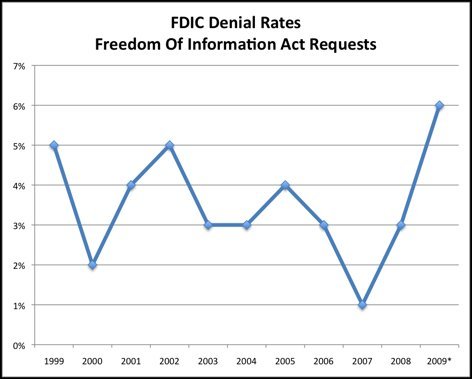
[HT: DB]
Tuesday, September 01, 2009
The Good Ship U.S.S. Bank Failure Keeps A Chipper Pace
With three more failures this week, each of which was a good sized bank ($400 million to $1 billion in assets), the FDIC further dug its hole. While The Sheila Bear may not cop to being broke for a while yet as she authorizes the FDIC to keep playing games like underestimating losses on failures by entering long-tail loss-sharing agreements and levying special assessments on its constituents, I cannot imagine there is a thinking person in the U.S. that has looked at the FDIC's own statistics and thought there is a chance in hell they do not tap the U.S. Treasury for emergency funding (is pre-authorized "emergency" funding really an emergency, or just an eventuality?).
Our bank death scoreboard for the July 1st, 2009 through September 30, 2010 period stands at:
39 down: 211 (minimum) to go
Everyone and their mother refers to the FDIC's published data on the size of its Deposit Insurance Fund (DIF) when discussing its size. For instance, in this paragraph from the 8/31/09 WSJ, we can see the DIF is $10.4 billion:
THE FDIC IS BROKE. As we noted last week:
Happy days!
Luckily, our government shits out $50 billion like it ain't no thing these days. The Fed will continue its backdoor monetization as it attempts to inflate away our debt problem without anyone noticing via a variety of lightly masked helicopter drops (we'll address this another day as we can only put so much angst into one post). We're sure nobody will so much as blink an eye at this.
Nor will anyone talk about the fact that the FDIC continues to steal from the poor and give to the rich in absolute violation of its mandate with nearly each and every bank failure. This was yet another week in which every depositor, whether or not they had deposits in excess of $250,000, was fully preserved. THIS IS JUST AN ABSOLUTE ABDICATION OF RESPONSIBILITY AND FIDUCIARY DUTY! Tell me one other insurance company that volunfuckingtarily provides insurance to its customers for events that both parties agree were not actually covered by the policy.
Tell me one.
Half the time you cannot get a private insurer to pay for things that you thought were insured!
F!!!
F!!!
TILB hereby challenges anyone from the FDIC to justify why on fucking Earth they provide insurance to depositors that are over the $250,000 limit. LaJuan Williams-Dickerson, are you listening? And Lajuan Williams-Dickerson, don't you dare tell me that this is needed to keep the public calm; if that is the case and everyone agrees it is necessary (we do not agree, but assume everyone excluding us for the time being), then at least charge for the service provided (gasp!). This is not rocket science.
Lord willing we will see a series of congressional hearings that end this theft going forward.
In any case, on to this week's stats:
Red Jersey of Shame Leaderboard - California picks up one point:
Georgia 18, Illinois 13, California 9, Florida 6.
Weekly Failure Summary:
Our bank death scoreboard for the July 1st, 2009 through September 30, 2010 period stands at:
39 down: 211 (minimum) to go
Everyone and their mother refers to the FDIC's published data on the size of its Deposit Insurance Fund (DIF) when discussing its size. For instance, in this paragraph from the 8/31/09 WSJ, we can see the DIF is $10.4 billion:
We're referring to the federal deposit insurance fund, which has been shrinking faster than reservoirs in the California drought. The Federal Deposit Insurance Corp. reported late last week that the fund that insures some $4.5 trillion in U.S. bank deposits fell to $10.4 billion at the end of June, as the list of failing banks continues to grow. The fund was $45.2 billion a year ago, when regulators told us all was well and there was no need to take precautions to shore up the fund.What they fail to mention is that by the FDIC's on estimates, in the bank failures that happened in July and August alone, the FDIC self-reports that it lost $10.7 billion!!! Now, obviously it has continued to receive guarantee fees for its monoline-esque business and it continues to bring in premium. Those probably total $3 billion in the past two months. That means that the DIF has less than $3 billion remaining.
THE FDIC IS BROKE. As we noted last week:
Now, now, we know the US Treasury guarantees the DIF, so depositors need not fear, but hopefully this recognition of functional insolvency allows us to get past the ruse that the FDIC has fulfilled its duty of charging appropriate insurance premiums and providing capable regulatory oversight. In fact, the FDIC's has been an abject failure at these core functions. If the FDIC DIF were were an actual insurer, the FDIC Deposit Insurance Fund itself would have been taken over and killed by the government.This is all happening in front of our very eyes and with another 300+ banks tee'd up to fail, if we assume the average failure costs $200 million (vs $274 million per failure since 6/30/09), the FDIC will burn through another $60 billion of capital between now and the end of 2010.
Keep that track record in mind when the FDIC "experts" espouse their opinions on the "solutions" to our current ills.
Happy days!
Luckily, our government shits out $50 billion like it ain't no thing these days. The Fed will continue its backdoor monetization as it attempts to inflate away our debt problem without anyone noticing via a variety of lightly masked helicopter drops (we'll address this another day as we can only put so much angst into one post). We're sure nobody will so much as blink an eye at this.
Nor will anyone talk about the fact that the FDIC continues to steal from the poor and give to the rich in absolute violation of its mandate with nearly each and every bank failure. This was yet another week in which every depositor, whether or not they had deposits in excess of $250,000, was fully preserved. THIS IS JUST AN ABSOLUTE ABDICATION OF RESPONSIBILITY AND FIDUCIARY DUTY! Tell me one other insurance company that volunfuckingtarily provides insurance to its customers for events that both parties agree were not actually covered by the policy.
Tell me one.
Half the time you cannot get a private insurer to pay for things that you thought were insured!
F!!!
F!!!
TILB hereby challenges anyone from the FDIC to justify why on fucking Earth they provide insurance to depositors that are over the $250,000 limit. LaJuan Williams-Dickerson, are you listening? And Lajuan Williams-Dickerson, don't you dare tell me that this is needed to keep the public calm; if that is the case and everyone agrees it is necessary (we do not agree, but assume everyone excluding us for the time being), then at least charge for the service provided (gasp!). This is not rocket science.
Lord willing we will see a series of congressional hearings that end this theft going forward.
In any case, on to this week's stats:
Red Jersey of Shame Leaderboard - California picks up one point:
Georgia 18, Illinois 13, California 9, Florida 6.
Weekly Failure Summary:
Bradford Bank, Baltimore, MDHappy Happy, Joy Joy.
Assets: $452mm, FDIC Losses: $97mm, Losses as a Percentage of Assets: 21.5%
Mainstreet Bank, Forest Lake, MN
Assets: $459mm, FDIC Losses: $95mm, Losses as a Percentage of Assets: 20.7%
Affinity Bank, Ventura, CA
Assets: $1000mm, FDIC Losses: $254mm, Losses as a Percentage of Assets: 25.4%
Straight Average Losses as a Percentage of Assets: 22.5%
Weighted Average Losses as a Percentage of Assets: 23.3%
Sunday, August 23, 2009
The FDIC Goes Broke; Guaranty Bank Find Its Way To The Dustbin Of History (And Three Other Banks Fail)
The FDIC is trickling bank deaths at its New Normal steady state of four or five per week. As we predicted a ways back, at least 250 banks would die before the end of September 2010.
Our bank death scoreboard on the July 1st, 2009 through September 30, 2010 period stands at:
36 down: 214 (minimum) to go
Should be fun.
We also had our second $10+ billion asset bank fail in as many weeks.
This week, Guaranty Bank of Austin Texas took a Glock single shot to the dome...and the FDIC dragged its feet long enough on reforming its rules that govern private equity ownership of banks that We The People ended up placing Guaranty in the hands of Spain's second largest (and probably best run) bank, Banco Bilbao Vizcaya Argentaria (BBVA). Technically BBVA's Birmingham, Alabama based subsidiary BBVA Compass is the acquiror (the South(ern banking capital of Birmingham) will rise again!).
This transaction cost the FDIC Deposit Insurance Fund (DIF) a cool $3 billion on Guaranty's $13 billion asset base (23%). As a citizen guarantor of the DIF, aren't you comforted by the FDIC's desire to keep private capital bidders out of these auctions? Nothing like suppressing capital to get a full and fair price on our behalf!
Jackasses...
Of the other three banks that failed, two were in Georgia (numbers 17 and 18 for the year) and one was in Alabama (its second in two weeks). And for the fourth time in less than three months, Stearns Bank of Minnesota acquired a failed bank (this time an internet bank ostensibly located in Atlanta, Georgia called eBank). This puts the Red Jersey of Shame leaderboard at: Georgia 18, Illinois 13, California 8, Florida 6.
Weekly Failure Summary:
Per the FDIC's own estimates, since July 1st alone the DIF has lost $10.5 billion! Mind you, at March 31st the DIF stood at $13 billion and while the FDIC has taken in rich TLGP guarantee fees during that period, when the 4/1/09 - 6/30/09 losses (which we don't have at our fingertips but are substantial) are taken into account we can safely state that the DIF is, for all intents and purposes, broke.
Now, now, we know the US Treasury guarantees the DIF, so depositors need not fear, but hopefully this recognition of functional insolvency allows us to get past the ruse that the FDIC has fulfilled its duty of charging appropriate insurance premiums and providing capable regulatory oversight. In fact, the FDIC's has been an abject failure at these core functions. If the FDIC DIF were were an actual insurer, the FDIC Deposit Insurance Fund itself would have been taken over and killed by the government.
Keep that track record in mind when the FDIC "experts" espouse their opinions on the "solutions" to our current ills.
As an aside, the FDIC continues its rampant and unrighteous theft from its US citizen guarantors by providing deposit insurance to accounts over $250,000!
Memo To Sheila:
As if your horribly managed insurance "business" was not screwing us all enough, you have decided to insure depositors that - in essence - have not paid for insurance! What the deuce?! For the love of all that is holy, this gift to certain rich depositors is a regressive tax to end all regressive taxes. You are providing free deposit insurance to rich people paid for by the deposits of the portion of the population that does not happen to have two hundred fifty thousand dollars cash on hand. Are you kidding me? At least stop pretending like you don't insure these deposits and charge banks for this insurance. Otherwise, stop violating your mandate and stealing from U.S. citizens out of some sense of unfounded paranoia.
-TILB
The below video is intended to deliver TILB's message to the FDIC. Anytime it refers to Arthur, his cohort, or the English just substitute The Sheila Bear, her cohort, or the FDIC. Yes, we accept the roles as the French guys. It can be summarize as, "I fart in your general direction, your mother was a hamster and you father smelled of elderberries...you fuckers."
Our bank death scoreboard on the July 1st, 2009 through September 30, 2010 period stands at:
36 down: 214 (minimum) to go
Should be fun.
We also had our second $10+ billion asset bank fail in as many weeks.
This week, Guaranty Bank of Austin Texas took a Glock single shot to the dome...and the FDIC dragged its feet long enough on reforming its rules that govern private equity ownership of banks that We The People ended up placing Guaranty in the hands of Spain's second largest (and probably best run) bank, Banco Bilbao Vizcaya Argentaria (BBVA). Technically BBVA's Birmingham, Alabama based subsidiary BBVA Compass is the acquiror (the South(ern banking capital of Birmingham) will rise again!).
This transaction cost the FDIC Deposit Insurance Fund (DIF) a cool $3 billion on Guaranty's $13 billion asset base (23%). As a citizen guarantor of the DIF, aren't you comforted by the FDIC's desire to keep private capital bidders out of these auctions? Nothing like suppressing capital to get a full and fair price on our behalf!
Jackasses...
Of the other three banks that failed, two were in Georgia (numbers 17 and 18 for the year) and one was in Alabama (its second in two weeks). And for the fourth time in less than three months, Stearns Bank of Minnesota acquired a failed bank (this time an internet bank ostensibly located in Atlanta, Georgia called eBank). This puts the Red Jersey of Shame leaderboard at: Georgia 18, Illinois 13, California 8, Florida 6.
Weekly Failure Summary:
eBank, Atlanta, GA...another brutal week.
Assets: $143mm, FDIC Losses: $63mm, Losses as a Percentage of Assets: 44.1%
First Coweta, Newnan, GA
Assets: $167mm, FDIC Losses: $48mm, Losses as a Percentage of Assets: 28.7%
CapitalSouth Bank, Birmingham, AL
Assets: $6170mm, FDIC Losses: $151mm, Losses as a Percentage of Assets: 24.7%
Guaranty Bank, Austin, TX
Assets: $13,000mm, FDIC Losses: $3,000mm, Losses as a Percentage of Assets: 23.1%
Straight Average Losses as a Percentage of Assets: 30.1%
Weighted Average Losses as a Percentage of Assets: 23.4%
Per the FDIC's own estimates, since July 1st alone the DIF has lost $10.5 billion! Mind you, at March 31st the DIF stood at $13 billion and while the FDIC has taken in rich TLGP guarantee fees during that period, when the 4/1/09 - 6/30/09 losses (which we don't have at our fingertips but are substantial) are taken into account we can safely state that the DIF is, for all intents and purposes, broke.
Now, now, we know the US Treasury guarantees the DIF, so depositors need not fear, but hopefully this recognition of functional insolvency allows us to get past the ruse that the FDIC has fulfilled its duty of charging appropriate insurance premiums and providing capable regulatory oversight. In fact, the FDIC's has been an abject failure at these core functions. If the FDIC DIF were were an actual insurer, the FDIC Deposit Insurance Fund itself would have been taken over and killed by the government.
Keep that track record in mind when the FDIC "experts" espouse their opinions on the "solutions" to our current ills.
As an aside, the FDIC continues its rampant and unrighteous theft from its US citizen guarantors by providing deposit insurance to accounts over $250,000!
Memo To Sheila:
As if your horribly managed insurance "business" was not screwing us all enough, you have decided to insure depositors that - in essence - have not paid for insurance! What the deuce?! For the love of all that is holy, this gift to certain rich depositors is a regressive tax to end all regressive taxes. You are providing free deposit insurance to rich people paid for by the deposits of the portion of the population that does not happen to have two hundred fifty thousand dollars cash on hand. Are you kidding me? At least stop pretending like you don't insure these deposits and charge banks for this insurance. Otherwise, stop violating your mandate and stealing from U.S. citizens out of some sense of unfounded paranoia.
-TILB
The below video is intended to deliver TILB's message to the FDIC. Anytime it refers to Arthur, his cohort, or the English just substitute The Sheila Bear, her cohort, or the FDIC. Yes, we accept the roles as the French guys. It can be summarize as, "I fart in your general direction, your mother was a hamster and you father smelled of elderberries...you fuckers."
Sunday, August 16, 2009
Five More Bank Failures, Including The Colonial Bank Doozy; WSJ Reports On FDIC Struggles

Another Friday, another five bank homicides.
The FDIC closed five more banks this past weekend, including the sixth largest failure in the FDIC's history: Colonial Bank at $25 billion asset base.
BB&T stepped up to the plate to takeover Colonial in what looks like a win for the FDIC. The Sheila Bear even went on record as stating, "losses from [Friday's] failures are lower than had been projected." Perhaps not surprisingly, TILB has a alightly different take on the matter.
We have been stating for some time, losses are actually higher than they should be under the FDIC's legal mandate, as the FDIC continues to provide insurance on deposits that are, in fact, not insured. This theft from the FDIC's U.S. citizen owners seems completely ignored by the fourth estate and, frankly, everyone else in the world.
On Friday, all deposits were again protected except potentially $4.2 million from the Community Bank of Nevada. That bank was apparently so toxic that there was no willing buyer at a price the FDIC found acceptable. As such, the FDIC set up a government managed run-off bank and will likely leave those $4 million of depositors out in the cold. As George Orwell warned us so long ago, "All animals are equal but some animals are more equal than others."
Apparently.
While The Sheila Bear may be pounding the table that losses are lower than "projected," TILB will note that a) these losses are still estimates, we'll see how final losses come out; b) it's obviously (and appropriately) weighted largely by Colonial's failure given its size; and c) three of the other four banks that failed had losses that were 50% of assets. Holy shit.
Losses have trended so poorly that even the media is starting to catch on. In tomorrow's WSJ, this article by Joe Bel Bruno will begin highlighting to the masses what TILB has been saying for over a year: losses as a percent of bank assets are trending at a staggeringly high rate.
Banks in the U.S. that failed in the past two years were in far worse shape than those that collapsed during the industry's last crisis, a looming problem for the government agency charged with insuring deposits.Down to the nitty gritty, as the WSJ's nifty chart shown at the top of the post indicates, this was a binary week. Two banks trended better than average (including Colonial) and three were epically horrible:
At three of the five banks that failed Friday, increasing the total to 77 so far this year, the financial hit to the agency's deposit-insurance fund is expected by the Federal Deposit Insurance Corp. to be about 50% of their assets.
The biggest hit on a percentage basis is coming from Community Bank of Nevada, a Las Vegas bank with $1.52 billion in assets and an estimated cost of $781.5 million. The failure of Colonial Bank, a unit of Colonial BancGroup Inc. that was sold to BB&T Corp., will cost $2.8 billion, or 11% of the Montgomery, Ala., bank's assets.
For the 102 banks that have collapsed in the past two years, the FDIC's estimated cost averaged 25% of assets. That is up from the 19% rate between 1989 and 1995, when 747 financial institutions were closed by regulators, according to the FDIC.
...
As the number of bank failures escalates, FDIC officials have been trying to find investors and buyers for terminally ill financial institutions, increasingly by agreeing to shield acquirers from certain losses on assets of the failed bank.
Weekly Failure Summary:
Dwelling House Savings and Loan Association, Pittsburgh, PAAs The Sheila Bear noted, the weighted average outcome is a substantial improvement. However, the simple average outcome was by far the worst we've seen. This was driven by the fact that any of the three truly toxic takeovers would have represented the single worst percentage of assets performer in our dataset by a wide margin (our dataset is incomplete and has not yet been backfilled but covers approximately the last 40 failures).
Assets: $13.4mm, FDIC Losses: $6.8mm, Losses as a Percentage of Assets: 50.7%
Colonial Bank, Montgomery, AL
Assets: $25,000mm, FDIC Losses: $2,800mm, Losses as a Percentage of Assets: 11.2%
Community Bank of Nevada, Las Vegas, NV
Assets: $1,520mm, FDIC Losses: $781.5mm, Losses as a Percentage of Assets: 51.4%
Community Bank of Arizona, Phoenix, AZ
Assets: $158.5mm, FDIC Losses: $25.5mm, Losses as a Percentage of Assets: 16.1%
Union Bank, NA, Gilbert, AZ
Assets: $124mm, FDIC Losses: $61mm, Losses as a Percentage of Assets: 49.2%
Straight Average Losses as a Percentage of Assets: 35.7%
Weighted Average Losses as a Percentage of Assets: 13.7%
While we have not yet seen it reported, we strongly suspect that the Community Bank of Arizona and Community Bank of Nevada are controlled by the same folks. The Arizona failure probably had to be done at the same time as the Nevada failure to avoid creating a taint from one to the other. Additionally, the FDIC sold both Arizona failures to MidFirst Bank (based in Oklahoma City). Its Arizona presence just jumped a notch...
Tracking the race for the Red Jersey of Shame, it's good to see Nevada (now three) and Arizona (now two) put some points on the board. We highlighted a few weeks ago that we suspected they had some good, toxic bank failure runway in front of them. The leaderboard now stands at:
Georgia with 16, Illinois 13, California 8, Florida 6.
Saturday, August 01, 2009
Sun Rises In East; Five More Bank Failures
As TILB predicted several weeks ago, we believe four or five banks will fail on average, per week, for at least the next fifteen months.
A few weeks into this and we look smart.
After seven failures last week, the FDIC cashed five more banks this week. LB's line for weekly bank failure over/under has ceased to be a question of whether or not the overs will take it and instead has become a question of "by how much?"
Weekly Failure Summary:
Two other points worth noting.
First, Illinois sank another basket, tightening the Red Jersey of Shame tally: Georgia - 16, Illinois 13, California 8. In our opinion, Florida with four seems woefully underrepresented. We suspect their most shameful days are ahead of them
Secondly, the FDIC again this week made sure that all deposits were absorbed by an acquiring bank.
Our opinion is this is illegal.
The FDIC is taking losses (that means TILB and our dear readers, as citizen guarantors of the FDIC, are taking losses) rather than depositors that clearly do not qualify for insurance.
The FDIC waterfall should look like this:
1) FDIC takes over failing institution;
2) Cash out from FDIC Deposit Insurance Fund (DIF) to insured depositors;
3) Cash into DIF for sale of insured deposits;
4) Cash into DIF for sale of assets;
5) Cash to uninsured depositors if #3 and #4 exceed #2;
6) Any final excess cash falls through the capital structure as expected: unsecured creditors, subordinated debt, preferreds, equity.
For reasons that we can guess at but that have not been adequately addressed, #5 has generally been moved ahead of repaying the DIF. Basically, the FDIC is insuring depositors that have not "paid" an insurance premium and thusly should not receive insurance proceeds. The FDIC is doing this with our money and we feel it is akin to theft.
TILB is getting angry...
A few weeks into this and we look smart.
After seven failures last week, the FDIC cashed five more banks this week. LB's line for weekly bank failure over/under has ceased to be a question of whether or not the overs will take it and instead has become a question of "by how much?"
Weekly Failure Summary:
First State Bank of Altus, OKThis is on par with the worst set of averages over the past month and a half since the pace of collapse has accelerated.
Assets: $103.4mm, FDIC Losses: $25.2mm, Losses as a Percentage of Assets: 24.4%
Integrity Bank, Jupiter, FL
Assets: $119mm, FDIC Losses: $46mm, Losses as a Percentage of Assets: 38.7%
People's Community Bank, West Chester, OH
Assets: $705.8mm, FDIC Losses: $129.5mm, Losses as a Percentage of Assets: 18.3%
First BankAmericano, Elizabeth, NJ
Assets: $166mm, FDIC Losses: $15mm, Losses as a Percentage of Assets: 9.0%
Mutual Bank, Harvey, IL
Assets: $1,600mm, FDIC Losses: $696mm, Losses as a Percentage of Assets: 43.5%
Straight Average Losses as a Percentage of Assets: 26.8%
Weighted Average Losses as a Percentage of Assets: 33.8%
Two other points worth noting.
First, Illinois sank another basket, tightening the Red Jersey of Shame tally: Georgia - 16, Illinois 13, California 8. In our opinion, Florida with four seems woefully underrepresented. We suspect their most shameful days are ahead of them
Secondly, the FDIC again this week made sure that all deposits were absorbed by an acquiring bank.
Our opinion is this is illegal.
The FDIC is taking losses (that means TILB and our dear readers, as citizen guarantors of the FDIC, are taking losses) rather than depositors that clearly do not qualify for insurance.
The FDIC waterfall should look like this:
1) FDIC takes over failing institution;
2) Cash out from FDIC Deposit Insurance Fund (DIF) to insured depositors;
3) Cash into DIF for sale of insured deposits;
4) Cash into DIF for sale of assets;
5) Cash to uninsured depositors if #3 and #4 exceed #2;
6) Any final excess cash falls through the capital structure as expected: unsecured creditors, subordinated debt, preferreds, equity.
For reasons that we can guess at but that have not been adequately addressed, #5 has generally been moved ahead of repaying the DIF. Basically, the FDIC is insuring depositors that have not "paid" an insurance premium and thusly should not receive insurance proceeds. The FDIC is doing this with our money and we feel it is akin to theft.
TILB is getting angry...
Friday, July 24, 2009
Seven More Failures; FDIC On A Bank Failure Treadmill
Seven banks were closed today.
The FDIC almost cannot shut banks down fast enough these days.
Earlier this week, TILB predicted that the FDIC would shutdown 250 or more banks over the next 15 months (equating to 4-5 failures per week). One week into our prediction, the FDIC has not let us down.
That said, as with the last time we had seven failures, this week comes with a big caveat: six of the failures were sister banks in Georgia: Security Bank of Gwinnett County, Security Bank of Bibb County, Security Bank of Houston County, Security Bank of Jones County, Security Bank of North Metro, and Security Bank of North Fulton. Collectively these six banks had a pretty good sized asset base at $2.8 billion.
The seventh bank was the tiny Waterford Village Bank in Williamsville, NY with $61.4 million of assets.
As has been true in the majority of cases, no depositors took losses as all deposits were absorbed by acquiring banks (including deposits over the FDIC minimum). Someday in the future, we will talk about how the FDIC is basically subsidizing non-insured depositors despite this clearly being outside their legal mandate. In our opinion, the FDIC's action on this front is dishonest, illegal and immoral. This undeserved gift to uninsured depositors, of course, comes at the expense of the tax payer and the dollar-based saver (the latter resulting from our suspicion that printing money is the Occam's Razor answer that will be pursued to handle the enormous debts our government is issuing, including the debt it will take on in order to replenish the FDIC deposit insurance fund, which is virtually empty).
Unlike most weeks, the FDIC did not break out its estimate of losses for each of the different bank failures. Instead, the Security Bank failures were aggregated together. As such, we've assumed that each bank is allocated a pro-rata share of losses based on its asset base (collectively, the Security Banks are estimated to cost the FDIC insurance fund 28.8% of their assets). Here's this week's analysis (spoiler alert: things still suck for the FDIC):
Waterford Village Bank, NY
Assets: $61.4mm, FDIC Losses: $5.6mm, Losses as a Percentage of Assets: 9.1%
Security Bank of Gwinnett County, GA
Assets: $322mm, FDIC Losses: $92.8mm, Losses as a Percentage of Assets: 28.8%
Security Bank of Bibb County, GA
Assets: $1,200mm, FDIC Losses: $346mm, Losses as a Percentage of Assets: 28.8%
Security Bank of Houston County, GA
Assets: $383mm, FDIC Losses: $110mm, Losses as a Percentage of Assets: 28.8%
Security Bank of Jones County, GA
Assets: $453mm, FDIC Losses: $131mm, Losses as a Percentage of Assets: 28.8%
Security Bank of North Metro, GA
Assets: $242mm, FDIC Losses: $64.6mm, Losses as a Percentage of Assets: 28.8%
Security Bank of North Fulton, GA
Assets: $209mm, FDIC Losses: $60mm, Losses as a Percentage of Assets: 28.8%
Straight Average Losses as a Percentage of Assets: 26.0%
Weighted Average Losses as a Percentage of Assets: 28.4%
For those keeping score at home, you may recall that last week we applauded California and Georgia for making a contest of the failure championship. Illinois, on the backs of the Campbell family, seemed to be running away with the 2009 Red Jersey of Shame (mistakenly referred to as black last week).
What a difference a week makes! Georgia now leads the competition and has posted sixteen bank failures in 2009. Third place California has eight bank failures and current runner-up Illinois has twelve. Those three states represent 36 of the 64 failures this year.
Noticeably absent from the list is meaningful failure volume from Nevada, Florida or Arizona based banks. We suspect California banks have a good chunk of Nevada and Arizona risk, but there is no way local banks in those states are not getting obliterated. As an email from a friend of TILB at BTIG said today:
The FDIC almost cannot shut banks down fast enough these days.
Earlier this week, TILB predicted that the FDIC would shutdown 250 or more banks over the next 15 months (equating to 4-5 failures per week). One week into our prediction, the FDIC has not let us down.
That said, as with the last time we had seven failures, this week comes with a big caveat: six of the failures were sister banks in Georgia: Security Bank of Gwinnett County, Security Bank of Bibb County, Security Bank of Houston County, Security Bank of Jones County, Security Bank of North Metro, and Security Bank of North Fulton. Collectively these six banks had a pretty good sized asset base at $2.8 billion.
The seventh bank was the tiny Waterford Village Bank in Williamsville, NY with $61.4 million of assets.
As has been true in the majority of cases, no depositors took losses as all deposits were absorbed by acquiring banks (including deposits over the FDIC minimum). Someday in the future, we will talk about how the FDIC is basically subsidizing non-insured depositors despite this clearly being outside their legal mandate. In our opinion, the FDIC's action on this front is dishonest, illegal and immoral. This undeserved gift to uninsured depositors, of course, comes at the expense of the tax payer and the dollar-based saver (the latter resulting from our suspicion that printing money is the Occam's Razor answer that will be pursued to handle the enormous debts our government is issuing, including the debt it will take on in order to replenish the FDIC deposit insurance fund, which is virtually empty).
Unlike most weeks, the FDIC did not break out its estimate of losses for each of the different bank failures. Instead, the Security Bank failures were aggregated together. As such, we've assumed that each bank is allocated a pro-rata share of losses based on its asset base (collectively, the Security Banks are estimated to cost the FDIC insurance fund 28.8% of their assets). Here's this week's analysis (spoiler alert: things still suck for the FDIC):
Waterford Village Bank, NY
Assets: $61.4mm, FDIC Losses: $5.6mm, Losses as a Percentage of Assets: 9.1%
Security Bank of Gwinnett County, GA
Assets: $322mm, FDIC Losses: $92.8mm, Losses as a Percentage of Assets: 28.8%
Security Bank of Bibb County, GA
Assets: $1,200mm, FDIC Losses: $346mm, Losses as a Percentage of Assets: 28.8%
Security Bank of Houston County, GA
Assets: $383mm, FDIC Losses: $110mm, Losses as a Percentage of Assets: 28.8%
Security Bank of Jones County, GA
Assets: $453mm, FDIC Losses: $131mm, Losses as a Percentage of Assets: 28.8%
Security Bank of North Metro, GA
Assets: $242mm, FDIC Losses: $64.6mm, Losses as a Percentage of Assets: 28.8%
Security Bank of North Fulton, GA
Assets: $209mm, FDIC Losses: $60mm, Losses as a Percentage of Assets: 28.8%
Straight Average Losses as a Percentage of Assets: 26.0%
Weighted Average Losses as a Percentage of Assets: 28.4%
For those keeping score at home, you may recall that last week we applauded California and Georgia for making a contest of the failure championship. Illinois, on the backs of the Campbell family, seemed to be running away with the 2009 Red Jersey of Shame (mistakenly referred to as black last week).
What a difference a week makes! Georgia now leads the competition and has posted sixteen bank failures in 2009. Third place California has eight bank failures and current runner-up Illinois has twelve. Those three states represent 36 of the 64 failures this year.
Noticeably absent from the list is meaningful failure volume from Nevada, Florida or Arizona based banks. We suspect California banks have a good chunk of Nevada and Arizona risk, but there is no way local banks in those states are not getting obliterated. As an email from a friend of TILB at BTIG said today:
*LAS VEGAS AREA HOME PRICES FELL 41.3% IN JUNE FROM YR EARLIERThis does not auger well for the FDIC's bank failure pipeline. When you're levered 12:1 or 15:1, collateral value declines of 50% (peak to today) have a particularly upsetting impact.
*LAS VEGAS HOME SALES INCREASE 44%, MDA DATAQUICK SAYS
--- so homes are starting to clear = good, but the clearing prices are still 45% lower than they are now = bad ....... i wonder if they have a break down of speculators vs real family buyers
Subscribe to:
Posts (Atom)