Crickets.
Sheila is getting good at her job. She's managed to drag this bank failure parade on for so long that we've collectively become numb to it. Nobody cares anymore. For instance, last weekend (10/30/09), we lost a $19 billion BHC (nine separate banks!) and nary a word was written about it.
This weekend, we lost another five banks including an $11 billion San Francisco based bank that caters to Asian Americans called United Commercial Bank (as an aside, check this out from earlier this week for a good laugh!). In addition to being a good sized bank, it actually has an international presence with a Chinese partner and branches in Hong Kong and Shanghai. What will the press say about this?
More crickets.
The Fourth Estate does not seem capable of simple arithmetic, as they rarely (never?) report the aggregate losses incurred since the end of the prior quarter, instead preferring to lean on the FDIC's quarterly reporting as their crutch. These are some hawkshaw pressmen if we've ever seen them!
So we will do the math for you.
In the five weekends since the end of last quarter (i.e., beginning on Friday October 2nd), we have suffered 25 failures with a total estimated loss to the FDIC deposit insurance fund (DIF) of $4.8 billion. During that period, the FDIC has managed to place the vast majority of failed assets at acquiring banks by entering into expensive loss-sharing agreements. In fact, the FDIC has entered into loss-sharing agreements during those five weekends covering $23.8 billion of assets.
But it has not been able to put all of the assets of failed banks to the acquiring banks, even with the incentive of loss-sharing agreements. The FDIC takes ownership of these residual assets. As you might imagine, an asset that someone won't acquire even when virtually all of the risk of loss is taken off the table is a wee bit more toxic than your average bear. The FDIC has inherited $2.7 billion of these assets in the past five weeks alone.
But, who really cares?
Crickets.
Showing posts with label failed banks. Show all posts
Showing posts with label failed banks. Show all posts
Friday, November 06, 2009
Sunday, November 01, 2009
Happy November: CIT Files For Chapter 11 Bankruptcy
Too medium to fail? No. CIT files with "overwhelming" support of creditors. For some unclear reason, GMAC continues to get Chinese money via the U.S. Treasury but CIT gets something different: indifference.
In any case, here's the press release:
In any case, here's the press release:
November 01, 2009 03:39 PM Eastern Time
CIT Board of Directors Approves Proceeding with Prepackaged Plan of Reorganization with Overwhelming Support of Debtholders
Nearly 90% in Favor of Plan; Emergence Sought by Year-End
Operating Entities Remain Unaffected and Highly Liquid
Continue Lending to Small and Middle Market Businesses
NEW YORK--(BUSINESS WIRE)--CIT Group Inc. (NYSE: CIT), a leading provider of financing to small businesses and middle market companies, today announced that, with the overwhelming support of its debtholders, the Board of Directors voted to proceed with the prepackaged plan of reorganization for CIT Group Inc. and a subsidiary that will restructure the Company’s debt and streamline its capital structure.
Importantly, none of CIT’s operating subsidiaries, including CIT Bank, a Utah state bank, will be included in the filings. As a result, all operating entities are expected to continue normal operations during the pendency of the cases.
All classes voted to accept the prepackaged plan and all were substantially in excess of the required thresholds for a successful vote. Approximately 85% of the Company’s eligible debt participated in the solicitation, and nearly 90% of those participating supported the prepackaged plan of reorganization.
Similarly, approximately 90% of the number of debtholders voting, both large and small, cast affirmative votes for the prepackaged plan. The conditions for consummating the exchange offers were not met.
Accordingly, CIT’s Board of Directors approved the Company to proceed with the voluntary filings for CIT Group Inc. and CIT Group Funding Company of Delaware LLC with the U.S. Bankruptcy Court for the Southern District of New York (“the Court”).
Due to the overwhelming and broad support from its debtholders, the Company is asking the Court for a quick confirmation of the approved prepackaged plan. Under the plan, CIT expects to reduce total debt by approximately $10 billion, significantly reduce its liquidity needs over the next three years, enhance its capital ratios and accelerate its return to profitability.
“The decision to proceed with our plan of reorganization will allow CIT to continue to provide funding to our small business and middle market customers, two sectors that remain vitally important to the U.S. economy,” said Jeffrey M. Peek, Chairman and CEO. “We are enormously appreciative of the extraordinary support we have received from our many constituencies. This market-based solution allows CIT to enter into the reorganization process well-prepared and positioned for a swift emergence. I want to thank our customers for their support and express my gratitude to our employees whose dedication and hard work are crucial to the future of CIT. We also acknowledge our constructive working relationship with our regulators and look forward to their continued guidance as we move through this process.”
For more than 100 years, CIT has provided much needed capital to small business and middle market customers. These two sectors play a vital role in the U.S. economy and in overall employment and job creation, representing more than 90 million employees. CIT is the leading provider of financing to the retail sector and to women-, minority- and veteran-owned small businesses. Over one million customers depend on CIT to provide the financing needed to run their businesses. In addition to being one of the largest independent leasing companies in the U.S., CIT maintains the following leadership positions among others:
#1 factoring company in the U.S.;
3rd largest railcar lessor in the U.S.; and
3rd largest aircraft lessor in the world.
As previously announced, CIT expanded its $3 billion senior secured credit facility by an additional $4.5 billion on October 28, 2009. These funds, supplemented by cash generated from operations, will allow us to meet clients’ needs and to satisfy customary obligations associated with the daily operation of its businesses during the confirmation process. CIT has also secured an incremental $1 billion committed line of credit to provide supplemental liquidity as it pursues that plan.
In conjunction with today’s announcement, CIT has filed a number of first day motions that will allow it to continue to operate in the ordinary course during the confirmation process. These motions include requests to continue the payment of wages, salaries and other employee benefits. Additionally, the Company filed a motion seeking the necessary relief from the Court to pay its vendors and certain other creditors in full.
Under the proposed prepackaged plan of reorganization, all existing common and preferred stock will be cancelled upon emergence.
Treatment of Securities in Offers and Solicitations
The original CIT Group Inc. offers launched on October 1, 2009 have expired. Securities tendered in these offers will be released into their original CUSIP numbers as soon as practicable.
Securities tendered in connection with offers that have not yet expired, certain long-term notes maturing after 2018 and the Delaware Funding offers, are being retained in the CUSIP numbers for those offers; however, these securities can be withdrawn from the offers and returned to the original CUSIP number for trading. Any withdrawn securities can be re-tendered until the expiration date.
For Additional Information
Additional information about CIT’s restructuring can be found on the Company’s Web site, www.cit.com. For access to Court documents and other general information about the Chapter 11 cases, please visit www.kccllc.net/citgroup. The Company has established a toll-free Supplier Information Line at 800-422-2738 or, if you are calling from outside the U.S. 973-422-3877 and a toll-free Restructuring Information Line for all other interested parties at 866-967-1786 or 310-751-2686.
Evercore Partners and FTI Consulting are the Company’s financial advisors and Skadden, Arps, Slate, Meagher & Flom LLP is legal counsel in connection with the restructuring plan and Chapter 11 cases. Sullivan & Cromwell advised CIT’s Board of Directors on the restructuring plan and will act as legal counsel to CIT going forward on certain corporate matters.
Houlihan Lokey Howard & Zukin Capital, Inc. serves as financial advisor, and Paul, Weiss, Rifkind, Wharton & Garrison LLP serves as legal counsel to the Lender Steering Committee.
Individuals interested in receiving future updates on CIT via e-mail can register at http://newsalerts.cit.com
About CIT
CIT (NYSE: CIT) is a bank holding company with more than $60 billion in finance and leasing assets that provides financial products and advisory services to small and middle market businesses. Operating in more than 50 countries across 30 industries, CIT provides an unparalleled combination of relationship, intellectual and financial capital to its customers worldwide. CIT maintains leadership positions in small business and middle market lending, retail finance, aerospace, equipment and rail leasing, and vendor finance. Founded in 1908 and headquartered in New York City, CIT is a member of the Fortune 500. www.cit.com
FORWARD-LOOKING STATEMENTS
This press release contains forward-looking statements within the meaning of applicable federal securities laws that are based upon our current expectations and assumptions concerning future events, which are subject to a number of risks and uncertainties that could cause actual results to differ materially from those anticipated. The words “expect,” “anticipate,” “estimate,” “forecast,” “initiative,” “objective,” “plan,” “goal,” “project,” “outlook,” “priorities,” “target,” “intend,” “evaluate,” “pursue,” “commence,” “seek,” “may,” “would,” “could,” “should,” “believe,” “potential,” “continue,” or the negative of any of those words or similar expressions is intended to identify forward-looking statements. All statements contained in this press release, other than statements of historical fact, including without limitation, statements about our plans, strategies, prospects and expectations regarding future events and our financial performance, are forward-looking statements that involve certain risks and uncertainties. While these statements represent our current judgment on what the future may hold, and we believe these judgments are reasonable, these statements are not guarantees of any events or financial results, and our actual results may differ materially. Important factors that could cause our actual results to be materially different from our expectations include, among others, the risk that the additional facilities do not provide the liquidity that CIT is seeking due to material negative changes to CIT’s liquidity from draw down of loans by customers, the risk that CIT is unsuccessful in its efforts to consummate the plan of reorganization. Accordingly, you should not place undue reliance on the forward-looking statements contained in this press release. These forward-looking statements speak only as of the date on which the statements were made. CIT undertakes no obligation to update publicly or otherwise revise any forward-looking statements, except where expressly required by law.
Contacts
CIT Media Relations:
C. Curtis Ritter, 212-461-7711
Vice President
Director of External Communications & Media Relations
Curt.Ritter@cit.com
or
CIT Investor Relations:
Ken Brause, 1-866-54CITIR (542-4847)
Executive Vice President
investor.relations@cit.com


Wednesday, October 28, 2009
Seven Bank Failures - Sheila, Sheila, Sheila
Well, after a few weeks of sitting on their hands costing tax payers money, the FDIC decided to continue slowly doing their job and shut seven more banks this past Friday.
You may say, "TILB, they shut seven banks, how can you say they are slowly doing their job?" Well, it was three months ago that - using some simple back of the envelope math - we predicted 250 banks would close in the ensuing 15 months. That would have meant about 300 failures through October of 2010(obviously with more to come afterwards), which was well above consensus.
Since then, loan performance has worsened and we've learned that the FDIC has ramped its staff by 10,000 - 15,000 employees. We suspect they will not sit idly be as a total waste of taxpayer money (simply a partial waste). Our current view is that ultimately we could have closer to 1,000 failures than 500, with several hundred (500+ coming before the end of 2010). It is our opinion that one dark, cold Friday, rather than the 3-6 weekly failures we've become accustomed to over the past few months (itself a step function up from the 1-2 we were used to pre-June 09), we will witness 10-15 failures. That should serve as a clarion call that it is go-time.
In any case, this was one of the largest failure weeks in nearly two decades (measured by number of banks). Seven failures.
So, let's go to this week's stats:
Red Jersey of Shame Leaderboard - Florida picks up three points, Georgia one and Illinois one. Cali picked up one last week. As an aside, much like Bill Poole, Illinois's state banking regulator is SHAMEFUL, he should be ashamed!:
Georgia 20, Illinois 17, California 10, Florida 9.
Weekly Failure Summary:
Actually, the loss sharing agreements, while massive gifts to their recipients are not totally crazy (just mostly crazy). It basically equates to the FDIC paying the asset acquiror to manage the assets so that the FDIC doesn't have to. The FDIC already has $40-50 billion of inherited toxic assets to deal with, so it's basically giving sweetheart deals to acquirors to avoid adding to its already overwhelming burden. As an aside, this is in essence one of the reasons that banks are choosing not to foreclose on effectively defaulted CRE assets (in addition to defering the magnitude of the writedown): it allows the banks to outsource the property management while they get their own house in order.
Green shoots.
You may say, "TILB, they shut seven banks, how can you say they are slowly doing their job?" Well, it was three months ago that - using some simple back of the envelope math - we predicted 250 banks would close in the ensuing 15 months. That would have meant about 300 failures through October of 2010(obviously with more to come afterwards), which was well above consensus.
Since then, loan performance has worsened and we've learned that the FDIC has ramped its staff by 10,000 - 15,000 employees. We suspect they will not sit idly be as a total waste of taxpayer money (simply a partial waste). Our current view is that ultimately we could have closer to 1,000 failures than 500, with several hundred (500+ coming before the end of 2010). It is our opinion that one dark, cold Friday, rather than the 3-6 weekly failures we've become accustomed to over the past few months (itself a step function up from the 1-2 we were used to pre-June 09), we will witness 10-15 failures. That should serve as a clarion call that it is go-time.
In any case, this was one of the largest failure weeks in nearly two decades (measured by number of banks). Seven failures.
So, let's go to this week's stats:
Red Jersey of Shame Leaderboard - Florida picks up three points, Georgia one and Illinois one. Cali picked up one last week. As an aside, much like Bill Poole, Illinois's state banking regulator is SHAMEFUL, he should be ashamed!:
Georgia 20, Illinois 17, California 10, Florida 9.
Weekly Failure Summary:
Partners Bank, FLSo, another ho-hum week: seven failures, continued ugly trending in loss levels, more obfuscating loss sharing agreements, etc.
Assets: $66mm, FDIC Losses: $28.6mm, Losses as a Percentage of Assets: 43.7%
American United Bank, GA
Assets: $111mm, FDIC Losses: $44mm, Losses as a Percentage of Assets: 39.6%
Hillcrest Bank Florida, FL
Assets: $83mm, FDIC Losses: $45mm, Losses as a Percentage of Assets: 54.2% (that's not a typo)
Flagship National Bank, FL
Assets: $190mm, FDIC Losses: $59mm, Losses as a Percentage of Assets: 31.1%
Bank of Elmwood, WI
Assets: $327mm, FDIC Losses: $101mm, Losses as a Percentage of Assets: 30.9%
Riverview Community Bank, MN
Assets: $108mm, FDIC Losses: $20mm, Losses as a Percentage of Assets: 18.5%
First DuPage Bank, IL
Assets: $279mm, FDIC Losses: $59mm, Losses as a Percentage of Assets: 21.1%
Straight Average Losses as a Percentage of Assets: 34.2%
Weighted Average Losses as a Percentage of Assets: 30.6%
Actually, the loss sharing agreements, while massive gifts to their recipients are not totally crazy (just mostly crazy). It basically equates to the FDIC paying the asset acquiror to manage the assets so that the FDIC doesn't have to. The FDIC already has $40-50 billion of inherited toxic assets to deal with, so it's basically giving sweetheart deals to acquirors to avoid adding to its already overwhelming burden. As an aside, this is in essence one of the reasons that banks are choosing not to foreclose on effectively defaulted CRE assets (in addition to defering the magnitude of the writedown): it allows the banks to outsource the property management while they get their own house in order.
Green shoots.
Friday, October 16, 2009
Let The Pigeons Loose: We Got A Bank Failure
After the FDIC decided - apparently - to give its people a few weeks off despite a backlog of several hundred banks, we finally have a another official bank failure: San Joaquin Bank in California. Every week the FDIC chooses to relax at home and not takeout banks costs the U.S. taxpayers another few hundred million dollars. But, as we noted yesterday, nobody seems to care about the government's wasteful ways.
San Joaquin Bank had $775 million of assets and $103 million of estimated losses (including a big loss-sharing agreement).
Link to the press release.
Sorry, but we just have to mention again how much we dislike the FDIC. Fuckers.
San Joaquin Bank had $775 million of assets and $103 million of estimated losses (including a big loss-sharing agreement).
Link to the press release.
Sorry, but we just have to mention again how much we dislike the FDIC. Fuckers.
Wednesday, September 23, 2009
The FDIC Announces Intention To Rob The Rich To Give To the Poor
We assure you that it was never our intention to become a site dedicated to unmasking the shitshow that is the FDIC, but we play the hand we are dealt.
The most recent FDIC ridiculousness, which we will address below, should not surprise loyal TILB readers as we have been stating over and over again that, using the FDIC's own numbers, the FDIC is insolvent.
Last week, we proved mathematically that the FDIC DIF is now negative and chewing through its reserves. While its liabilities exceed its assets, a portion of those liabilities are reserves that will be used to offset actual losses and pay its creditors (depositors of failed banks). This conversion of reserves into realized losses will keep the DIF alive for a period of time, but the FDIC will soon hit a wall in which it still has "assets" but those assets just don't happen to be "cash". In fact, we also noted that a huge portion of its assets are illiquid assets that are amongst the toxic of the toxic. This of course would not be a problem if they could pay depositors with toxic mortgages, but alas...
After losing another $650 million of value to the Deposit Insurance Fund (DIF) last week (basically $850 million of insured losses offset by $200 million of accrued premium and guaranteed fees), the DIF's capitalization now stands at worse than negative one billion!
As we have said many times, if the FDIC were a bank under the regulation of the FDIC, it would have been seized a long time ago. As American citizens, we find this all very embarrassing.
So, that leads us to this week's FDIC announcement: the FDIC is considering asking sound banks to pay their regular deposit insurance premiums in advance of the normal timeframe (while not asking unsound banks to do the same [note: calling all sellside analysts, you now have a great question to ask the banks you track!!!])
This announcement tacitly equates to stating the following:
1) Oh, shit - we're out of money! ...but not really, but we do need cash, but don't worry, everything's great!
2) In order to remedy this problem, we are going to make all of our lend us their insurance premiums until the premiums come due (don't worry though, this isn't a backdoor special assessment - next quarter we'll credit you for it - wink, wink...)
2a) Oh, and we're not going to make relatively weak banks pay this advance payment...it just feels more fair that way
3) For the time being, our real problem is a "cash" problem rather than an asset problem - don't you see all our pretty reserves? We keep those reserves right there on our balance sheet offset by assets (e.g., toxic, unpurchasable mortgages)
What the deuce is going on here? Are we the only people on Earth that think taking capital out of the banking system to prop up the banking system makes no sense? Isn't Bernie Madoff in jail until he dies for f'ing fewer people behind their backs?
At least the mainstream press is catching on a little bit to the debacle that is the FDIC. That said, the press is confused in its rationale for why big banks "support" this. They obviously support it because they don't want yet another "special" assessment and if paying their normal assessment early helps them avoid said special assessment, they certainly will be in favor of that. However, the article goes on to state big banks don't want the FDIC to borrow from taxpayers...er, the Treasury.
This we are skeptical of.
To say that this would be construed as a taxpayer bailout of banks, is ridiculous. It's a taxpayer bailout of the government. And by the way, the FDIC's entire purpose is to provide bailouts. That's what the FDIC inherently is: a taxpayer guaranteed bailer-outer...but the bailout is to depositors, so to bailout the FDIC is to bailout depositors. While banks, of course, benefit from this in the form of reduced risk of bank runs, that is a statement that is always true, not true just now.
This proposal does not begin to address the FDIC's core problem: THE FDIC IS INSOLVENT. IT HAS LIABILITIES THAT MASSIVELY EXCEED ITS ASSETS. Borrowing more money does not generally address solvency (actually, it often makes the problem worse). What this solution does is simply delay the inevitable; kick the can down the road. As we said on SeekingAlpha last week, the FDIC's core problem is that while it has "reserved" $30 billion for losses (before Q3), it does not actually have $30 billion in cash. In fact, depending on how you calculate "cash" the FDIC had $20 billion or so of cash on June 30th (which is down by about $12 billion so far this quarter). Its largest asset was actually $22 billion of the most toxic loans from the most toxic banks: assets that buyers of failed banks were not willing to purchase ($22 billion as of June 30th, much bigger now).
...and, as we noted, the problem is compounding because the FDIC has been underreserving and its assets are almost certainly overstated. Because the FDIC has been extremely reticent to sell siezed assets, these generally non-performing loans have been sitting on their books stagnant, largely unmanaged and thus suffering deteriorating value as the likelihood of ultimate recovery declines by the day
[Note: generally when a bank fails, the FDIC sells some portion but not 100% of the assets of the failed bank. It retains the balance for disposition at a later date, generally through auctions]
And so this frames the FDIC's problem. It can pull cash forward by a few months, but that just means that unless the new payment cycle becomes permanent, the problem is worse three months hence. The FDIC can borrow from the Taxpayers...er, the "U.S. Treasury", but that does not address solvency - it simply adds another liability to the FDIC's balance sheet. Unless the Treasury makes an "equity" injection into the FDIC, we are not talking about "if" the FDIC is insolvent, we are simply talking about "when" people realize it.
When the FDIC files its September 30th balance sheet for the DIF, unless they start gaming their reserving (which is why bankers go to jail, mind you!), Sheila will have to admit that the DIF is technically insolvent.
The FDIC will have some modicum of claims paying ability that lasts for another two quarters perhaps, but it hits a wall soon unless she starts converting toxic assets into cash. TILB has been following the whole loan mortgage market for the past few years in a variety of capacities - we strongly suspect that the FDIC will not be able to move those assets at anything close to carrying value. When Q3's new basket of bank failures is added, the FDIC's total will exceed $30 billion of super-toxic loans. This is an enormous volume of this type of asset. Extracting value from these kinds of loans requires lots of time and manpower - the likely buyers are niche oriented.
Of course, if these toxic assets start actually trading to new hands (so that the FDIC can raise cash), these sales will have a depressing impact on the realizable value of similar assets on what are theoretically solvent banks, leading to yet more bank failures.
And so here we sit, staring at a Federal government operated trainwreck that's playing out in slow motion. Nobody seems to be paying any attention, yet we find ourselves mesmerized and not able to turn out attention away. We deal with it by standing tall and sharing our views with the our readers.
This is our world and we suppose it's indicative of the role that we play. If the mainstream media will not talk about the Emperor's lack of clothes, we'll go ahead and let you know: Sheila Bair is naked. No, not that way. She's naked in that she is managing a debacle of a regulatory body that has failed at its mission, is insolvent and is introducing all sorts of despicable incentives into the system. She's naked because she is now undertaking in all the despicable acts that she so rightly criticizes and regulates. She's playing favorites, mismarking her assets and understating her liabilities. But time is running out. The paintrain is coming - our view is man-up and admit the situation.
Don't "borrow" from Timmy G; rather, ask for an infusion of new "equity". Frankly, the truly appropriate thing to do would be to seek private capital, recapitalize the FDIC, spin it out completely from the government and operate it as a for profit insurer.
But what is the FDIC's response?
Pretend it's not happening.
Head in the sand, just hoping taxpayers keep walking by pretending there isn't some crazy bastard suffocating under the weight of the beach around them.
The most recent FDIC ridiculousness, which we will address below, should not surprise loyal TILB readers as we have been stating over and over again that, using the FDIC's own numbers, the FDIC is insolvent.
Last week, we proved mathematically that the FDIC DIF is now negative and chewing through its reserves. While its liabilities exceed its assets, a portion of those liabilities are reserves that will be used to offset actual losses and pay its creditors (depositors of failed banks). This conversion of reserves into realized losses will keep the DIF alive for a period of time, but the FDIC will soon hit a wall in which it still has "assets" but those assets just don't happen to be "cash". In fact, we also noted that a huge portion of its assets are illiquid assets that are amongst the toxic of the toxic. This of course would not be a problem if they could pay depositors with toxic mortgages, but alas...
After losing another $650 million of value to the Deposit Insurance Fund (DIF) last week (basically $850 million of insured losses offset by $200 million of accrued premium and guaranteed fees), the DIF's capitalization now stands at worse than negative one billion!
As we have said many times, if the FDIC were a bank under the regulation of the FDIC, it would have been seized a long time ago. As American citizens, we find this all very embarrassing.
So, that leads us to this week's FDIC announcement: the FDIC is considering asking sound banks to pay their regular deposit insurance premiums in advance of the normal timeframe (while not asking unsound banks to do the same [note: calling all sellside analysts, you now have a great question to ask the banks you track!!!])
This announcement tacitly equates to stating the following:
1) Oh, shit - we're out of money! ...but not really, but we do need cash, but don't worry, everything's great!
2) In order to remedy this problem, we are going to make all of our lend us their insurance premiums until the premiums come due (don't worry though, this isn't a backdoor special assessment - next quarter we'll credit you for it - wink, wink...)
2a) Oh, and we're not going to make relatively weak banks pay this advance payment...it just feels more fair that way
3) For the time being, our real problem is a "cash" problem rather than an asset problem - don't you see all our pretty reserves? We keep those reserves right there on our balance sheet offset by assets (e.g., toxic, unpurchasable mortgages)
What the deuce is going on here? Are we the only people on Earth that think taking capital out of the banking system to prop up the banking system makes no sense? Isn't Bernie Madoff in jail until he dies for f'ing fewer people behind their backs?
At least the mainstream press is catching on a little bit to the debacle that is the FDIC. That said, the press is confused in its rationale for why big banks "support" this. They obviously support it because they don't want yet another "special" assessment and if paying their normal assessment early helps them avoid said special assessment, they certainly will be in favor of that. However, the article goes on to state big banks don't want the FDIC to borrow from taxpayers...er, the Treasury.
This we are skeptical of.
To say that this would be construed as a taxpayer bailout of banks, is ridiculous. It's a taxpayer bailout of the government. And by the way, the FDIC's entire purpose is to provide bailouts. That's what the FDIC inherently is: a taxpayer guaranteed bailer-outer...but the bailout is to depositors, so to bailout the FDIC is to bailout depositors. While banks, of course, benefit from this in the form of reduced risk of bank runs, that is a statement that is always true, not true just now.
This proposal does not begin to address the FDIC's core problem: THE FDIC IS INSOLVENT. IT HAS LIABILITIES THAT MASSIVELY EXCEED ITS ASSETS. Borrowing more money does not generally address solvency (actually, it often makes the problem worse). What this solution does is simply delay the inevitable; kick the can down the road. As we said on SeekingAlpha last week, the FDIC's core problem is that while it has "reserved" $30 billion for losses (before Q3), it does not actually have $30 billion in cash. In fact, depending on how you calculate "cash" the FDIC had $20 billion or so of cash on June 30th (which is down by about $12 billion so far this quarter). Its largest asset was actually $22 billion of the most toxic loans from the most toxic banks: assets that buyers of failed banks were not willing to purchase ($22 billion as of June 30th, much bigger now).
...and, as we noted, the problem is compounding because the FDIC has been underreserving and its assets are almost certainly overstated. Because the FDIC has been extremely reticent to sell siezed assets, these generally non-performing loans have been sitting on their books stagnant, largely unmanaged and thus suffering deteriorating value as the likelihood of ultimate recovery declines by the day
[Note: generally when a bank fails, the FDIC sells some portion but not 100% of the assets of the failed bank. It retains the balance for disposition at a later date, generally through auctions]
And so this frames the FDIC's problem. It can pull cash forward by a few months, but that just means that unless the new payment cycle becomes permanent, the problem is worse three months hence. The FDIC can borrow from the Taxpayers...er, the "U.S. Treasury", but that does not address solvency - it simply adds another liability to the FDIC's balance sheet. Unless the Treasury makes an "equity" injection into the FDIC, we are not talking about "if" the FDIC is insolvent, we are simply talking about "when" people realize it.
When the FDIC files its September 30th balance sheet for the DIF, unless they start gaming their reserving (which is why bankers go to jail, mind you!), Sheila will have to admit that the DIF is technically insolvent.
The FDIC will have some modicum of claims paying ability that lasts for another two quarters perhaps, but it hits a wall soon unless she starts converting toxic assets into cash. TILB has been following the whole loan mortgage market for the past few years in a variety of capacities - we strongly suspect that the FDIC will not be able to move those assets at anything close to carrying value. When Q3's new basket of bank failures is added, the FDIC's total will exceed $30 billion of super-toxic loans. This is an enormous volume of this type of asset. Extracting value from these kinds of loans requires lots of time and manpower - the likely buyers are niche oriented.
Of course, if these toxic assets start actually trading to new hands (so that the FDIC can raise cash), these sales will have a depressing impact on the realizable value of similar assets on what are theoretically solvent banks, leading to yet more bank failures.
And so here we sit, staring at a Federal government operated trainwreck that's playing out in slow motion. Nobody seems to be paying any attention, yet we find ourselves mesmerized and not able to turn out attention away. We deal with it by standing tall and sharing our views with the our readers.
This is our world and we suppose it's indicative of the role that we play. If the mainstream media will not talk about the Emperor's lack of clothes, we'll go ahead and let you know: Sheila Bair is naked. No, not that way. She's naked in that she is managing a debacle of a regulatory body that has failed at its mission, is insolvent and is introducing all sorts of despicable incentives into the system. She's naked because she is now undertaking in all the despicable acts that she so rightly criticizes and regulates. She's playing favorites, mismarking her assets and understating her liabilities. But time is running out. The paintrain is coming - our view is man-up and admit the situation.
Don't "borrow" from Timmy G; rather, ask for an infusion of new "equity". Frankly, the truly appropriate thing to do would be to seek private capital, recapitalize the FDIC, spin it out completely from the government and operate it as a for profit insurer.
But what is the FDIC's response?
Pretend it's not happening.
Head in the sand, just hoping taxpayers keep walking by pretending there isn't some crazy bastard suffocating under the weight of the beach around them.
Monday, September 14, 2009
Failure Friday? Yes. Finally The FDIC Deposit Insurance Fund (DIF) Goes Negative
Well, as we have been saying week after week, the wizards at the FDIC are managing a functionally bankrupt Deposit Insurance Fund (DIF). Anyone with common sense could assess loss-reserves to the DIF asset base and recognize this as fact.
But this week is different.
This week the DIF actually lost its last penny and went negative.
Best we can tell, the FDIC is now drawing down its line from the U.S. Tax Payers...excuse us, we mean U.S. Treasury.
With the finally announced and seemingly inevitable failure of Corus Bank in Chicago (shocker!) as well as the not-insignificant failure of Venture Bank in Washington state, the DIF suffered a $2.0 billion nutpunch this week.
Loyal readers know that last week we calculated the DIF's remaining value at $1.3 billion. While the FDIC is bringing in about $200 million in top-line fees per week, simple math let's you know that $1.3 billion + $200 million - $2.0 billion = bad outcomes.
Because this is a red-letter day, we update the math below.
Deposit Insurance Fund Status:
+ $10.4 billion: DIF balance as of 6/30/09 (FDIC reported)
- $12.95 billion: Insured losses from 6/30/09 - 9/11/09 (FDIC reported)
- $0.2 billion: DIF operating expenses from 6/30/09 - 9/11/09 (estimate based on last 12 quarters)
+ $1.85 billion: Insurance assessments (estimated based on 20bps p.a. assessment per insured deposit on $4.8 trillion of insured deposits)
+ $0.4 billion: TLGP fees (TILB estimate of 65bps p.a. on $339 billion outstanding guaranteed debt at 6/30/09)
+ $0.1 billion: Transaction Accounts Guarantee Program ($736 billion guaranteed at 10bps p.a.)
= -$0.4 billion: Total DIF as of September 11th, 2009.
So, from here on out, We The People - the citizen guarantors of the FDIC - will be paying for the FDIC's (and other regulators') foolish behavior. It is officially our dime...and yet nobody seems to care. The media could do this math. This should be splashed across front pages nationwide, "FDIC Goes Broke", "Bank Failures Overwhelm FDIC," "FDIC Fails".
Where's the anger? Where's the dismay? All we see is resigned acceptance; the beaten attitude of a conquered spirit.
TILB is prepared to stand alone...
Pissed.
But this week is different.
This week the DIF actually lost its last penny and went negative.
Best we can tell, the FDIC is now drawing down its line from the U.S. Tax Payers...excuse us, we mean U.S. Treasury.
With the finally announced and seemingly inevitable failure of Corus Bank in Chicago (shocker!) as well as the not-insignificant failure of Venture Bank in Washington state, the DIF suffered a $2.0 billion nutpunch this week.
Loyal readers know that last week we calculated the DIF's remaining value at $1.3 billion. While the FDIC is bringing in about $200 million in top-line fees per week, simple math let's you know that $1.3 billion + $200 million - $2.0 billion = bad outcomes.
Because this is a red-letter day, we update the math below.
Deposit Insurance Fund Status:
+ $10.4 billion: DIF balance as of 6/30/09 (FDIC reported)
- $12.95 billion: Insured losses from 6/30/09 - 9/11/09 (FDIC reported)
- $0.2 billion: DIF operating expenses from 6/30/09 - 9/11/09 (estimate based on last 12 quarters)
+ $1.85 billion: Insurance assessments (estimated based on 20bps p.a. assessment per insured deposit on $4.8 trillion of insured deposits)
+ $0.4 billion: TLGP fees (TILB estimate of 65bps p.a. on $339 billion outstanding guaranteed debt at 6/30/09)
+ $0.1 billion: Transaction Accounts Guarantee Program ($736 billion guaranteed at 10bps p.a.)
= -$0.4 billion: Total DIF as of September 11th, 2009.
So, from here on out, We The People - the citizen guarantors of the FDIC - will be paying for the FDIC's (and other regulators') foolish behavior. It is officially our dime...and yet nobody seems to care. The media could do this math. This should be splashed across front pages nationwide, "FDIC Goes Broke", "Bank Failures Overwhelm FDIC," "FDIC Fails".
Where's the anger? Where's the dismay? All we see is resigned acceptance; the beaten attitude of a conquered spirit.
TILB is prepared to stand alone...
Pissed.
Tuesday, September 08, 2009
Is The FDIC Deposit Insurance Fund Broke; TILB Provides The Analysis
We are rolling out a new regular series on TILB today. We will update this periodically during the next year and a half.
As we noted recently, the FDIC Deposit Insurance Fund (DIF) took another $400 million hickey over the weekend. We have written several times about the de facto bankruptcy of the FDIC, including:
Thus begins our regular tally of the DIF. We'll give you a sneak preview: the FDIC is bankrupt.
Deposit Insurance Fund Status:
+ $10.4 billion: DIF balance as of 6/30/09 (FDIC reported)
- $11.1 billion: Insured losses from 6/30/09 - 9/5/09 (FDIC reported)
- $0.2 billion: DIF operating expenses from 6/30/09 - 9/5/09 (estimate based on last 12 quarters)
+ $1.7 billion: Insurance assessments
+ $0.4 billion: TLGP fees (TILB estimate of 65bps p.a. on $339 billion outstanding guaranteed debt at 6/30/09)
+ $0.1 billion: Transaction Accounts Guarantee Program ($736 billion guaranteed at 10bps p.a.)
= $1.3 billion: Total DIF as of September 5th, 2009.
So, on a $4.7 trillion insured deposit base, that $1.3 billion represents less than 3 bps of reserve cushion. While Chairmen Bair, Bernanke and Geithner rail against the evils of overlevered banks and insurers, they share a hand in a government run insurer that is levered 3615 times its reserve base.
Don't you just feel secure? Thanks FDIC: you rock!
Green shoots.
As we noted last week, we expect the DIF to lose more than $60 billion between now and the end of 2009. If the FDIC were analyzing itself, it would look at its equity capital base of $1.3 billion, look at its likely losses of $60 billion (perhaps $20 of which would have already been reserved) and note that the stated net worth of the FDIC would be negative $18.7 billion with more losses on the way.
Given the higher insurance premiums it now charges, the FDIC generates about $10 billion per year in pre-reserving cash flow (i.e., it takes $10 billion of bank capital and sucks it out of the system, ironically weakening the banks it insures by precisely that amount), we suspect the FDIC would need the better part of a decade to "earn" its way out of this mess.
So, by its own standards not only would the FDIC would be on the problem bank list, the FDIC is broke. It is, in fact, a failed financial institution (and a big one at that).
Yes, these are the people in charge of the banking system (in combination with state regulators and the Fed, each of whom acquitted itself miserably over the past decade). As these bureaucrats make recommendations on future regulatory frameworks and on the future financial industry banking business model, please keep in mind that they themselves are proven abject professional failures.
While it is the FDIC that insures banks, it is the US Treasury that insures the FDIC and We The People that insure the U.S. Treasury. As such, the awful management of the FDIC and its failed practices leave you, TILB and the rest of us on the hook. Luckily, nobody is paying attention - Chairmen Bair, Bernanke and Geithner maintain robust credibility with the traditional media.
While they are busy negotiating our future amongst themselves, with not a dash of politics involved we're sure, We The People all sit back in our oversized ergo-chairs made to comfortably support either our 115 pound wives or our 300 pound friends that have a medical condition called "eating too much" and are brain-numbed by our 50 inch Chinese assembled plasmas and watch with placid stares of confusion and would-be bemusement as our country is systematically weakened from above.
Don't worry though, a "great" president frequently invoked by our modern incarnation once said "the only thing we have to to fear is...fear itself."
And spiders.
And snakes.
And werewolves.
-------------------------
If you find this enlightening, concerning, bemusing or some combination of the above, please let us know and share this with other folks. Spread the word.
We should not accept the revised regulatory profferings of the damned as the pathway to a sin-free future.
Be skeptical.
Be wary.
Most importantly, be angry.
As we noted recently, the FDIC Deposit Insurance Fund (DIF) took another $400 million hickey over the weekend. We have written several times about the de facto bankruptcy of the FDIC, including:
Now, now, we know the US Treasury guarantees the DIF, so depositors need not fear [other than for their tax dollars and the global incentive system], but hopefully this recognition of functional insolvency allows us to get past the ruse that the FDIC has fulfilled its duty of charging appropriate insurance premiums and providing capable regulatory oversight. In fact, the FDIC's has been an abject failure at these core functions. If the FDIC DIF were were an actual insurer, the FDIC Deposit Insurance Fund itself would have been taken over and killed by the government.So the natural thought arises, "TILB, you say the FDIC is broke, but on June 30th the DIF had $10.4 billion remaining. That seems like a lot of money, so why should I worry?"
Keep that track record in mind when the FDIC "experts" espouse their opinions on the "solutions" to our current ills.
This is all happening in front of our very eyes and with another 300+ banks tee'd up to fail, if we assume the average failure costs $200 million (vs [$252] million per failure since 6/30/09), the FDIC will burn through another $60 billion of capital between now and the end of 2010.
Thus begins our regular tally of the DIF. We'll give you a sneak preview: the FDIC is bankrupt.
Deposit Insurance Fund Status:
+ $10.4 billion: DIF balance as of 6/30/09 (FDIC reported)
- $11.1 billion: Insured losses from 6/30/09 - 9/5/09 (FDIC reported)
- $0.2 billion: DIF operating expenses from 6/30/09 - 9/5/09 (estimate based on last 12 quarters)
+ $1.7 billion: Insurance assessments
+ $0.4 billion: TLGP fees (TILB estimate of 65bps p.a. on $339 billion outstanding guaranteed debt at 6/30/09)
+ $0.1 billion: Transaction Accounts Guarantee Program ($736 billion guaranteed at 10bps p.a.)
= $1.3 billion: Total DIF as of September 5th, 2009.
So, on a $4.7 trillion insured deposit base, that $1.3 billion represents less than 3 bps of reserve cushion. While Chairmen Bair, Bernanke and Geithner rail against the evils of overlevered banks and insurers, they share a hand in a government run insurer that is levered 3615 times its reserve base.
Don't you just feel secure? Thanks FDIC: you rock!
Green shoots.
As we noted last week, we expect the DIF to lose more than $60 billion between now and the end of 2009. If the FDIC were analyzing itself, it would look at its equity capital base of $1.3 billion, look at its likely losses of $60 billion (perhaps $20 of which would have already been reserved) and note that the stated net worth of the FDIC would be negative $18.7 billion with more losses on the way.
Given the higher insurance premiums it now charges, the FDIC generates about $10 billion per year in pre-reserving cash flow (i.e., it takes $10 billion of bank capital and sucks it out of the system, ironically weakening the banks it insures by precisely that amount), we suspect the FDIC would need the better part of a decade to "earn" its way out of this mess.
So, by its own standards not only would the FDIC would be on the problem bank list, the FDIC is broke. It is, in fact, a failed financial institution (and a big one at that).
Yes, these are the people in charge of the banking system (in combination with state regulators and the Fed, each of whom acquitted itself miserably over the past decade). As these bureaucrats make recommendations on future regulatory frameworks and on the future financial industry banking business model, please keep in mind that they themselves are proven abject professional failures.
While it is the FDIC that insures banks, it is the US Treasury that insures the FDIC and We The People that insure the U.S. Treasury. As such, the awful management of the FDIC and its failed practices leave you, TILB and the rest of us on the hook. Luckily, nobody is paying attention - Chairmen Bair, Bernanke and Geithner maintain robust credibility with the traditional media.
While they are busy negotiating our future amongst themselves, with not a dash of politics involved we're sure, We The People all sit back in our oversized ergo-chairs made to comfortably support either our 115 pound wives or our 300 pound friends that have a medical condition called "eating too much" and are brain-numbed by our 50 inch Chinese assembled plasmas and watch with placid stares of confusion and would-be bemusement as our country is systematically weakened from above.
Don't worry though, a "great" president frequently invoked by our modern incarnation once said "the only thing we have to to fear is...fear itself."
And spiders.
And snakes.
And werewolves.
-------------------------
If you find this enlightening, concerning, bemusing or some combination of the above, please let us know and share this with other folks. Spread the word.
We should not accept the revised regulatory profferings of the damned as the pathway to a sin-free future.
Be skeptical.
Be wary.
Most importantly, be angry.
Saturday, September 05, 2009
Deposit Insurance Roulette Hits Green Zero; An Unusually Bloody Week For The FDIC
Depositors with more than $250,000 can take heart that the FDIC tends to favor them in contravention of their mandate by providing free insurance for 24 out of 25 bank failures. Loyal readers know that we have challenged FDIC spokesman Lajuan Williams-Dickerson to defend this indefensible position. In our mind, it is fraud. The FDIC is robbing its citizen guarantors by paying taxpayer money to uninsured depositors in virtually every single bank failure.
We said "virtually" every single bank failure. For the second time in the past two and a half months, the FDIC deposit insurance roulette wheel hit green zero when no buyer was found for the failure of Platinum Community Bank, Rolling Meadows, Illinois. This of course is what "should" happen every week. A service not purchased (insurance on the portion of a deposit that is over $250,000) is a service that should not be provided. Yet we at TILB are angry about this as well. We are angry because this inconsistency is nonsensical and immoral. We are frustrated because this leads to confusion and manipulated outcomes. We are incensed because certain taxpayers are favored at the expense of others for no predictable or reasonably explainable reason.
Lajuan Williams-Dickerson, come to the conversation prepared. You stand forewarned. If you aren't prepared, send The Sheila Bear our way.
This was an unusually bloody week as five banks failed and all five banks generated losses to assets of over 30%. Interestingly, after a week of brutal press on the dubious loss-sharing agreements the FDIC has been entering, they only entered one loss-sharing agreement this week. Prior to this week, 13 out of the last 15 failures had loss-sharing agreements.
It seems increasingly clear to us that the folks over at the FDIC are so overwhelmed by failure right now that they can't tell their ass from their head. This is what happens when you are forced onto the defensive. Understaffed, ill-prepared, under-capitalized, facing an ever-increasing tidal wave of failure and losses, and with uncertain leadership in the future (as GOP appointed Sheila Bair will likely leave after her term expires) it does not surprise us that the FDIC finds itself reacting to news stories with billions of taxpayer dollars rather than doing what they believe is right. Lajuan? Lajuan? Lajuan?
Our bank death scoreboard for the July 1st, 2009 through September 30, 2010 period stands at:
44 down: 206 (minimum) to go
On to this week's stats:
Red Jersey of Shame Leaderboard - Illinois picks up two points:
Georgia 18, Illinois 15, California 9, Florida 6.
Weekly Failure Summary:
In total, the DIF suffered another $400 million of losses this week. Green shoots.
We said "virtually" every single bank failure. For the second time in the past two and a half months, the FDIC deposit insurance roulette wheel hit green zero when no buyer was found for the failure of Platinum Community Bank, Rolling Meadows, Illinois. This of course is what "should" happen every week. A service not purchased (insurance on the portion of a deposit that is over $250,000) is a service that should not be provided. Yet we at TILB are angry about this as well. We are angry because this inconsistency is nonsensical and immoral. We are frustrated because this leads to confusion and manipulated outcomes. We are incensed because certain taxpayers are favored at the expense of others for no predictable or reasonably explainable reason.
Lajuan Williams-Dickerson, come to the conversation prepared. You stand forewarned. If you aren't prepared, send The Sheila Bear our way.
This was an unusually bloody week as five banks failed and all five banks generated losses to assets of over 30%. Interestingly, after a week of brutal press on the dubious loss-sharing agreements the FDIC has been entering, they only entered one loss-sharing agreement this week. Prior to this week, 13 out of the last 15 failures had loss-sharing agreements.
It seems increasingly clear to us that the folks over at the FDIC are so overwhelmed by failure right now that they can't tell their ass from their head. This is what happens when you are forced onto the defensive. Understaffed, ill-prepared, under-capitalized, facing an ever-increasing tidal wave of failure and losses, and with uncertain leadership in the future (as GOP appointed Sheila Bair will likely leave after her term expires) it does not surprise us that the FDIC finds itself reacting to news stories with billions of taxpayer dollars rather than doing what they believe is right. Lajuan? Lajuan? Lajuan?
Our bank death scoreboard for the July 1st, 2009 through September 30, 2010 period stands at:
44 down: 206 (minimum) to go
On to this week's stats:
Red Jersey of Shame Leaderboard - Illinois picks up two points:
Georgia 18, Illinois 15, California 9, Florida 6.
Weekly Failure Summary:
First Bank of Kansas City, Kansas City, MO
Assets: $16mm, FDIC Losses: $6mm, Losses as a Percentage of Assets: 37.5%
InBank, Oak Forest, IL
Assets: $212mm, FDIC Losses: $66mm, Losses as a Percentage of Assets: 31.1%
Vantus Bank, Sioux City, IA
Assets: $458mm, FDIC Losses: $168mm, Losses as a Percentage of Assets: 36.7%
Platinum Community Bank, Rolling Meadows, IL
Assets: $345mm, FDIC Losses: $114mm, Losses as a Percentage of Assets: 33.1%
First State Bank, Flagstaff, AZ
Assets: $105mm, FDIC Losses: $47mm, Losses as a Percentage of Assets: 44.8%
Straight Average Losses as a Percentage of Assets: 36.6%
Weighted Average Losses as a Percentage of Assets: 35.3%
In total, the DIF suffered another $400 million of losses this week. Green shoots.
Friday, September 04, 2009
Questions Arise Regarding FDIC Bidding Process
The Huffington Post has written a piece about the FDIC's failure to disclose all the bids in a bidding process. This apparently is a change of action by the FDIC. Further, HP shows what percentage of FOIA requests the FDIC is denying and that we are at a historical high. We've included that graph below.
The article touches on recently popular topics like the FDIC's loss sharing agreements and its insolvent deposit insurance fund (which we've been talking about forever, including earlier this week.

[HT: DB]
The article touches on recently popular topics like the FDIC's loss sharing agreements and its insolvent deposit insurance fund (which we've been talking about forever, including earlier this week.
Since the start of 2008, the FDIC has cut 53 such deals, said David Barr, an agency spokesman.
Unlike most federal agencies, the FDIC does not receive appropriations from Congress. Rather, it relies on fees from the banks it oversees. The deposit insurance fund, which protects most bank deposits, now stands at about $10.4 billion; this time last year it was at $45 billion. It's supposed to insure about $4.8 trillion in deposits.
If that fund runs dry, the FDIC has a temporary $500 billion credit line to the U.S. Treasury through the end of next year. It was recently permanently increased from $30 billion to $100 billion.
Thomas argues that's part of the problem. Without knowing what the failed bids were offering, he said, it's impossible to know how much money the taxpayer may ultimately lose.
"The fund will go negative -- there's no doubt about it," he said.
The FDIC has not technically denied FOIA requests for the losing bid documents. Rather, the agency has simply delayed sending its decisions.
But a review of agency records shows that the FDIC has increasingly denied the public access under the Freedom of Information Act.
Through this week, the rate of denied FOIA requests has doubled from last year. In fact, FOIA requests are being denied at a higher rate than at any point during the notoriously-secretive George W. Bush administration.
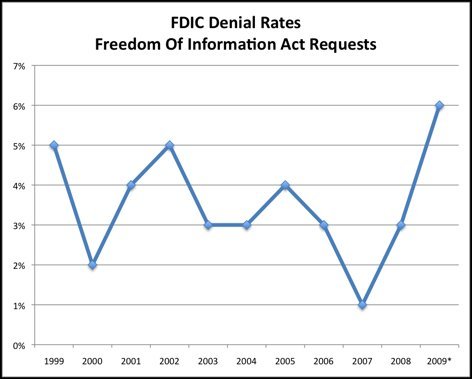
[HT: DB]
Tuesday, September 01, 2009
The Good Ship U.S.S. Bank Failure Keeps A Chipper Pace
With three more failures this week, each of which was a good sized bank ($400 million to $1 billion in assets), the FDIC further dug its hole. While The Sheila Bear may not cop to being broke for a while yet as she authorizes the FDIC to keep playing games like underestimating losses on failures by entering long-tail loss-sharing agreements and levying special assessments on its constituents, I cannot imagine there is a thinking person in the U.S. that has looked at the FDIC's own statistics and thought there is a chance in hell they do not tap the U.S. Treasury for emergency funding (is pre-authorized "emergency" funding really an emergency, or just an eventuality?).
Our bank death scoreboard for the July 1st, 2009 through September 30, 2010 period stands at:
39 down: 211 (minimum) to go
Everyone and their mother refers to the FDIC's published data on the size of its Deposit Insurance Fund (DIF) when discussing its size. For instance, in this paragraph from the 8/31/09 WSJ, we can see the DIF is $10.4 billion:
THE FDIC IS BROKE. As we noted last week:
Happy days!
Luckily, our government shits out $50 billion like it ain't no thing these days. The Fed will continue its backdoor monetization as it attempts to inflate away our debt problem without anyone noticing via a variety of lightly masked helicopter drops (we'll address this another day as we can only put so much angst into one post). We're sure nobody will so much as blink an eye at this.
Nor will anyone talk about the fact that the FDIC continues to steal from the poor and give to the rich in absolute violation of its mandate with nearly each and every bank failure. This was yet another week in which every depositor, whether or not they had deposits in excess of $250,000, was fully preserved. THIS IS JUST AN ABSOLUTE ABDICATION OF RESPONSIBILITY AND FIDUCIARY DUTY! Tell me one other insurance company that volunfuckingtarily provides insurance to its customers for events that both parties agree were not actually covered by the policy.
Tell me one.
Half the time you cannot get a private insurer to pay for things that you thought were insured!
F!!!
F!!!
TILB hereby challenges anyone from the FDIC to justify why on fucking Earth they provide insurance to depositors that are over the $250,000 limit. LaJuan Williams-Dickerson, are you listening? And Lajuan Williams-Dickerson, don't you dare tell me that this is needed to keep the public calm; if that is the case and everyone agrees it is necessary (we do not agree, but assume everyone excluding us for the time being), then at least charge for the service provided (gasp!). This is not rocket science.
Lord willing we will see a series of congressional hearings that end this theft going forward.
In any case, on to this week's stats:
Red Jersey of Shame Leaderboard - California picks up one point:
Georgia 18, Illinois 13, California 9, Florida 6.
Weekly Failure Summary:
Our bank death scoreboard for the July 1st, 2009 through September 30, 2010 period stands at:
39 down: 211 (minimum) to go
Everyone and their mother refers to the FDIC's published data on the size of its Deposit Insurance Fund (DIF) when discussing its size. For instance, in this paragraph from the 8/31/09 WSJ, we can see the DIF is $10.4 billion:
We're referring to the federal deposit insurance fund, which has been shrinking faster than reservoirs in the California drought. The Federal Deposit Insurance Corp. reported late last week that the fund that insures some $4.5 trillion in U.S. bank deposits fell to $10.4 billion at the end of June, as the list of failing banks continues to grow. The fund was $45.2 billion a year ago, when regulators told us all was well and there was no need to take precautions to shore up the fund.What they fail to mention is that by the FDIC's on estimates, in the bank failures that happened in July and August alone, the FDIC self-reports that it lost $10.7 billion!!! Now, obviously it has continued to receive guarantee fees for its monoline-esque business and it continues to bring in premium. Those probably total $3 billion in the past two months. That means that the DIF has less than $3 billion remaining.
THE FDIC IS BROKE. As we noted last week:
Now, now, we know the US Treasury guarantees the DIF, so depositors need not fear, but hopefully this recognition of functional insolvency allows us to get past the ruse that the FDIC has fulfilled its duty of charging appropriate insurance premiums and providing capable regulatory oversight. In fact, the FDIC's has been an abject failure at these core functions. If the FDIC DIF were were an actual insurer, the FDIC Deposit Insurance Fund itself would have been taken over and killed by the government.This is all happening in front of our very eyes and with another 300+ banks tee'd up to fail, if we assume the average failure costs $200 million (vs $274 million per failure since 6/30/09), the FDIC will burn through another $60 billion of capital between now and the end of 2010.
Keep that track record in mind when the FDIC "experts" espouse their opinions on the "solutions" to our current ills.
Happy days!
Luckily, our government shits out $50 billion like it ain't no thing these days. The Fed will continue its backdoor monetization as it attempts to inflate away our debt problem without anyone noticing via a variety of lightly masked helicopter drops (we'll address this another day as we can only put so much angst into one post). We're sure nobody will so much as blink an eye at this.
Nor will anyone talk about the fact that the FDIC continues to steal from the poor and give to the rich in absolute violation of its mandate with nearly each and every bank failure. This was yet another week in which every depositor, whether or not they had deposits in excess of $250,000, was fully preserved. THIS IS JUST AN ABSOLUTE ABDICATION OF RESPONSIBILITY AND FIDUCIARY DUTY! Tell me one other insurance company that volunfuckingtarily provides insurance to its customers for events that both parties agree were not actually covered by the policy.
Tell me one.
Half the time you cannot get a private insurer to pay for things that you thought were insured!
F!!!
F!!!
TILB hereby challenges anyone from the FDIC to justify why on fucking Earth they provide insurance to depositors that are over the $250,000 limit. LaJuan Williams-Dickerson, are you listening? And Lajuan Williams-Dickerson, don't you dare tell me that this is needed to keep the public calm; if that is the case and everyone agrees it is necessary (we do not agree, but assume everyone excluding us for the time being), then at least charge for the service provided (gasp!). This is not rocket science.
Lord willing we will see a series of congressional hearings that end this theft going forward.
In any case, on to this week's stats:
Red Jersey of Shame Leaderboard - California picks up one point:
Georgia 18, Illinois 13, California 9, Florida 6.
Weekly Failure Summary:
Bradford Bank, Baltimore, MDHappy Happy, Joy Joy.
Assets: $452mm, FDIC Losses: $97mm, Losses as a Percentage of Assets: 21.5%
Mainstreet Bank, Forest Lake, MN
Assets: $459mm, FDIC Losses: $95mm, Losses as a Percentage of Assets: 20.7%
Affinity Bank, Ventura, CA
Assets: $1000mm, FDIC Losses: $254mm, Losses as a Percentage of Assets: 25.4%
Straight Average Losses as a Percentage of Assets: 22.5%
Weighted Average Losses as a Percentage of Assets: 23.3%
Sunday, August 23, 2009
The FDIC Goes Broke; Guaranty Bank Find Its Way To The Dustbin Of History (And Three Other Banks Fail)
The FDIC is trickling bank deaths at its New Normal steady state of four or five per week. As we predicted a ways back, at least 250 banks would die before the end of September 2010.
Our bank death scoreboard on the July 1st, 2009 through September 30, 2010 period stands at:
36 down: 214 (minimum) to go
Should be fun.
We also had our second $10+ billion asset bank fail in as many weeks.
This week, Guaranty Bank of Austin Texas took a Glock single shot to the dome...and the FDIC dragged its feet long enough on reforming its rules that govern private equity ownership of banks that We The People ended up placing Guaranty in the hands of Spain's second largest (and probably best run) bank, Banco Bilbao Vizcaya Argentaria (BBVA). Technically BBVA's Birmingham, Alabama based subsidiary BBVA Compass is the acquiror (the South(ern banking capital of Birmingham) will rise again!).
This transaction cost the FDIC Deposit Insurance Fund (DIF) a cool $3 billion on Guaranty's $13 billion asset base (23%). As a citizen guarantor of the DIF, aren't you comforted by the FDIC's desire to keep private capital bidders out of these auctions? Nothing like suppressing capital to get a full and fair price on our behalf!
Jackasses...
Of the other three banks that failed, two were in Georgia (numbers 17 and 18 for the year) and one was in Alabama (its second in two weeks). And for the fourth time in less than three months, Stearns Bank of Minnesota acquired a failed bank (this time an internet bank ostensibly located in Atlanta, Georgia called eBank). This puts the Red Jersey of Shame leaderboard at: Georgia 18, Illinois 13, California 8, Florida 6.
Weekly Failure Summary:
Per the FDIC's own estimates, since July 1st alone the DIF has lost $10.5 billion! Mind you, at March 31st the DIF stood at $13 billion and while the FDIC has taken in rich TLGP guarantee fees during that period, when the 4/1/09 - 6/30/09 losses (which we don't have at our fingertips but are substantial) are taken into account we can safely state that the DIF is, for all intents and purposes, broke.
Now, now, we know the US Treasury guarantees the DIF, so depositors need not fear, but hopefully this recognition of functional insolvency allows us to get past the ruse that the FDIC has fulfilled its duty of charging appropriate insurance premiums and providing capable regulatory oversight. In fact, the FDIC's has been an abject failure at these core functions. If the FDIC DIF were were an actual insurer, the FDIC Deposit Insurance Fund itself would have been taken over and killed by the government.
Keep that track record in mind when the FDIC "experts" espouse their opinions on the "solutions" to our current ills.
As an aside, the FDIC continues its rampant and unrighteous theft from its US citizen guarantors by providing deposit insurance to accounts over $250,000!
Memo To Sheila:
As if your horribly managed insurance "business" was not screwing us all enough, you have decided to insure depositors that - in essence - have not paid for insurance! What the deuce?! For the love of all that is holy, this gift to certain rich depositors is a regressive tax to end all regressive taxes. You are providing free deposit insurance to rich people paid for by the deposits of the portion of the population that does not happen to have two hundred fifty thousand dollars cash on hand. Are you kidding me? At least stop pretending like you don't insure these deposits and charge banks for this insurance. Otherwise, stop violating your mandate and stealing from U.S. citizens out of some sense of unfounded paranoia.
-TILB
The below video is intended to deliver TILB's message to the FDIC. Anytime it refers to Arthur, his cohort, or the English just substitute The Sheila Bear, her cohort, or the FDIC. Yes, we accept the roles as the French guys. It can be summarize as, "I fart in your general direction, your mother was a hamster and you father smelled of elderberries...you fuckers."
Our bank death scoreboard on the July 1st, 2009 through September 30, 2010 period stands at:
36 down: 214 (minimum) to go
Should be fun.
We also had our second $10+ billion asset bank fail in as many weeks.
This week, Guaranty Bank of Austin Texas took a Glock single shot to the dome...and the FDIC dragged its feet long enough on reforming its rules that govern private equity ownership of banks that We The People ended up placing Guaranty in the hands of Spain's second largest (and probably best run) bank, Banco Bilbao Vizcaya Argentaria (BBVA). Technically BBVA's Birmingham, Alabama based subsidiary BBVA Compass is the acquiror (the South(ern banking capital of Birmingham) will rise again!).
This transaction cost the FDIC Deposit Insurance Fund (DIF) a cool $3 billion on Guaranty's $13 billion asset base (23%). As a citizen guarantor of the DIF, aren't you comforted by the FDIC's desire to keep private capital bidders out of these auctions? Nothing like suppressing capital to get a full and fair price on our behalf!
Jackasses...
Of the other three banks that failed, two were in Georgia (numbers 17 and 18 for the year) and one was in Alabama (its second in two weeks). And for the fourth time in less than three months, Stearns Bank of Minnesota acquired a failed bank (this time an internet bank ostensibly located in Atlanta, Georgia called eBank). This puts the Red Jersey of Shame leaderboard at: Georgia 18, Illinois 13, California 8, Florida 6.
Weekly Failure Summary:
eBank, Atlanta, GA...another brutal week.
Assets: $143mm, FDIC Losses: $63mm, Losses as a Percentage of Assets: 44.1%
First Coweta, Newnan, GA
Assets: $167mm, FDIC Losses: $48mm, Losses as a Percentage of Assets: 28.7%
CapitalSouth Bank, Birmingham, AL
Assets: $6170mm, FDIC Losses: $151mm, Losses as a Percentage of Assets: 24.7%
Guaranty Bank, Austin, TX
Assets: $13,000mm, FDIC Losses: $3,000mm, Losses as a Percentage of Assets: 23.1%
Straight Average Losses as a Percentage of Assets: 30.1%
Weighted Average Losses as a Percentage of Assets: 23.4%
Per the FDIC's own estimates, since July 1st alone the DIF has lost $10.5 billion! Mind you, at March 31st the DIF stood at $13 billion and while the FDIC has taken in rich TLGP guarantee fees during that period, when the 4/1/09 - 6/30/09 losses (which we don't have at our fingertips but are substantial) are taken into account we can safely state that the DIF is, for all intents and purposes, broke.
Now, now, we know the US Treasury guarantees the DIF, so depositors need not fear, but hopefully this recognition of functional insolvency allows us to get past the ruse that the FDIC has fulfilled its duty of charging appropriate insurance premiums and providing capable regulatory oversight. In fact, the FDIC's has been an abject failure at these core functions. If the FDIC DIF were were an actual insurer, the FDIC Deposit Insurance Fund itself would have been taken over and killed by the government.
Keep that track record in mind when the FDIC "experts" espouse their opinions on the "solutions" to our current ills.
As an aside, the FDIC continues its rampant and unrighteous theft from its US citizen guarantors by providing deposit insurance to accounts over $250,000!
Memo To Sheila:
As if your horribly managed insurance "business" was not screwing us all enough, you have decided to insure depositors that - in essence - have not paid for insurance! What the deuce?! For the love of all that is holy, this gift to certain rich depositors is a regressive tax to end all regressive taxes. You are providing free deposit insurance to rich people paid for by the deposits of the portion of the population that does not happen to have two hundred fifty thousand dollars cash on hand. Are you kidding me? At least stop pretending like you don't insure these deposits and charge banks for this insurance. Otherwise, stop violating your mandate and stealing from U.S. citizens out of some sense of unfounded paranoia.
-TILB
The below video is intended to deliver TILB's message to the FDIC. Anytime it refers to Arthur, his cohort, or the English just substitute The Sheila Bear, her cohort, or the FDIC. Yes, we accept the roles as the French guys. It can be summarize as, "I fart in your general direction, your mother was a hamster and you father smelled of elderberries...you fuckers."
Sunday, August 16, 2009
Five More Bank Failures, Including The Colonial Bank Doozy; WSJ Reports On FDIC Struggles

Another Friday, another five bank homicides.
The FDIC closed five more banks this past weekend, including the sixth largest failure in the FDIC's history: Colonial Bank at $25 billion asset base.
BB&T stepped up to the plate to takeover Colonial in what looks like a win for the FDIC. The Sheila Bear even went on record as stating, "losses from [Friday's] failures are lower than had been projected." Perhaps not surprisingly, TILB has a alightly different take on the matter.
We have been stating for some time, losses are actually higher than they should be under the FDIC's legal mandate, as the FDIC continues to provide insurance on deposits that are, in fact, not insured. This theft from the FDIC's U.S. citizen owners seems completely ignored by the fourth estate and, frankly, everyone else in the world.
On Friday, all deposits were again protected except potentially $4.2 million from the Community Bank of Nevada. That bank was apparently so toxic that there was no willing buyer at a price the FDIC found acceptable. As such, the FDIC set up a government managed run-off bank and will likely leave those $4 million of depositors out in the cold. As George Orwell warned us so long ago, "All animals are equal but some animals are more equal than others."
Apparently.
While The Sheila Bear may be pounding the table that losses are lower than "projected," TILB will note that a) these losses are still estimates, we'll see how final losses come out; b) it's obviously (and appropriately) weighted largely by Colonial's failure given its size; and c) three of the other four banks that failed had losses that were 50% of assets. Holy shit.
Losses have trended so poorly that even the media is starting to catch on. In tomorrow's WSJ, this article by Joe Bel Bruno will begin highlighting to the masses what TILB has been saying for over a year: losses as a percent of bank assets are trending at a staggeringly high rate.
Banks in the U.S. that failed in the past two years were in far worse shape than those that collapsed during the industry's last crisis, a looming problem for the government agency charged with insuring deposits.Down to the nitty gritty, as the WSJ's nifty chart shown at the top of the post indicates, this was a binary week. Two banks trended better than average (including Colonial) and three were epically horrible:
At three of the five banks that failed Friday, increasing the total to 77 so far this year, the financial hit to the agency's deposit-insurance fund is expected by the Federal Deposit Insurance Corp. to be about 50% of their assets.
The biggest hit on a percentage basis is coming from Community Bank of Nevada, a Las Vegas bank with $1.52 billion in assets and an estimated cost of $781.5 million. The failure of Colonial Bank, a unit of Colonial BancGroup Inc. that was sold to BB&T Corp., will cost $2.8 billion, or 11% of the Montgomery, Ala., bank's assets.
For the 102 banks that have collapsed in the past two years, the FDIC's estimated cost averaged 25% of assets. That is up from the 19% rate between 1989 and 1995, when 747 financial institutions were closed by regulators, according to the FDIC.
...
As the number of bank failures escalates, FDIC officials have been trying to find investors and buyers for terminally ill financial institutions, increasingly by agreeing to shield acquirers from certain losses on assets of the failed bank.
Weekly Failure Summary:
Dwelling House Savings and Loan Association, Pittsburgh, PAAs The Sheila Bear noted, the weighted average outcome is a substantial improvement. However, the simple average outcome was by far the worst we've seen. This was driven by the fact that any of the three truly toxic takeovers would have represented the single worst percentage of assets performer in our dataset by a wide margin (our dataset is incomplete and has not yet been backfilled but covers approximately the last 40 failures).
Assets: $13.4mm, FDIC Losses: $6.8mm, Losses as a Percentage of Assets: 50.7%
Colonial Bank, Montgomery, AL
Assets: $25,000mm, FDIC Losses: $2,800mm, Losses as a Percentage of Assets: 11.2%
Community Bank of Nevada, Las Vegas, NV
Assets: $1,520mm, FDIC Losses: $781.5mm, Losses as a Percentage of Assets: 51.4%
Community Bank of Arizona, Phoenix, AZ
Assets: $158.5mm, FDIC Losses: $25.5mm, Losses as a Percentage of Assets: 16.1%
Union Bank, NA, Gilbert, AZ
Assets: $124mm, FDIC Losses: $61mm, Losses as a Percentage of Assets: 49.2%
Straight Average Losses as a Percentage of Assets: 35.7%
Weighted Average Losses as a Percentage of Assets: 13.7%
While we have not yet seen it reported, we strongly suspect that the Community Bank of Arizona and Community Bank of Nevada are controlled by the same folks. The Arizona failure probably had to be done at the same time as the Nevada failure to avoid creating a taint from one to the other. Additionally, the FDIC sold both Arizona failures to MidFirst Bank (based in Oklahoma City). Its Arizona presence just jumped a notch...
Tracking the race for the Red Jersey of Shame, it's good to see Nevada (now three) and Arizona (now two) put some points on the board. We highlighted a few weeks ago that we suspected they had some good, toxic bank failure runway in front of them. The leaderboard now stands at:
Georgia with 16, Illinois 13, California 8, Florida 6.
Saturday, August 08, 2009
Failure Friday; Three More Put Out Of Their Misery
Almost a boring week; only three bank failures.
As with virtually every other failure during this run, the FDIC insured all deposits, not just those within the $250,000 limit, effectively stealing from its citizens to give money away in violation of its mandate (as we discussed last week).
In that same post last week, we also noted that Florida was a dark horse contender to make a run at the Red Jersey of Shame, which will be granted by TILB the state that leads the nation in bank failures. Going into this week, Florida had a paltry four failures trailing: Georgia with 16, Illinois 13, California 8. Last week we said,
Here's this week's summary of losses. A slight improvement from last week, though still generally in the ballpark:
Go home and get your boots, the party is just getting started.
As with virtually every other failure during this run, the FDIC insured all deposits, not just those within the $250,000 limit, effectively stealing from its citizens to give money away in violation of its mandate (as we discussed last week).
In that same post last week, we also noted that Florida was a dark horse contender to make a run at the Red Jersey of Shame, which will be granted by TILB the state that leads the nation in bank failures. Going into this week, Florida had a paltry four failures trailing: Georgia with 16, Illinois 13, California 8. Last week we said,
In our opinion, Florida with four seems woefully underrepresented. We suspect their most shameful days are ahead of them.Florida responded quite helpfully with two this week and Oregon tacked on its third of the year. Both Florida banks were in the Sarasota area and were acquired by Stearns Bank in Minnesota. These are the second and third banks Stearns acquired this year (the last being the June 26th failure of Horizon Bank in Minnesota).
Here's this week's summary of losses. A slight improvement from last week, though still generally in the ballpark:
First State Bank, Sarasota, FLImportantly, the pace of failure has stayed brisk. As we predicted, banks are going to begin failing at such a rapid clip that people will almost become numb to the problem. In mid-July, we wrote that we expect at least 250 failures in the next 15 months, equating to 3-4 failures per week. Since then we have averaged five a week.
Assets: $463mm, FDIC Losses: $116mm, Losses as a Percentage of Assets: 25.1%
Community National Bank of Sarasota County, FL
Assets: $97mm, FDIC Losses: $24mm, Losses as a Percentage of Assets: 24.7%
Community First Bank, Prineville, OR
Assets: $209mm, FDIC Losses: $45mm, Losses as a Percentage of Assets: 21.5%
Straight Average Losses as a Percentage of Assets: 23.8%
Weighted Average Losses as a Percentage of Assets: 24.1%
Go home and get your boots, the party is just getting started.
Saturday, August 01, 2009
Sun Rises In East; Five More Bank Failures
As TILB predicted several weeks ago, we believe four or five banks will fail on average, per week, for at least the next fifteen months.
A few weeks into this and we look smart.
After seven failures last week, the FDIC cashed five more banks this week. LB's line for weekly bank failure over/under has ceased to be a question of whether or not the overs will take it and instead has become a question of "by how much?"
Weekly Failure Summary:
Two other points worth noting.
First, Illinois sank another basket, tightening the Red Jersey of Shame tally: Georgia - 16, Illinois 13, California 8. In our opinion, Florida with four seems woefully underrepresented. We suspect their most shameful days are ahead of them
Secondly, the FDIC again this week made sure that all deposits were absorbed by an acquiring bank.
Our opinion is this is illegal.
The FDIC is taking losses (that means TILB and our dear readers, as citizen guarantors of the FDIC, are taking losses) rather than depositors that clearly do not qualify for insurance.
The FDIC waterfall should look like this:
1) FDIC takes over failing institution;
2) Cash out from FDIC Deposit Insurance Fund (DIF) to insured depositors;
3) Cash into DIF for sale of insured deposits;
4) Cash into DIF for sale of assets;
5) Cash to uninsured depositors if #3 and #4 exceed #2;
6) Any final excess cash falls through the capital structure as expected: unsecured creditors, subordinated debt, preferreds, equity.
For reasons that we can guess at but that have not been adequately addressed, #5 has generally been moved ahead of repaying the DIF. Basically, the FDIC is insuring depositors that have not "paid" an insurance premium and thusly should not receive insurance proceeds. The FDIC is doing this with our money and we feel it is akin to theft.
TILB is getting angry...
A few weeks into this and we look smart.
After seven failures last week, the FDIC cashed five more banks this week. LB's line for weekly bank failure over/under has ceased to be a question of whether or not the overs will take it and instead has become a question of "by how much?"
Weekly Failure Summary:
First State Bank of Altus, OKThis is on par with the worst set of averages over the past month and a half since the pace of collapse has accelerated.
Assets: $103.4mm, FDIC Losses: $25.2mm, Losses as a Percentage of Assets: 24.4%
Integrity Bank, Jupiter, FL
Assets: $119mm, FDIC Losses: $46mm, Losses as a Percentage of Assets: 38.7%
People's Community Bank, West Chester, OH
Assets: $705.8mm, FDIC Losses: $129.5mm, Losses as a Percentage of Assets: 18.3%
First BankAmericano, Elizabeth, NJ
Assets: $166mm, FDIC Losses: $15mm, Losses as a Percentage of Assets: 9.0%
Mutual Bank, Harvey, IL
Assets: $1,600mm, FDIC Losses: $696mm, Losses as a Percentage of Assets: 43.5%
Straight Average Losses as a Percentage of Assets: 26.8%
Weighted Average Losses as a Percentage of Assets: 33.8%
Two other points worth noting.
First, Illinois sank another basket, tightening the Red Jersey of Shame tally: Georgia - 16, Illinois 13, California 8. In our opinion, Florida with four seems woefully underrepresented. We suspect their most shameful days are ahead of them
Secondly, the FDIC again this week made sure that all deposits were absorbed by an acquiring bank.
Our opinion is this is illegal.
The FDIC is taking losses (that means TILB and our dear readers, as citizen guarantors of the FDIC, are taking losses) rather than depositors that clearly do not qualify for insurance.
The FDIC waterfall should look like this:
1) FDIC takes over failing institution;
2) Cash out from FDIC Deposit Insurance Fund (DIF) to insured depositors;
3) Cash into DIF for sale of insured deposits;
4) Cash into DIF for sale of assets;
5) Cash to uninsured depositors if #3 and #4 exceed #2;
6) Any final excess cash falls through the capital structure as expected: unsecured creditors, subordinated debt, preferreds, equity.
For reasons that we can guess at but that have not been adequately addressed, #5 has generally been moved ahead of repaying the DIF. Basically, the FDIC is insuring depositors that have not "paid" an insurance premium and thusly should not receive insurance proceeds. The FDIC is doing this with our money and we feel it is akin to theft.
TILB is getting angry...
Friday, July 24, 2009
Seven More Failures; FDIC On A Bank Failure Treadmill
Seven banks were closed today.
The FDIC almost cannot shut banks down fast enough these days.
Earlier this week, TILB predicted that the FDIC would shutdown 250 or more banks over the next 15 months (equating to 4-5 failures per week). One week into our prediction, the FDIC has not let us down.
That said, as with the last time we had seven failures, this week comes with a big caveat: six of the failures were sister banks in Georgia: Security Bank of Gwinnett County, Security Bank of Bibb County, Security Bank of Houston County, Security Bank of Jones County, Security Bank of North Metro, and Security Bank of North Fulton. Collectively these six banks had a pretty good sized asset base at $2.8 billion.
The seventh bank was the tiny Waterford Village Bank in Williamsville, NY with $61.4 million of assets.
As has been true in the majority of cases, no depositors took losses as all deposits were absorbed by acquiring banks (including deposits over the FDIC minimum). Someday in the future, we will talk about how the FDIC is basically subsidizing non-insured depositors despite this clearly being outside their legal mandate. In our opinion, the FDIC's action on this front is dishonest, illegal and immoral. This undeserved gift to uninsured depositors, of course, comes at the expense of the tax payer and the dollar-based saver (the latter resulting from our suspicion that printing money is the Occam's Razor answer that will be pursued to handle the enormous debts our government is issuing, including the debt it will take on in order to replenish the FDIC deposit insurance fund, which is virtually empty).
Unlike most weeks, the FDIC did not break out its estimate of losses for each of the different bank failures. Instead, the Security Bank failures were aggregated together. As such, we've assumed that each bank is allocated a pro-rata share of losses based on its asset base (collectively, the Security Banks are estimated to cost the FDIC insurance fund 28.8% of their assets). Here's this week's analysis (spoiler alert: things still suck for the FDIC):
Waterford Village Bank, NY
Assets: $61.4mm, FDIC Losses: $5.6mm, Losses as a Percentage of Assets: 9.1%
Security Bank of Gwinnett County, GA
Assets: $322mm, FDIC Losses: $92.8mm, Losses as a Percentage of Assets: 28.8%
Security Bank of Bibb County, GA
Assets: $1,200mm, FDIC Losses: $346mm, Losses as a Percentage of Assets: 28.8%
Security Bank of Houston County, GA
Assets: $383mm, FDIC Losses: $110mm, Losses as a Percentage of Assets: 28.8%
Security Bank of Jones County, GA
Assets: $453mm, FDIC Losses: $131mm, Losses as a Percentage of Assets: 28.8%
Security Bank of North Metro, GA
Assets: $242mm, FDIC Losses: $64.6mm, Losses as a Percentage of Assets: 28.8%
Security Bank of North Fulton, GA
Assets: $209mm, FDIC Losses: $60mm, Losses as a Percentage of Assets: 28.8%
Straight Average Losses as a Percentage of Assets: 26.0%
Weighted Average Losses as a Percentage of Assets: 28.4%
For those keeping score at home, you may recall that last week we applauded California and Georgia for making a contest of the failure championship. Illinois, on the backs of the Campbell family, seemed to be running away with the 2009 Red Jersey of Shame (mistakenly referred to as black last week).
What a difference a week makes! Georgia now leads the competition and has posted sixteen bank failures in 2009. Third place California has eight bank failures and current runner-up Illinois has twelve. Those three states represent 36 of the 64 failures this year.
Noticeably absent from the list is meaningful failure volume from Nevada, Florida or Arizona based banks. We suspect California banks have a good chunk of Nevada and Arizona risk, but there is no way local banks in those states are not getting obliterated. As an email from a friend of TILB at BTIG said today:
The FDIC almost cannot shut banks down fast enough these days.
Earlier this week, TILB predicted that the FDIC would shutdown 250 or more banks over the next 15 months (equating to 4-5 failures per week). One week into our prediction, the FDIC has not let us down.
That said, as with the last time we had seven failures, this week comes with a big caveat: six of the failures were sister banks in Georgia: Security Bank of Gwinnett County, Security Bank of Bibb County, Security Bank of Houston County, Security Bank of Jones County, Security Bank of North Metro, and Security Bank of North Fulton. Collectively these six banks had a pretty good sized asset base at $2.8 billion.
The seventh bank was the tiny Waterford Village Bank in Williamsville, NY with $61.4 million of assets.
As has been true in the majority of cases, no depositors took losses as all deposits were absorbed by acquiring banks (including deposits over the FDIC minimum). Someday in the future, we will talk about how the FDIC is basically subsidizing non-insured depositors despite this clearly being outside their legal mandate. In our opinion, the FDIC's action on this front is dishonest, illegal and immoral. This undeserved gift to uninsured depositors, of course, comes at the expense of the tax payer and the dollar-based saver (the latter resulting from our suspicion that printing money is the Occam's Razor answer that will be pursued to handle the enormous debts our government is issuing, including the debt it will take on in order to replenish the FDIC deposit insurance fund, which is virtually empty).
Unlike most weeks, the FDIC did not break out its estimate of losses for each of the different bank failures. Instead, the Security Bank failures were aggregated together. As such, we've assumed that each bank is allocated a pro-rata share of losses based on its asset base (collectively, the Security Banks are estimated to cost the FDIC insurance fund 28.8% of their assets). Here's this week's analysis (spoiler alert: things still suck for the FDIC):
Waterford Village Bank, NY
Assets: $61.4mm, FDIC Losses: $5.6mm, Losses as a Percentage of Assets: 9.1%
Security Bank of Gwinnett County, GA
Assets: $322mm, FDIC Losses: $92.8mm, Losses as a Percentage of Assets: 28.8%
Security Bank of Bibb County, GA
Assets: $1,200mm, FDIC Losses: $346mm, Losses as a Percentage of Assets: 28.8%
Security Bank of Houston County, GA
Assets: $383mm, FDIC Losses: $110mm, Losses as a Percentage of Assets: 28.8%
Security Bank of Jones County, GA
Assets: $453mm, FDIC Losses: $131mm, Losses as a Percentage of Assets: 28.8%
Security Bank of North Metro, GA
Assets: $242mm, FDIC Losses: $64.6mm, Losses as a Percentage of Assets: 28.8%
Security Bank of North Fulton, GA
Assets: $209mm, FDIC Losses: $60mm, Losses as a Percentage of Assets: 28.8%
Straight Average Losses as a Percentage of Assets: 26.0%
Weighted Average Losses as a Percentage of Assets: 28.4%
For those keeping score at home, you may recall that last week we applauded California and Georgia for making a contest of the failure championship. Illinois, on the backs of the Campbell family, seemed to be running away with the 2009 Red Jersey of Shame (mistakenly referred to as black last week).
What a difference a week makes! Georgia now leads the competition and has posted sixteen bank failures in 2009. Third place California has eight bank failures and current runner-up Illinois has twelve. Those three states represent 36 of the 64 failures this year.
Noticeably absent from the list is meaningful failure volume from Nevada, Florida or Arizona based banks. We suspect California banks have a good chunk of Nevada and Arizona risk, but there is no way local banks in those states are not getting obliterated. As an email from a friend of TILB at BTIG said today:
*LAS VEGAS AREA HOME PRICES FELL 41.3% IN JUNE FROM YR EARLIERThis does not auger well for the FDIC's bank failure pipeline. When you're levered 12:1 or 15:1, collateral value declines of 50% (peak to today) have a particularly upsetting impact.
*LAS VEGAS HOME SALES INCREASE 44%, MDA DATAQUICK SAYS
--- so homes are starting to clear = good, but the clearing prices are still 45% lower than they are now = bad ....... i wonder if they have a break down of speculators vs real family buyers
Tuesday, July 21, 2009
Failure Friday Killed Four More Banks, A Visit From Our Friend Vineyard Bank, And A Prediction As To How Many Banks Will Fail In The Next 15 Months
Friday July 17th, 2009 was a special day for TILB.
As we referenced in our post this past weekend on bank failures, two of this past weekend's four failures communicate a particularly fascinating message. Today we will address one of those messages.
Not only did four banks fail, one of them was Vineyard Bank. TILB first wrote about Vineyard Bank's walking dead status a year ago. In that blog posting, we walked through its deleterious state noting that it was virtually certain to fail.
Vineyard's collapse gives us a specific, useful metric: for all intents and purposes, this bank failed over a year ago in May 2008 when its regulators began sending angry and restricting letters. The FDIC finally admitted as much and took it over this past weekend. As such, that 14.5 month span provides a handy measuring stick for determining how far behind the curve the FDIC is. As of now, it appears the pipeline is 14-15 months deep.
Since May 5th, 2008, we have had 81 banks fail. Of course, the past year has seen much worse credit performance than the year prior. The pace of bank failures has been 4x in 2009 what it was in 2008 (and actually many times greater yet if you just compare 1H08 to 1H09).
Given that asset performance continues to worsen for most banks and we can easily define how far behind the curve the FDIC is by using the Vineyard measuring stick, TILB believes it is fair to extrapolate that the pipeline for failures in the next 15 months is approximately 3x-4x the past 15 months or 243-324 banks. That comes out to somewhere between 3.7 - 5.0 failures per week for that entire 15 month period.
We will state it again: TILB is forecasting over 250 failures in the next 15 months. If borrower performance deteriorates further (which it will), we believe the number could be much greater than 250.
Ignore our warning at your own risk.
Green shoots?
Nay. Brown vines.
As we referenced in our post this past weekend on bank failures, two of this past weekend's four failures communicate a particularly fascinating message. Today we will address one of those messages.
Not only did four banks fail, one of them was Vineyard Bank. TILB first wrote about Vineyard Bank's walking dead status a year ago. In that blog posting, we walked through its deleterious state noting that it was virtually certain to fail.
Vineyard's collapse gives us a specific, useful metric: for all intents and purposes, this bank failed over a year ago in May 2008 when its regulators began sending angry and restricting letters. The FDIC finally admitted as much and took it over this past weekend. As such, that 14.5 month span provides a handy measuring stick for determining how far behind the curve the FDIC is. As of now, it appears the pipeline is 14-15 months deep.
Since May 5th, 2008, we have had 81 banks fail. Of course, the past year has seen much worse credit performance than the year prior. The pace of bank failures has been 4x in 2009 what it was in 2008 (and actually many times greater yet if you just compare 1H08 to 1H09).
Given that asset performance continues to worsen for most banks and we can easily define how far behind the curve the FDIC is by using the Vineyard measuring stick, TILB believes it is fair to extrapolate that the pipeline for failures in the next 15 months is approximately 3x-4x the past 15 months or 243-324 banks. That comes out to somewhere between 3.7 - 5.0 failures per week for that entire 15 month period.
We will state it again: TILB is forecasting over 250 failures in the next 15 months. If borrower performance deteriorates further (which it will), we believe the number could be much greater than 250.
Ignore our warning at your own risk.
Green shoots?
Nay. Brown vines.
Sunday, July 19, 2009
CIT Bondholders Leading Last Minute "Rescue"; Would Buy Breathing Room
This basically looks like CIT bondholders (led by PIMCO) are willing to gamble that this "injection" will make CIT more regulator friendly and perhaps get them better options from the FDIC. Structured as a high interest rate bridge that buys CIT some time to undertake a series of exchange offers. This alone wouldn't fix their liquidity problem, but would give them breathing room. If this deal were to happen, our view is that at best it most likely postpones the inevitable. In any case, CIT has no balance sheet flexibility to make new loans right now as all new capital is desperately needed to pay off existing creditors. In fact, it has every incentive to be incredibly aggessive with existing borrowers in order to recover as much cash now as possible. As such, from a systemic standpoint, CIT is as good as dead already...
Highlights from the WSJ follow:
Highlights from the WSJ follow:
CIT Group Inc. was close to securing $3 billion in last-minute rescue financing from its bondholders Sunday in a deal that should keep the struggling firm -- once the largest issuer of small-business loans in the U.S. -- out of bankruptcy court, people familiar with the matter say.
The deal, which was being considered by CIT's board Sunday night, charges CIT very high interest rates, and it doesn't permanently fix the company's long-term financing needs, say people involved in the transaction. But it buys time for the lender to restructure itself, and minimizes bondholders' losses. Bondholders calculated they would lose more if CIT filed for bankruptcy and sold assets at fire-sale prices than if they offered the rescue.
...
If the deal is completed, it could help reduce CIT's debt load, strengthen its capital position and alleviate pressure on CIT to pay down $1 billion in debt that comes due in August. It may also preserve the U.S. Treasury's $2.33 billion investment made as part of the Troubled Asset Relief Program.
...
Still, CIT and its bondholders hope that their effort to stabilize the company will cause bank regulators to look more favorably on a CIT plan to transfer more of its loans from the holding company to its bank in Utah. CIT has trouble borrowing money, but its bank can finance itself by taking in deposits. To transfer more assets to the bank, however, CIT needs an exemption from the Federal Reserve and a nod from the Federal Deposit Insurance Corp.
...
Under the proposal, CIT would likely pay interest rates 10 percentage points above the London interbank offered rate, said these people. (As of Friday, three-month Libor stood around 0.5%.) CIT has also agreed to pledge some of its highest-quality loans as collateral on the $3 billion package.
The new loan could act like a "bridge" to a series of debt-exchange offers that CIT would launch in order to get bondholders to swap some of their bonds for equity in the company or for new debt that matures later.
...
At least one analyst viewed the deal as a stopgap measure. "Even if they put together a deal today and postpone a bankruptcy filing, CIT may be back in the same place in the not-too-distant future because unemployment rates, business-loan delinquencies and corporate default rates are climbing," said Martin Weiss, president of Weiss Research, an investment consulting firm in Jupiter, Fla. "The outlook for the next six months looks pretty rough for many banks, including CIT," he said.
Late Thursday night, CIT officials believed they had secured a $2 billion rescue-financing plan from J.P. Morgan Chase & Co. But that fell through by Friday morning, said these people.
J.P. Morgan would have considered lending if CIT were first to seek bankruptcy protection, but the bank "couldn't get comfortable with a deal outside (bankruptcy) court," said one person familiar with the matter.
Four Banks Fail; FDIC Euthanization Pace Stays Brisk

The overs take it for the third week out of four...and each of those wins was by a wide margin, perhaps indicating a new stage in our ongoing bank failure cycle.
The real turn began four Fridays ago when we had what seemed like the dawning of a new era as five banks failed. That was trumped a week later by an epic Fourth of July fireworks celebration of seven failed banks. The seven failures were followed by a relative snoozer last week with only one failure. This past Friday was back on track with four failures: Temecula Valley Bank in CA, Vineyard Bank in CA, BankFirst in SD and First Piedmont Bank in GA.
As a personal aside, it's nice to see Cali and Georgia get back in the game. Illinois had broken off from the peloton and it seemed California and Georgia might simply compete for second as they let Chief Illiniwek run away and capture the black jersey of shame. But the chase pack has mobilized! In 2009, Georgia has posted ten bank failures, California eight bank failures, and Illinois leads with twelve. Those three states represent 30 of the 57 failures.
Anyway, back to the story at hand. With 17 failures in the past four weeks, it seems to indicate that the FDIC has finally ramped its staff to begin handling a sustainably higher level of failures. It has long been our suspicion that the FDIC was woefully undermanned for the crisis at hand. More than four failures per week for four weeks has us believing that the staffing issues are much closer to being ironed out.
As long time readers of TILB know, one of the metrics we are fond of tracking is what the FDIC assumes losses will be as a percentage of stated bank assets. In mid-2008, losses were averaging 20-25% of assets. More recently it has been in the 30%+ range, which is an enormous number.
Let's see how this week and last week went:
Bank of Wyoming, WY (last week's single failure)
Assets: $70mm, FDIC Losses: $27mm, Losses as a Percentage of Assets: 38.6%
First Piedmont Bank, GA
Assets: $115mm, FDIC Losses: $29mm, Losses as a Percentage of Assets: 25.2%
BankFirst, SD
Assets: $275mm, FDIC Losses: $91mm, Losses as a Percentage of Assets: 33.1%
Vineyard Bank, CA
Assets: $1900mm, FDIC Losses: $579mm, Losses as a Percentage of Assets: 30.5%
Temecula Valley Bank, CA
Assets: $1500mm, FDIC Losses: $391mm, Losses as a Percentage of Assets: 26.1%
Straight Average Losses as a Percentage of Assets: 30.7%
Weighted Average Losses as a Percentage of Assets: 28.9%
This is in line with the longer-term trend and indicates that the lower loss percentage that accompanied the six Illinois-based banks all controlled by one family (the Campbell's) that failed on July 2nd was the anomaly.
When those six and one other bank failed two weeks ago, the summary stats were as follows:
Straight Average Losses as a Percentage of Assets: 23.0%We strongly suspected that because the banks were controlled by a single family, the FDIC took a few down that - if they'd been truly independent - it may have otherwise kept on life support for more time. In fact, we wrote:
Weighted Average Losses as a Percentage of Assets: 23.5%
We suppose this is "good" news as 23% average losses seems like a bit of an improvement (though still epically horrible). However, this week is a bit of a strange bird given that six of the banks are related to each other and all six were in pretty bad shape even if all six were not in the 30%+ camp. One of the six Illinois cousins was 30%+, one was 20%+, the largest bank was just under 20% and the other three were mid-teens. I suspect the reality is the FDIC knew if it closed one it would have to close all six.We will have more commentary on this week's failures in ensuing posts as two of the failed banks provide particular insight into the state of our current crisis.
...
The Texas bank, on the other hand, is just a total shit show at almost 40% losses to assets.
Stay tuned...
Monday, July 06, 2009
Six illinois Based Banks Were Owned By Campbell Family; Poisoned By TruPS
As TILB predicted four days ago, the WSJ is reporting the collapse of six banks in Illinois last week was precipitated by their reliance on TruPS and CDOs of TruPS. As we said last Thursday night:
The WSJ described the situation with the six failed Illinois banks as follows:
Our suspicion is either CLOs or, more likely CDOs of TruPS, which was a giant ratings agency blessed orgiastic daisy chain of banks funding other banks that were funding other banks compounded by structured finance technology (i.e., leverage). Apparently a few banks caught the hiv and, well, you can imagine how well these have done...As a friend of TILB recently put it after consultation with us:
These CDOs of TruPS are poison to a great number of small and mid-sized banks and they all shared the slow acting lethal koolaid cup a few years ago. Ironically, without checking, I'd bet that each of Campbell's banks is/was itself a big issuer of TruPS, so the collapse of these six banks will weaken the rest of the banking system daisy chain of TruPS and TruPS CDOsNo doubt. Our understanding is that this truly was a daisy chain: virtually all of the banks that are TruPS CDO ABS owners were issuers of TruPS to CDOs playing a ratings/funding arbitrage (or at least a perceived arbitrage!).
The WSJ described the situation with the six failed Illinois banks as follows:
In 2005, the failed banks and two others owned by the Campbell family of Illinois started snapping up trust preferred securities, which are a hybrid between debt and equity, in an attempt to fuel earnings growth [actually, TILB strongly suspects it was CDOs backed by TruPS that the banks actually acquired]. Demand was sluggish for loans in the small Midwestern towns where the family's banks were based."The appetite is not large"? Shocker! You've only managed to drive six banks into the ground, basically drove a seventh into a distressed sale and have two remaining on the brink. I cannot believe capital providers are not just lining up to send you their money. Perhaps you can call up Jeffries and have them pool another CDO to fund your capital needs!
When the credit crisis hit, the values of the securities and pools into which they were packaged [read: "CDOs"] rapidly lost value, partly because some banks stopped paying dividends on the securities. Under accounting rules, the banks were required to write down the securities to market value. That forced the banks to absorb big losses, winnowing their capital cushions.
...
The Campbell family still controls three banks that remain in business. Two are based in Illinois and also have been battered by investments in trust preferred securities. A third bank, in Scottsdale, Ariz., steered clear of the securities because it had plenty of growth opportunities through lending. It is now suffering from a wave of souring loans to finance commercial real-estate projects.
Lyle Campbell, the 73-year-old patriarch of the family's banking business, said in an interview on Monday that he is scrambling to raise as much as $25 million from private investors to bolster capital at his three surviving banks. "The appetite is not large," he said.
Friday, July 03, 2009
Seven Banks Fail Today, Six In Illinois Alone
Fireworks in Illinois tonight and it's not even July 4th.
Today, seven banks were put to sleep by the FDIC including SIX bank failures in Illinois alone (bringing that state's total to 12 in 2009 out of a total of 52 for the nation). This puts last weekend's total of five to shame and sets a 15+ year record for most bank failures in a single day. Interestingly, all six of the Illinois bank failures were controlled by one family, per the FDIC's press release:
According to this Bloomberg article, the six Illinois banks are all affiliated with Peotone Bank & Trust Co. in Illinois. We are not sure where Bloomberg got that information, but if you're a large depositor at Peotone Bank, and this weekend you read the headlines that six of its affiliates were euthanized on Thursday, we have to imagine you get just a wee bit antsy.
As frequent TILB readers know, we are tracking the severity of the crisis by monitoring how much the FDIC expects to lose at failed banks as a percentage of the reported assets. In mid-2008, losses were averaging 20% of assets. More recently its been in the 30%+ range, which is an enormous number.
Let's look at how this week went:
Founders Bank
Assets: $962mm, FDIC Losses: $188.5mm, Losses as a Percentage of Assets: 19.6%
Millennium State Bank of Texas
Assets: $118mm, FDIC Losses: $47mm, Losses as a Percentage of Assets: 39.8%
First National Bank of Danville
Assets: $166mm, FDIC Losses: $24mm, Losses as a Percentage of Assets: 14.5%
Elizabeth State Bank
Assets: $55.5mm, FDIC Losses: $11.2mm, Losses as a Percentage of Assets: 20.2%
Rock River Bank
Assets: $77mm, FDIC Losses: $27.6mm, Losses as a Percentage of Assets: 35.8%
First State Bank of Winchester
Assets: $36mm, FDIC Losses: $6mm, Losses as a Percentage of Assets: 16.7%
John Warner Bank
Assets: $70mm, FDIC Losses: $10mm, Losses as a Percentage of Assets: 14.3%
Straight Average Losses as a Percentage of Assets: 23.0%
Weighted Average Losses as a Percentage of Assets: 23.5%
We suppose this is "good" news as 23% average losses seems like a bit of an improvement (though still epically horrible). However, this week is a bit of a strange bird given that six of the banks are related to each other and all six were in pretty bad shape even if all six were not in the 30%+ camp. One of the six Illinois cousins was 30%+, one was 20%+, the largest bank was just under 20% and the other three were mid-teens. I suspect the reality is the FDIC knew if it closed one it would have to close all six. I am curious as to how Peotone survived and how much better its balance sheet is.
The Texas bank, on the other hand, is just a total shit show at almost 40% losses to assets. It almost seems impossible to lose that much money in banking.
Almost.
Today, seven banks were put to sleep by the FDIC including SIX bank failures in Illinois alone (bringing that state's total to 12 in 2009 out of a total of 52 for the nation). This puts last weekend's total of five to shame and sets a 15+ year record for most bank failures in a single day. Interestingly, all six of the Illinois bank failures were controlled by one family, per the FDIC's press release:
The six failed Illinois banks are all controlled by one family and followed a similar business model that created concentrated exposure in each institution. The failure of these banks resulted primarily from losses related to the banks' investment in collateralized debt obligations and other loan losses.Our suspicion is either CLOs or, more likely CDOs of TruPS, which was a giant ratings agency blessed orgiastic daisy chain of banks funding other banks that were funding other banks compounded by structured finance technology (i.e., leverage). Apparently a few banks caught the hiv and, well, you can imagine how well these have done...
According to this Bloomberg article, the six Illinois banks are all affiliated with Peotone Bank & Trust Co. in Illinois. We are not sure where Bloomberg got that information, but if you're a large depositor at Peotone Bank, and this weekend you read the headlines that six of its affiliates were euthanized on Thursday, we have to imagine you get just a wee bit antsy.
As frequent TILB readers know, we are tracking the severity of the crisis by monitoring how much the FDIC expects to lose at failed banks as a percentage of the reported assets. In mid-2008, losses were averaging 20% of assets. More recently its been in the 30%+ range, which is an enormous number.
Let's look at how this week went:
Founders Bank
Assets: $962mm, FDIC Losses: $188.5mm, Losses as a Percentage of Assets: 19.6%
Millennium State Bank of Texas
Assets: $118mm, FDIC Losses: $47mm, Losses as a Percentage of Assets: 39.8%
First National Bank of Danville
Assets: $166mm, FDIC Losses: $24mm, Losses as a Percentage of Assets: 14.5%
Elizabeth State Bank
Assets: $55.5mm, FDIC Losses: $11.2mm, Losses as a Percentage of Assets: 20.2%
Rock River Bank
Assets: $77mm, FDIC Losses: $27.6mm, Losses as a Percentage of Assets: 35.8%
First State Bank of Winchester
Assets: $36mm, FDIC Losses: $6mm, Losses as a Percentage of Assets: 16.7%
John Warner Bank
Assets: $70mm, FDIC Losses: $10mm, Losses as a Percentage of Assets: 14.3%
Straight Average Losses as a Percentage of Assets: 23.0%
Weighted Average Losses as a Percentage of Assets: 23.5%
We suppose this is "good" news as 23% average losses seems like a bit of an improvement (though still epically horrible). However, this week is a bit of a strange bird given that six of the banks are related to each other and all six were in pretty bad shape even if all six were not in the 30%+ camp. One of the six Illinois cousins was 30%+, one was 20%+, the largest bank was just under 20% and the other three were mid-teens. I suspect the reality is the FDIC knew if it closed one it would have to close all six. I am curious as to how Peotone survived and how much better its balance sheet is.
The Texas bank, on the other hand, is just a total shit show at almost 40% losses to assets. It almost seems impossible to lose that much money in banking.
Almost.
Subscribe to:
Posts (Atom)