What follows is an investment write-up I recently put together for an investment club I'm a member of. I've made some slight tweaks since the original posting on 2/2/10. For those of you that have followed TILB, you probably know that I have something of a problem with the FDIC and the way it handles assisted transactions. I decided to do some research and figure out how to exploit the opportunity so that I could at least recoup my share of the economic devestation the FDIC wreaks upon our society. There are other good banks available as well.
As a disclaimer: 1) I may not ever make another disclaimer again but you should assume the factset of this disclaimer is always true; 2) I own shares in First Citizens BancShares so consider me very biased; 3) Do your own work. If you buy or sell this based on some random write-up you found on the internet, you are taking very real, independent risk. You absolutely should not rely on my work or views to be accurate or current; 4) I may increase, decrease or entirely exit my stake in this business (or any other investment opportunity) at anytime I want without informing anyone; 5) Please recognize this is a bank being recommended in the middle of an ongoing credit contraction, so use a double dollop of caution.
-----------------------------------------------------------------
First Citizens Bancshares, Inc. - $172/share - Groundhog Day 2010 - Ticker FCNCA/B
Over the past few months, I've been migrating my portfolio from some of the juicier stuff offered twelve to eighteen months ago into conservative, stable investments that offer long-term double digit return potential albeit perhaps at the expense of not being short-term multi-baggers.
First Citizens BancShares is a family-controlled Raleigh, North Carolina based bank holding company (BHC) that just acquired its third loss-share via an FDIC assisted transaction. It trades for 1.1x stated book, though I suspect book will accrete faster than normal over the next few years implying today's purchase price is really at or slightly below book. I've been an owner since this fall and it seems more clear to me now than ever that this conservatively managed bank is exceedingly well positioned to expand its deposit franchise both organically and via acquisition (the latter method being self evident, at this point). I believe downside is fairly limited.
The BHC refers to itself as "BancShares" and is a holding company that operates two primary brands: First-Citizens Bank & Trust (FCB) as well as IronStone Bank a federally chartered thrift ("IronStone" - a solid sounding name if there ever was one - not simply iron, not simply stone, but ironstone). In any case, BancShares is a well positioned BHC with a long track record - it's more important brand, FCB, was founded in 1898.
The FCB arm has been the acquirer in each of the three FDIC assisted transactions - Temecula Valley Bank, CA on 7/17/09, Venture Bank, WA on 9/11/09 and First Regional Bank, CA on 1/19/10. I believe most FDIC assisted transaction are low risk and most offer attractive upside.
By my tally, only two banks have participated in more than three FDIC assisted transactions since the onset of the crisis, both of which are privately controlled banks based in Minnesota (each getting four deals). Not only has FCB acquired three failed banks, it has done so in an incredibly risk-averse manner. It has acquired $4.54 billion of assets (before acquisition accounting fair value markdowns) but did so with loss-sharing agreements with the FDIC covering 88% of those acquired assets, significantly limiting BancShare's downside. This compares to less than 80% coverage for the typical loss-share backed transaction.
Along with those $4.54 billion in assets, BancShares acquired $4.1 billion of deposits and deepened its footprint in two geographies that it was already involved with: Southern California and Washington's Puget Sound counties. Both face obvious cyclical headwinds but have long-term secular tailwinds. Also, each is likely to be an ongoing epicenter of bank failure, leading to incremental opportunity for FCB. [As a brief aside, I think the Pacific Northwest is going to be the Georgia of 2010]
The acquisition of $4.5 billion of assets and $4.1 billion of deposits compares to its June 30, 2009 balance sheet of $17.3 billion of assets and $14.4 billion of deposits. This means BancShares added around 25% to each assets and deposits during the past seven months (June 30th is used because it's the last balance sheet that predates any of the three transactions). This was all accomplished without raising any new capital or taking on much in the way of incremental risk.
To show you the limit of what can happen, the FDIC assisted East West Bank of Pasadena, CA in acquiring United Commercial Bank in November 2009. East West had $12.5 billion of assets and about $10.5 billion of deposits beforehand and added $10.2 billion of assets and $7.5 billion of deposits (with $7.7 billion of loss-sharing). East West Bank thus added 82% and 71% to assets and deposits, respectively. That implies that from the perspective of the FDIC, BancShares has ample flexibility to continue acquiring.
BancShares has not paid a deposit premium for any of the acquired failed institutions.
Capitalization: 8.76 million A shares and 1.68 million B shares with identical economic value, but class B holding 16 votes per share. The overwhelming majority of equity is tangible equity.
Family Controlled: The Holding family controls and runs FCB. They and their family and trusts continue to own well in excess of BancShares votes. They pay themselves fairly - only three employees received over $1 million in total compensation during 2008, none received over $2 million. Two of those employees, Lewis Holding (Chairman & CEO $1.9 million) and James Hyler Jr. (Vice Chairman and COO $1.1 million) retired in early 2009 after 40 and 25 years of service, respectively. Frank Holding Jr. ($0.6 million and 25 years of service) was named Chairman and CEO. His father is the Executive Vice Chairman and has 40 years of service ($1.9 million). Neither retiring executive received any sort of unusual retirement benefits. With a $1.8 billion market cap and insiders owning more than half of it, it's fairly clear that they make money when we do: through building and distributing value to shareholders. No golden parachutes exist.
The company has not issued new shares in many years.
Well Capitalized: If the fact that in the past seven months the FDIC has allowed BancShares to make three acquisitions - including one last week - doesn't provide a hint that BancShares is well capitalized, then nothing will.
BancShares refused TARP money and is considered well capitalized by virtually every objective standard. The company ended 2008 with 13.2% Tier 1 capital ratio, 15.5% total risk based capital ratio and 9.9% leverage capital ratio. According to a recent 8-K, 2009 ended with 13.3%, 15.6% and 9.5%. The FCB subsidiary was 12.7%, 15.1% and 8.7%. Each of these is well in excess of the minimum requirement to be considered well-capitalized (6%, 10% and 5%). While all details haven't yet been released by BancShares about the most recent acquisition (First Regional Bank on 1/29/10), I expect it will not meaningfully negatively impact either BancShares' overall or FCB's specific capitalization scores. BancShares also has a TCE ratio in excess of 8% (calculated before the most recent transaction).
BancShares continues to increase allowances for losses faster than chargeoffs are coming through, despite the fact that both metrics have begun moderating on a quarter over quarter basis, creating some hope that the worst is behind BancShares. The conservative reserving and modest trend improvement both provide hope for reserve release at some point in the future.
Statements like the following one, from a recent 10-Q, provide a qualitative reflection on management's conservative approach [emphasis added]:
"Financial institutions frequently focus their strategic and operating emphasis on maximizing profitability and measure their relative success by reference to profitability measures such as return on average assets or return on average shareholders' equity. Historically, we have placed primary emphasis upon asset quality, balance sheet liquidity and capital conservation, even when those priorities may be detrimental to short-term profitability."
Operating Performance: Over the past fifteen years, BancShares has earned approximately a 10% ROE. That average has been pulled down somewhat by the last several years as the bank was around an 11.5% ROE business for many years through 2000. BancShares earned $11.08 in CY09 vs. $8.73 in CY08, however $6.12 of 2009 was due to acquisition gains from the two 2009 transactions. Book value is approximately $150 per share (tangible book value is about $140 per share).
Chargeoffs in 2009 on non-loss-share assets was 0.56% vs. 0.40% in 2008, though it declined modestly in Q409 at 0.50% vs. 0.62% in Q408. Provisions grew to $77 million vs. $66 million in 2008.
PPOP in 2009 was around $154 million off from $205 million in 2008. Much of this decline is to be expected because as BancShares takes over more troubled assets and new banks, it increases its cost structure. Initially, however, it does not proportionally increase its interest income due to the fact that a large portion of those acquired assets are non-earning assets until they are worked out and the cash is redeployed into earning assets. PPOP in the fourth quarter was somewhat higher than the 2009 annualized rate at $48 million (or $192 million annualized). I expect that over time, it will continue to grow.
Recurring profitability, over time, will expand substantially as the $4.5 billion of assets acquired is redeployed without new equity needing to be raised. More accurately, the fair value of the assets acquired is closer to $3.5-4.0 billion (we don't yet have that detail for First Regional Bank), so the redeployment opportunity is probably more like $3.5-4 billion. In essence, BancShares has increased its loan portfolio and deposit franchise without needing to raise fresh equity. In fact, the growth has come without any meaningful change in BancShares risk metrics because each transaction has been immediately and substantially accretive to book value (described below in the Assisted Transaction section). As such, incremental spread will accrete undiluted to owners. This will improve returns to equity substantially. Over time, I'd expect an incremental $40-50 million of annual income (and growing) from these acquisitions.
I estimate that BancShares could earn in excess of $25 per share on a normalized basis in three years as assets grow from $21 billion and equity grows to over $2 billion. Upside optionality exists in the form of further assisted transactions, faster deployment of excess capital, sustainably higher NIM, and better than expected charge-off experience which releases reserves back to owners.
Steep Yield Curve: While my assumptions do not project substantial NIM spread percentage expansion, it is clearly quite possible. The yield curve is approximately as steep as it has ever been and the lending environment remains very favorable to lenders. This combination amounts to a great environment for banks to operate in, at least for new business. Legacy business obviously remains a challenge for most players as they deal with the less attractive book of assets from the several years leading up to the crisis. As older loans mature and cash is redeployed in a more attractive lending environment, it seems reasonable to expect that this roll leads to average profitability growing over time, even if the size of the asset base stayed the same. I expect that assets will continue to grow as BancShares continues to deploy some of its excess capital and it hunts for additional transactions.
Integration Risk: As with most banks that are larger than $10 billion of assets, BancShares has some history with acquisition and integration. Since 1990, but excluding the three recent assisted transaction, BancShares has acquired nine companies. It wisely stopped buying banks in 2003 as quality and price both degraded. Rather than acquire overpriced banks during the past ten years, BancShares has focused on organic growth of FCB and it has developed its IronStone brand growing it from its founding in 1997 to a $2.1 billion thrift today. I believe the BancShares management team will comfortably manage the integration of the FDIC assisted transactions.
How Does An Assisted Transaction Work: When an FDIC-insured depository institution fails, the FDIC typically conducts an auction to find the highest bidder (actually, to find the "least costly" solution). Some people bid for the entire bank including all assets and liabilities while others bid on pieces. The FDIC seeks to minimize losses to its Deposit Insurance Fund (DIF). This is the normal process.
Historically bidders want to avoid buying bad assets for two reasons: 1) they require management, so there's a personnel cost; and 2) they tie up capital that could otherwise be productively deployed in performing assets. However, during the ongoing crisis, the FDIC was finding that so many bidders were excluding such a large number of assets from their bids that the FDIC began promoting an option to buyers called a "loss-share" agreement where the FDIC covers 80% of losses up to a pre-determined threshold and then 95% of losses beyond that threshold.
In practice this works approximately as follows: the FDIC sets a loss threshold for bidding purposes. This is the threshold where the loss-share triggers from 80% to 95%. For example, on a $100 million asset bank, if we expect losses to the portfolio of $35 million and the loss threshold for bidding purposes is set at $20 million, then the FDIC will absorb losses calculated as 80% x $20 + 95% x ($35 - $20) = $30.25 million (we'll round to $30). Further, because capital is tied up in these troubled loans and resources must be focused on working out those loans, the bidder needs to charge their bid for those carrying costs. Those might be $11 million. As such, the bidder will take the banks pre-existing reserves as its "equity" (call it $10 million for this example), subtract $35 million of losses and $11 million of carrying costs, then add back the FDIC's loss share of $30 million for a total bid of negative $6 million (+$10 of beginning equity - $35 - $11 + $30 = -$6 million). If we were to win the bid, the FDIC would cut us a check for $6 million to take over the bank (and loss-sharing reimbursements would come over time as realized).
All of this is fine, but it still leaves the newly acquired bank with zero equity. A financial buyer (which these days comes in the form of a blind pool) might have to overcapitalize the bank with fresh capital, but a strategic buyer can take its existing capital and apply it to the newly acquired bank. In any case, for BancShares we could assume they'd need to contribute/tie-up $10 million of capital to acquire this hypothetical bank which would make it well capitalized. In essence, they buy this bank at 1.0x book with book being the newly contributed or assigned capital.
This is attractive for a variety of reasons. Importantly, the carry cost asset (the $11 million in our example) is based on a number of assumptions about how long it will take to liquidate bad assets, what the opportunity cost of that capital is, the resources needed to manage those assets, discount rate, etc. The bidder will generally be conservative in this assessment. In the extreme case, if the buyer were to liquidate all of the bad assets for zero, the book value would immediately increase by $6 million (60%) as we'd lose $5 million on the bad assets after the loss-share but we'd accrue the $11 million carry cost asset in its entirety.
This extreme scenario will never happen because the FDIC is both your partner in the assets, your source of future attractive deals, and a key regulator. As such, you would never completely screw them. However, you can see that even if the loss-share portfolio performs extremely poorly, it may actually be a positive event for BancShares. The result is that it is highly likely that the acquisition will end up being at less than book value and that the bank will be overcapitalized and capable of making attractive loans in a lending-friendly environment.
Actual Assisted Transactions:
Temecula Valley Bank - On July 17, 2009, FCB acquired Temecula Valley Bank (TVB) from the FDIC in an assisted transaction. TVB operated eleven branches in Southern California (San Diego and Temecula Valley east of SD). Prior to being shut down, TVB had $1.38 billion of assets and $0.97 billion of deposits (this excludes $304 million of brokered deposits the FCB refused). FCB purchased the $1.4 billion of assets at a $135 million discount. Day one, FCB wrote down the carrying value of the loan portion of TVB's asset portfolio from $1.21 billion to $0.86 billion and its REO from $66 million to $58 million. The bulk of the remaining assets were cash or cash-like, readily marked investment securities and a small amount of "other" assets.
No cash was paid by either FCB or the FDIC at closing. In essence, this was a zero bid. Losses are 100% FCB's on the first $193 million, then split 80/20 FDIC/FCB until losses meet $464 million and then are 95% absorbed by the FDIC thereafter (i.e., the loss threshold set by the FDIC was at $464 million). The term of the loss-share on residential assets is ten years, whereas non-resi real estate is five years with respect to loss-sharing and eight years with respect to loss recoveries. FCB recorded a $103 million loss-share receivable at the time of acquisition and in the first two and a half months identified $32 million in net losses to submit to the FDIC.
In summary, when the net assets of TVB were adjusted upward for the $103 million loss-share offset by the marking of the existing assets an liabilities, FCB records a $58 million "gain" which is effectively $58 million of equity that FCB can use to support the $856 million of loan assets that FCB acquired. FCB likely needed to use another $30 million of its capital to support those assets.
Venture Bank - On September 11, 2009, FCB acquired Venture Bank (VB) from the FDIC in an assisted transaction. VB was located in Seattle/Olympia Washington and operated eighteen branches. Prior to being shut down, Venture Bank had $0.85 billion of assets and $0.71 billion of deposits that FCB inherited (as well as $57 million of other liabilities). FCB purchased the $0.85 billion of assets at a $110 million discount. Day one, FCB wrote down the carrying value of VB's loan book from $650 million to $456 million and its REO from $52 million to $43 million. The bulk of the remaining assets were cash and cash-like investments, investment securities that are easily marked, a small amount of "other" assets.
The FDIC paid to FCB $19.4 million of cash at closing (a "negative" bid). The loss-share was tighter on VB as well. All losses are shared 80/20 FDIC/FCB until losses meet $235 million and then are 95% absorbed by the FDIC thereafter (i.e., the loss threshold set by the FDIC was at $464 million). The term of the loss-share on residential assets is ten years, whereas non-resi real estate is five years with respect to loss-sharing and eight years with respect to loss recoveries. FCB recorded a $139 million loss-share receivable at the time of acquisition and in the first nineteen days identified $8 million in net losses to submit to the FDIC.
In summary, when the net assets of VB were adjusted upward for the $139 million loss-share and the $19 million in cash from the FDIC, FCB records a $46 million "gain" which is effectively $46 million of equity that FCB can use to support the $456 million of loan assets that FCB acquired, meaning that very little to no new capital is required for FCB to take on VB. Further, the faster FCB can put losses to the FDIC, the faster it frees up its capital and resources for productive redeployment.
First Regional Bank - On January 29, 2010 FCB acquired First Regional Bank (FRB) from the FDIC in an assisted transaction. BancShares has not released in-depth detail on the FRB acquisition yet. The basics are that FRB was located in Los Angeles, CA and operated thirteen locations. Prior to being shut down, First Regional had $2.17 billion of assets and $1.87 billion of deposits that FCB inherited. $2.0 billion of the assets were acquired with loss-sharing. Regionally, this fits in with FCB's Temecula Valley Bank acquisition, giving them ample opportunity to continue an in-fill branch strategy or to acquire other contiguous bank footprints.
Return Opportunity: I'm sure nobody follows my write-ups particularly closely, but those that re-read them will notice I am not a fan of valuation targets. However, recognizing most VIC members want something tangible, I'll note the following.
Over the past 15 years, FCNCA has generally traded at a price to book of between 1.1x and 1.9x, creating a valuation arbitrage between the capital BancShares is deploying in FDIC assisted transactions and the market valuation multiple it receives on its book.
Given our acquisition price is at or near book value, it is difficult for me to imagine that over an extended period of time, our shareholder returns lag the returns on equity that BancShares generates. If the bank did no further transactions and were simply to generate 10% ROEs for the next five years, our return would be about 60%. Further, if the P/B were to expand from 1.1x to 1.5x, that would add an incremental 36% to the return. Combined, it seems reasonable that our total return over the next five years will be around 100% or a 15% annualized return. I believe this is achievable with low downside risk and substantial upside optionality from things like the attractive lending environment that prevails, improved scale leading to cost efficiency, "winner" banks receiving premium valuations and potential future attractive acquisitions.
Risks:
Integration: while I believe this is very manageable, it is of course a real risk. It is mitigated from a portfolio standpoint by the loss-shares with the FDIC. This means that the primary integration risk is around the "distraction" element of integration.
Underperformance: BancShares generated below average economic returns during the six years leading up to the crisis. While the conservatism which led to those below average returns during the boom has allowed them to be aggressive when others were licking their wounds, it is clearly possible that below average returns persist.
Macro: Everyday leads to further de-risking of the "macro" as some amount of legacy loans mature or amortize and new, more attractively underwritten loans replace them. However, clearly the macro risk remains heightened for all banks. One further mitigant is that given BancShare's relatively strong balance sheet, the macro "risk" also is "opportunity" for the survivor/winner banks as marketshare becomes available and assisted transactions become increasingly juicy.
-----------------------------------------------------------------
Post Script:
FCB pioked up yet another (its 4th) assisted transaction this weekend when four more banks failed. Two were not acquired by anyone and two were acquired by strategic buyers.
Fortunately, FCB was one of the strategic buyer, acquiring Sun American Bank in Boca Raton, FL (with 12 branches scattered across Boca, Palm Beach and Miami-Dade/Broward)
Link to FCB's press release on the acquisition.
This deal is FCB's fourth FDIC assisted transaction in the past eight months and second this year.
As of Dec. 31, 2009, Sun American Bank reported total assets of $536 million, loans of $424 million and total deposits of $443 million.
The FDIC and First-Citizens Bank & Trust Company entered into a loss-share transaction on $433.0 million of Sun American Bank's assets.
Also, we still haven't had much detail released on the First Regional Bank acquisition. A few sprinkles were covered in the recently filed 10-K, but nothing worth mentioning.
-----------------------------------------------------------------
Let me know what you think and remember, invest at your own peril. I probably know nothing about investing, so you probably should ignore me.
Sunday, March 07, 2010
Tuesday, March 02, 2010
Senator Jim Bunning Folds
Well, I guess he got what he wanted. He managed to get the Senate to sacrifice its "black liquor" subsidy to pay for the unemployment extension. At least he had principles, even if the fireworks didn't fully manifest. It feels somewhat anti-climactic (though perhaps not to holders of Boise warrants - you know who you are).
I'll always remember Bunning as "that guy that held up the Senate at gun point...and retired his seat creating an opportunity for Ron Paul's son Rand Paul to be elected to the U.S. Senate." Ah, you remember him, don't you? You know, That Guy? Oh, yeah, That Guy.
From this WSJ article:
I'll always remember Bunning as "that guy that held up the Senate at gun point...and retired his seat creating an opportunity for Ron Paul's son Rand Paul to be elected to the U.S. Senate." Ah, you remember him, don't you? You know, That Guy? Oh, yeah, That Guy.
From this WSJ article:
WASHINGTON—The Senate Tuesday reached a deal to lift Sen. Jim Bunning's blockade of a bill to extend unemployment benefits, following new moves by Mr. Bunning's fellow Republicans to distance themselves from his tactics.
The agreement allowed Mr. Bunning (R., Ky.), who had complained that the $10 billion bill was not paid for, to offer an amendment that would fund the legislation by rescinding a tax credit for a paper manufacturing byproduct.
His amendment was expected to fail later Tuesday night. After that vote, Mr. Bunning was set to lift his objection to the underlying bill, which was expected to pass.
Mr. Bunning argued that the unemployment bill violated congressional rules requiring new initiatives to be paid for. Democrats said the extension was emergency legislation, exempting it from those rules. The public relations battle appeared to be playing out in the Democrats' favor as more than 100,000 jobless workers saw their unemployment benefits dry up this week.
Democrats also agreed to allow Mr. Bunning to offer two amendments on Wednesday to a longer-term extension of unemployment benefits and other programs. Both amendments are expected to propose ways of paying for that larger measure.
After the deal was reached, Mr. Bunning reiterated his argument that federal spending was out of control.
"If we cannot pay for a bill that all 100 senators support, how can we tell the American people with a straight face that we will ever pay for anything?" he said. "That is what senators say they want, and that is what the American people want."
Democrats said Mr. Bunning had been offered the same deal last week but refused to take it. "The real question in this debate is who we are as a nation," said Sen. Richard Durbin (D., Ill.). "Do we care about these people, these breadwinners who are down on their luck?"
Mr. Durbin objected to Mr. Bunning's proposal to pay for the bill by rescinding a tax credit for "black liquor," a paper manufacturing byproduct, saying this revenue source was already set aside for another measure.
Mr. Bunning had held up the unemployment-benefits extension by objecting to Democrats' "unanimous consent" request to advance the legislation, a routine procedure that requires all senators to go along.


Monday, March 01, 2010
Jim Bunting Gives The Finger To...Well, To Everyone
...and we here at TILB fucking love it.
Before reading the below article, I didn't know jack about Jim Bunting save for one thing: he is retiring and his resignation has paved the way for the very real possibility that Ron Paul's son Rand Paul is elected to the U.S. Senate as Bunning's replacement.
That fact alone makes Bunning a hero in our eyes: even accidentally paving the way for potentially putting a Paul in the Senate is deserving of hero's praise.
But now we've learned one additional piecce of information about Senator Jim Bunning: he is single handedly holding up the extension (yet again!) of socialized unemployment and healthcare benefits. Workers already have had them extended from 26 weeks of state provided benefits to 26 weeks of state benefits plus 73 weeks from the Federal government! WTF!
Now without this extension, everyone is getting cut off once their current tier of benefits expires. While obviously it sucks tremendously for needy unemployed people, it is principled. All Bunting is saying is, (paraphrasing) "we need to cut an equal amount from somewhere else in the budget. I'm not going to be responsible for increasing the deficit any further given we already can't pay for what we have."
It's literally 99 to 1 in the Senate but it takes unanimity to extend an existing law without going through the traditional legislative process of actually passing a new law. As The Great Jim Bunning said on the Senate floor:
Oh, and because he's retiring and is basically untouchable as a result, he's literally flouting his opposition, including flicking off the media. Further, he actually told the Honorable Gentleman from Oregon, "Tough shit" when Senator Jeff Merkley criticized Bunning's stance.
I don't want to know anything else about the guy. Don't ruin this image of perfection.
I'm sure learning additional information would sully him in my eyes. But for now, he's perfect. On the one hand, he's going Mantan Moreland on them and putting his dick in the Senate's proverbial mashed potatoes while providing space for Rand Paul on the other.
Genius.
Stay strong, Jim. Stay strong.
Here's the Yahoo! article.
[HT: TD]
Before reading the below article, I didn't know jack about Jim Bunting save for one thing: he is retiring and his resignation has paved the way for the very real possibility that Ron Paul's son Rand Paul is elected to the U.S. Senate as Bunning's replacement.
That fact alone makes Bunning a hero in our eyes: even accidentally paving the way for potentially putting a Paul in the Senate is deserving of hero's praise.
But now we've learned one additional piecce of information about Senator Jim Bunning: he is single handedly holding up the extension (yet again!) of socialized unemployment and healthcare benefits. Workers already have had them extended from 26 weeks of state provided benefits to 26 weeks of state benefits plus 73 weeks from the Federal government! WTF!
Now without this extension, everyone is getting cut off once their current tier of benefits expires. While obviously it sucks tremendously for needy unemployed people, it is principled. All Bunting is saying is, (paraphrasing) "we need to cut an equal amount from somewhere else in the budget. I'm not going to be responsible for increasing the deficit any further given we already can't pay for what we have."
It's literally 99 to 1 in the Senate but it takes unanimity to extend an existing law without going through the traditional legislative process of actually passing a new law. As The Great Jim Bunning said on the Senate floor:
"If we can't find $10 billion to pay for something that we all support, we will never pay for anything on the floor of the U.S. Senate."Amen Saint Bunning. Amen.
Oh, and because he's retiring and is basically untouchable as a result, he's literally flouting his opposition, including flicking off the media. Further, he actually told the Honorable Gentleman from Oregon, "Tough shit" when Senator Jeff Merkley criticized Bunning's stance.
I don't want to know anything else about the guy. Don't ruin this image of perfection.
I'm sure learning additional information would sully him in my eyes. But for now, he's perfect. On the one hand, he's going Mantan Moreland on them and putting his dick in the Senate's proverbial mashed potatoes while providing space for Rand Paul on the other.
Genius.

Stay strong, Jim. Stay strong.
Here's the Yahoo! article.
[HT: TD]
Friday, February 26, 2010
The Anatomy Of A Failed T Bill Auction
So, the auction didn't actually "fail", per se. But this excellent Seeking Alpha piece breaks down a very strange Treasury Bill auction earlier this week. Very little buying from traditional sources forced primary dealers and - perhaps - The Fed to step into the breach. Here is an excellent breakdown on what was a very weak Bills auction yesterday.
We recommend clicking the above Seeking Alpha link and reading the article in its entirety, in order to understand how a Treasury auction works and what makes for a "strong" vs. a "weak" auction. What happened on February 23rd was unquestionably "weak", though to be fair, zero percent interest rates wouldn't drive me to bid either.
Here is a partial description from his article:
We recommend clicking the above Seeking Alpha link and reading the article in its entirety, in order to understand how a Treasury auction works and what makes for a "strong" vs. a "weak" auction. What happened on February 23rd was unquestionably "weak", though to be fair, zero percent interest rates wouldn't drive me to bid either.
Here is a partial description from his article:
Now here’s where things get odd.[HT: TD]
Of the competitive bids (meaning those bids coming from folks who care about yield), roughly 70% went to Primary Dealers (investors who HAVE to buy the debt and who usually turn around and try to sell it afterwards). To put this number into perspective here is the percentage of competitive purchases made by Primary Dealers in the last four 4-week Treasury issuances:
Date of 4-Week Treasury Auction
Primary Dealers as % of Competitive Buys
January 5 2010
42%
January 12 2010
70%
January 20 2010
60%
January 26 2010
67%
February 2 2010
51%
February 9 2010
51%
February 17 2010
61%
February 23 2010 (yesterday)
70%
You’ll note that during the stock market correction that took place during the end of January/beginning of February, Primary Dealers didn’t need to buy many Treasuries since investors were fleeing stocks and buying short-term Treasury debt as a safe haven.
You’ll also notice that yesterday’s auction featured MORE buys from Primary Dealers than almost any of those occurring in 2010. Remember, Primary Dealers HAVE to buy Treasuries. So to see them buying a high percentage of Treasuries at debt auctions means that few investors who can pick and choose what to buy are actually looking to buy US debt.
In plain terms, a debt auction that features a high percentage of competitive buys coming from Primary Dealers is BAD NEWS. It means investors generally aren’t buying US debt. It also means that foreign governments (those who have funded US debt auctions for decades) aren’t buying much anymore either.
So the fact we’ve have three short-term auctions in which more than two thirds of competitive buys came from Primary Dealers is worrisome to see the least.
Now here’s where it gets even worse.
Of the remaining competitive buys (about $8.86 billion), only 32% came from Direct Bidders or those who bought debt directly from the Treasury: orders that can easily be tracked. The other 68% ($5.9 billion) came from Indirect Bidders: folks who we cannot track.
Even more bizarre, only $5.9 billion in Indirect Bidder competitive buys were ACTUALLY OFFERED. So we had a 100% acceptance rate for Indirect Bidder competitive buys.
Let’s put this in perspective:
Date of 4-Week Treasury Auction
Indirect Bidder Acceptance Rate
January 5 2010
71%
January 12 2010
22%
January 20 2010
77%
January 26 2010
43%
February 2 2010
63%
February 9 2010
87%
February 17 2010
82%
February 23 2010 (yesterday)
100%
This means that the Treasury took up EVERY single cent of competitive bids coming from indirect buyers. Remember, indirect buyers are usually assumed to be foreign governments (even the Treasury website admits this).
If this was the case yesterday, then foreign governments barely bought much of anything in yesterday’s auction (only 19% of total debt issued). Moreover, it implies that Primary Dealers (those having to buy) had to gorge on the auction to make up for the fact that few if any foreign governments are interested in buying our debt anymore (including even short-term debt).
Or…
One could potentially argue that this indirect buying came from the Fed covertly buying under the guise of an indirect bidder (the Treasury recently changed the definition of what qualifies for an indirect bidder to make it more vague). It IS rather odd that every single cent of competitive bidding coming from indirect buyers was filled. It’s almost as if the indirect buyers knew precisely WHAT yield to accept… OR were simply trying to take up the slack in what was already a VERY weak auction.
I cannot tell you which of the above is true. Heck, neither of them could be and something completely different could be happening. But regardless, something very, VERY strange is going on in US debt auctions.
I wrote earlier this year that bonds, not stocks, would be the big story of 2010. We’re only into February and there are already some very unusual things happening on both the long (30 year) and the short (4 week) ends of the Treasury curve. And with the Fed’s Quantitative Easing Program scheduled to end in March, things are about to get a whole lot more interesting (barring of course an extension of the QE or QE 2.0).
Keep your eye on US Treasuries. Stocks, despite being so popular with investors are usually the LAST to get what’s coming down the pike. And investors just parked $30 billion for a month with Uncle Sam at virtually NO YIELD yesterday.
Put another way, someone(s) is/are willing to not make money just for the sake of insuring return OF capital (the US can always print money to return it) rather than any return ON capital.
Thursday, February 25, 2010
Japanese Collapse: The Pending Sovereign Ruin
As we have been saying for some time, Japan is well past the point of no return. The country faces financial collapse brought on by two decades of unbelievable profligacy. With 10 year JGB rates at 1.5% or so vs 3.5% for the rest of the G-7, Japan's cost of financing is unbelievably cheap despite having debt to GDP of nearly 200% (vs. just over 100% for Greece and about 80% for the US, both of whom are wildly over indebted). Japan has managed to pull this off for a variety of reasons including a) they've run a large trade surplus; b) they've been dealing with price deflation that has allowed even very low nominal interest rates to still be positive real interest rates; and c) 95% of Japan's sovereign debt is financed internally.
Japan's population began shrinking a few years ago and the demographics are such that new retirees are outnumbering new workforce entrants, leading to a dis-savings trend (you save during your working years and spend during your retirement years), meaning that the ability to internally fund Japan's debt is evaporating (simply rolling the existing debt will be increasingly difficult, much less continuing to run deficits, which Japan's is >10% of GDP). Replacing that internal funding with external funding is a non-starter because if Japan's cost of funding were to exceed 3%, nearly 100% of Japanese federal tax receipts would be consumed by interest expense. So going to the external market and competing at G-7 type interest rates would quickly lead to total collapse.
As such, Japan's central bank (the BOJ) will almost certainly have to monetize the debt, leading ultimately to a hyper-inflationary depression. Japan knows this. It has burned through six ministers of finance in the past 18 months (akin to Secretary of the Treasury), the fifth of which committed suicide rather than resigning. On top of that Japan's currency has stayed remarkably strong, staggering its export oriented economy.
We predict much higher rates (ultimately greater than 10%) and a much weaker Yen (surpassing 150 to the dollar and possibly 200). This will devastate Japanese savings, force austerity and likely make Japan default or rework its sovereign debt. Assuming this happens, hopefully it happens soon enough that the US has enough time to reflect on Mad Scientist Bernanke's experiment as conducted by Japan and we choose to retrench and not pursue these horrible, suicidal crippling policies of deficits and inflation.
The piper will ask to be paid someday. Be ready.
Anyway, enjoy the slide deck.
Japan - Past the Point of No Return - Katsenelson
HT: TD
Japan's population began shrinking a few years ago and the demographics are such that new retirees are outnumbering new workforce entrants, leading to a dis-savings trend (you save during your working years and spend during your retirement years), meaning that the ability to internally fund Japan's debt is evaporating (simply rolling the existing debt will be increasingly difficult, much less continuing to run deficits, which Japan's is >10% of GDP). Replacing that internal funding with external funding is a non-starter because if Japan's cost of funding were to exceed 3%, nearly 100% of Japanese federal tax receipts would be consumed by interest expense. So going to the external market and competing at G-7 type interest rates would quickly lead to total collapse.
As such, Japan's central bank (the BOJ) will almost certainly have to monetize the debt, leading ultimately to a hyper-inflationary depression. Japan knows this. It has burned through six ministers of finance in the past 18 months (akin to Secretary of the Treasury), the fifth of which committed suicide rather than resigning. On top of that Japan's currency has stayed remarkably strong, staggering its export oriented economy.
We predict much higher rates (ultimately greater than 10%) and a much weaker Yen (surpassing 150 to the dollar and possibly 200). This will devastate Japanese savings, force austerity and likely make Japan default or rework its sovereign debt. Assuming this happens, hopefully it happens soon enough that the US has enough time to reflect on Mad Scientist Bernanke's experiment as conducted by Japan and we choose to retrench and not pursue these horrible, suicidal crippling policies of deficits and inflation.
The piper will ask to be paid someday. Be ready.
Anyway, enjoy the slide deck.
Japan - Past the Point of No Return - Katsenelson
HT: TD
Monday, February 22, 2010
The Fabian Socialists Are Winning
The Fabian Socialist movement, first begun over one hundred years ago, is moving faster today than ever before. The success of their slow evolutionary drive toward central planning was highlighted a few days ago when we presented our Depressing Chart of the Day, shown to the right. It shows that the total of federal, state and local government spending as a percent of GDP has skyrocketed over the past few years, approaching 50% of all GDP.
By coincidence, your intrepid author is in the midst of Hayek's "The Road to Serfdom". In the excellent book is the excerpt that follows. TILB highlighted several points below [all emphasis added], but most important is the emphasis on Germany in 1928 (immediately prior to Nazi rule).
Of additional note is the description on how socialism is most effective in a republic or democracy - by taking the power away from elected leaders and handing it to non-elected bureaucrats (a modern day example would be the Federal Reserve's central planning role in determining the amount and price of money).
The words that follow are from Hayek published in 1944.
We can rely on voluntary agreement to guide the action of the state only so long as it is confined to spheres where agreement exists.But not only when the state undertakes direct control in fields where there is no such agreement is it bound to suppress individual freedom. We can unfortunately not indefinitely extend the sphere of common action and still leave the individual free in his own sphere. Once the communal sector in which the state controls all the means, exceeds a certain proportion of the whole, the effect of its actions dominate the whole system. Although the state controls directly the use of only a large part of the available resources, the effects of its decisions on the remaining part of the economic system become so great that indirectly it controls almost everything. Where, as was, for example, true in Germany as early as 1928, the central and local government authorities directly control the use of more than half of national income (according to an official German estimate then, 53 per cent), the control indirectly almost the whole economic life of the nation. There is, then, scarcely an individual end which is not dependent for its achievement on the action of the state, and the "social scale of values" which guides the state's action must embrace practically all individual ends.
It is not difficult to see what must be the consequences when democracy embarks upon a course of planning which in its execution requires more agreement than in fact exists. The people may have agreed on adopting a system of directed economy because they have been convinced that it will produce great prosperity.
In the discussions leading to the decision, the goal of planning will have been described by some such term as "common welfare," which only conceals the absence of real agreement on the ends of planning. Agreement will in fact exist only on the mechanism to be used.
But it is a mechanism which can be used only for a common end; and the question of the precise goal toward which all activity is to be directed will arise as soon as the executive power has to translate the demand for a single plan into a particular plan. Then it will appear that the agreement on the desirability of planning is not supported by agreement on the ends the plan is to serve.
The effect of the people's agreeing that there must be central planning, without agreeing on the ends, will be rather as if a group of people were to commit themselves to take a journey together without agreeing where they want to go: with the result that they may all have to make a journey which most of them do not want at all.
That planning creates a situation in which it is necessary for us to agree on a much larger number of topics than we have been used to, and that in a planned system we cannot confine collective action to the tasks on which we can agree but are forced to produce agreement on everything in order that any action can be taken at all, is one of the features which contributes more than most to determining the character of a planned system.
It may be the unanimously expressed will of the people that its parliament should prepare a comprehensive economic plan, yet neither the people nor its representatives need therefore be able to agree on any particular plan. The inability of democratic assemblies to carry out what seems to be a clear mandate of the people will inevitably cause dissatisfaction with democratic institutions.
Parliaments come to be regarded as ineffective "talking shops," unable or incompetent to carry out the tasks for which they have been chosen. The conviction grows that if efficient planning is to be done, the direction must be "taken out of politics" and placed in the hands of experts-permanent officials or independent autonomous bodies [TILB - see the Federal Reserve for a modern day socialist example].
The difficulty is well known to socialists. It will soon be half a century since the Webbs began to complain of "the increased incapacity of the House of Commons to cope with its work."' More recently, Professor Laski has elaborated the argument:
"It is common ground that the present parliamentary machine is quite unsuited to pass rapidly a great body of complicated legislation. The National Government, indeed, has in substance admitted this by implementing its economy and tariff measures not by detailed debate in the House of Commons but by a wholesale system of delegated legislation. A Labour Government would, I presume, build upon the amplitude of this precedent. It would confine the House of Commons to the two functions it can properly perform: the ventilation of grievances and the discussion of general principles of its measures. Its Bills would take the form of general formulae conferring wide powers on the appropriate government departments; and those powers would be exercised by Order in Council which could, if desired, be attacked in the House by means of a vote of no confidence. The necessity and value of delegated legislation has recently been strongly reaffirmed by the Donoughmore Committee; and its extension is inevitable if the process of socialisation is not to be wrecked by the normal methods of obstruction which existing parliamentary procedure sanctions."And to make it quite clear that a socialist government must not allow itself to be too much fettered by democratic procedure, Professor Laski at the end of the same article raised the question "whether in a period of transition to Socialism, a Labour Government can risk the overthrow of its measures as a result of the next general election"-and left it significantly unanswered.
It is important clearly to see the causes of this admitted ineffectiveness of parliaments when it comes to a detailed administration of the economic affairs of a nation. The fault is neither with the individual representatives nor with parliamentary institutions as such but with the contradictions inherent in the task with which they are charged.
They are not asked to act where they can agree, but to produce agreement on everything--the whole direction of the resources of the nation. For such a task the system of majority decision is, however, not suited. Majorities will be found where it is a choice between limited alternatives; but it is a superstition to believe that there must be a majority view on everything.We are fast approaching a tipping point. In the course of a decade, we have gone from the government representing an already egregious one third of economic outpoint to one that represents 44% of our economy. It seems likely not to shrink as the current administration clearly believes in its just and beneficent wisdom and will impose that wisdom upon us, whether we want it or not.
To be fair, the trend of the graph at the top of this page is party neutral - both donkeys and elephants share the blame - having built over the course of 80 years. The acceleration, though, is perhaps most frightening of all. TILB is not sure what will cause a secular shift back toward freedom and away from centrally planned oppression. We suspect that, in the end, the will of the people must exert itself and reclaim lost liberty.
Lord hear our prayers...
Sunday, February 21, 2010
The Borg, I Mean Obama Administration, Proposes Federal Price Controls On Health Insurers
Good lord, our president has no shortage of self-assuredness in his ability to control all aspects of society. Thomas Sowell preciently warned us of this prior to the 2008 election.
The Administration is apparently going to take another crack at health insurance reform (rather than healthcare reform) by imposing federal price controls on the insurance industry. The modicum of respect that I retain for the man declines everyday as his populist exploitations accumulate.
I mean, federally imposed price controls have worked so well in other areas of the economy. Fortunately, this effort is unconstitutional and clearly impedes states' rights and oversteps constitutionally limited federal authority. Unfortunately, we all know that Obama views the constitution as a simple set of best practices recommendations rather than the fundamental underpinning of the relationship between man and his servant government.
If it is not yet screamingly obvious that price controls reduce competition, reduce service quality, and impair productivity, then it never will be. There is not one sector of the economy that the government has ever successfully improved through price controls.
Here is the New York Times article on the topic of The Administration's efforts to set prices.
What's ironic is that every industry the government is heavily involved subsequently earns a terrible reputation: public schools, health care, banking, insurance, defense, etc. These are businesses that have costs that rise in excess of inflation and productivity gains that lag it. However, industries that are relatively more free such as high tech, retail, and consumer goods reflect the opposite: improving productivity, declining costs, and increasingly customer friendly prices and products.
The obvious answer is to free the health care and insurance sector of governmental interference and watch them blossom. Sadly, this will not happen under the rule of a man that believes he can impose better outcomes than individuals would receive through freedom (or, in the case of insurance, local judgement).
The Administration is apparently going to take another crack at health insurance reform (rather than healthcare reform) by imposing federal price controls on the insurance industry. The modicum of respect that I retain for the man declines everyday as his populist exploitations accumulate.
I mean, federally imposed price controls have worked so well in other areas of the economy. Fortunately, this effort is unconstitutional and clearly impedes states' rights and oversteps constitutionally limited federal authority. Unfortunately, we all know that Obama views the constitution as a simple set of best practices recommendations rather than the fundamental underpinning of the relationship between man and his servant government.
If it is not yet screamingly obvious that price controls reduce competition, reduce service quality, and impair productivity, then it never will be. There is not one sector of the economy that the government has ever successfully improved through price controls.
Here is the New York Times article on the topic of The Administration's efforts to set prices.
What's ironic is that every industry the government is heavily involved subsequently earns a terrible reputation: public schools, health care, banking, insurance, defense, etc. These are businesses that have costs that rise in excess of inflation and productivity gains that lag it. However, industries that are relatively more free such as high tech, retail, and consumer goods reflect the opposite: improving productivity, declining costs, and increasingly customer friendly prices and products.
The obvious answer is to free the health care and insurance sector of governmental interference and watch them blossom. Sadly, this will not happen under the rule of a man that believes he can impose better outcomes than individuals would receive through freedom (or, in the case of insurance, local judgement).
Wednesday, February 17, 2010
Sunday, February 14, 2010
Harrisburg. Pennsylvania Makes Official Its March Toward Default
As we discussed last week, Pennsylvania's state capitol city - Harrisburg - is insolvent. This week, Harrisburg makes it official by passing a budget that excludes paying their financing obligations. Chapter 9 feels right around the corner...
Reuters provides the story. Article included below [emphasis and comments added]:
Reuters provides the story. Article included below [emphasis and comments added]:
PHILADELPHIA, Feb 14 (Reuters) - Harrisburg, Pennsylvania, moved a step closer to defaulting on a bond payment when its city council passed a 2010 budget that does not include $68 million in debt repayments on an incinerator.
Without the debt provision in the $65 million budget, the state capital may miss a March 1 payment of $2.072 million, a rarity for a municipal bond issuer. [TILB: a "rarity" indeed, although we suspect that like homeowner mortgage default, this will become less rare over the next few years]
Joyce Davis, a spokeswoman for Mayor Linda Thompson, confirmed the council's decision -- taken at a special session on Saturday -- and said the mayor is not commenting for now on the implications of exclusion of the debt payments from the budget.
The council also defeated a plan to sell city assets to help pay down the debt which is guaranteed by the city on behalf of the Harrisburg Authority, a separate municipal entity that owns the incinerator. Council members also rejected Thompson's plan to raise property taxes and water rates.
The $2.072 million payment is the latest installment on a $300 million bond owed on the construction of the incinerator. An additional $637,000 is due on April 1.
City Controller Dan Miller said last year's payments on the incinerator were made from a debt service reserve fund that is now depleted.
Debt payments on the incinerator total $68 million in 2010, or more than the city's general fund budget of about $60 million, Miller said.
Miller said on Feb. 9 he would "not be surprised" if Harrisburg fails to meet the March 1 payment.
Asked whether the city may file Chapter 9 bankruptcy as a way to get its debts under control, Miller said that was a "possibility."
The tax-exempt municipal bond market, which states, cities and municipalities use to raise the funds to build roads, schools and hospitals, is viewed as very safe with a far lower default rate than the corporate bond market.
Just 54 municipal bond issuers rated by Moody's Investors Service defaulted on their debt between 1970 and 2009, the agency said on Thursday. The average five-year historical cumulative default rate for investment-grade municipal debt was 0.03 percent in the period, compared with 0.97 percent for corporate issuers.
The recession has raised concerns of an increase in defaults as states, cities and towns struggle to balance budgets as required by law in all states except Vermont.
So far, however, those fears have not been realized and ratings agencies have played down the likelihood of a spike in defaults.
Fitch Ratings in January cautioned cities against using the threat of bankruptcy as a weapon to win concessions from labor unions. Even talk of bankruptcy can become self-fulfilling and undermines investor confidence in the market, it said.
Wednesday, February 10, 2010
TILB Depressing Chart Of The Day: Government Spending As A Percent Of GDP
This basically speaks for itself. It is all government spending: federal, state and local. The data series can be found here.
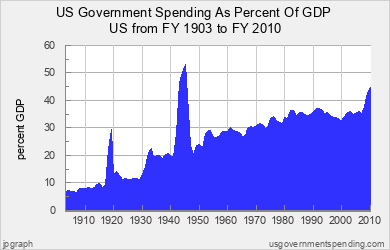
Another way to think of this is that 45% of your productive effort goes to supporting The State. While you may say, "but that's impossible because the sum of the average tax rate we pay doesn't get to 45%", then you just figured out what government borrowing allows for.
Paying off that debt (without defaulting) means one or a combination of higher explicit taxes, higher implicit taxes (money printing), or massively reduced government spending in the future. Guess which one of these is unlikely.
If you just vomited in your mouth and subsequently swallowed it, you're not alone.
Another way to think of this is that 45% of your productive effort goes to supporting The State. While you may say, "but that's impossible because the sum of the average tax rate we pay doesn't get to 45%", then you just figured out what government borrowing allows for.
Paying off that debt (without defaulting) means one or a combination of higher explicit taxes, higher implicit taxes (money printing), or massively reduced government spending in the future. Guess which one of these is unlikely.
If you just vomited in your mouth and subsequently swallowed it, you're not alone.
Sunday, February 07, 2010
Pennsylvania's Capital City, Harrisburg, Faces Bankruptcy
Somehow we missed this news during January. Hopefully it continues to develop toward a filing.
Awesomely, Pennsylvania's capital city - Harrisburg - is insolvent and on the brink of filing for Chapter 9 bankruptcy.
As reported in this link to WGAL's website, you can see that Harrisburg's new mayor is dealing with all sorts of tough decisions in her first few weeks in office.
TILB's advice to Mayor Thompson: take a page from Arnold's book and start issuing your own scrip. Seems like s no-brainer.
Emphasis added [and comments added in brackets]
Awesomely, Pennsylvania's capital city - Harrisburg - is insolvent and on the brink of filing for Chapter 9 bankruptcy.
As reported in this link to WGAL's website, you can see that Harrisburg's new mayor is dealing with all sorts of tough decisions in her first few weeks in office.
TILB's advice to Mayor Thompson: take a page from Arnold's book and start issuing your own scrip. Seems like s no-brainer.
Emphasis added [and comments added in brackets]
WGAL.comExpect more of this sort of thing.
Harrisburg Facing Bankruptcy; Mayor Proposes Tax Hike, Leasing Assets
Official: Incinerator Primary Cause Of Financial Woes
HARRISBURG, Pa. -- After just a few weeks in office, Harrisburg Mayor Linda Thompson is facing financial problems that could put the city in bankruptcy before the year is out.
City officials blame the incinerator facility, now over $228 million in debt, for the city's financial troubles.
That's not an option she even wants to consider at this point, but any successful plan must solve the financial drain of the city's incinerator.
The incinerator is currently $288 million in debt and is the primary cause of Harrisburg's financial problems.
Officials said it doesn't begin to produce the revenue needed to pay off the debt of repairing and operating the facility over the years.
Former City Council vice president Dan Miller said it's been a financial drain for decades.
"It's such a problem because for 25 years, the true problem of the incinerator has never been addressed," said Miller. "It's been refinanced repeatedly and pushed down the road, always waiting for someone else to solve the problem."
Now, he said, the city must solve the problem.
Miller said he believes the city should consider going into Act 47, the first step before bankruptcy. That would allow the city to negotiate with the people it owes to come up with realistic plans to settle debts.
Miller said raising taxes and other fees, or selling off revenue-producing city assets like the parking garages and water and sewer operations, will only create new problems.
Mayor Thompson Proposes Budget Amendments
Thompson addressed City Council Tuesday night with her own plans to fix the financial crisis.
City council member Wanda Williams said Thompson's proposed tax hike is "an outrageous amount" to increase any taxes. [TILB - I love this! "We can't cut spending" and "we can't sell our precious assets" and "we can't raise taxes"! Guess what you can do, loser: File BK.]
Thompson is proposing to increase water rates by 40 percent and cut overtime funding for the police and fire department.
At the meeting, Thompson also proposed what she called tough decisions, which include:
A 20 percent property tax increase
Cutting costs for trash collection
Merging Harrisburg dispatch with the Dauphin County 911 center
Thompson said her cuts would save the city about $8 million. She said her proposals will close the nearly $4 million gap in the budget, allow the city to make payroll next month and help ease the financial pain of the incinerator debt.
But not everyone is happy with the mayor's recommendations.
"I'm disturbed by it," said one taxpayer. "To me, a property tax increase as well as a water rate increase would be something I find objectionable." [TILB - while we totally agree, Johnny Taxpayer needs to recognize that these are symptoms of the debt and spending problem. It's like getting herpes from unprotected but enjoyable sex and then saying you find the sores "objectionable".]
Thompson said she is also considering selling or leasing the city's assets, including parking garages and City Island. [TILB - Honestly, this is a great idea...I mean, other than the fact that this is a horrible time to sell these sorts of assets. Maybe some public REIT with overpriced equity financing will provide the necessary bid. Why should municipalities be in the business of managing parking garages anyway?]
City council will look into the mayor's budget proposal at Thursday's budget and finance committee meeting.
Friday, January 29, 2010
The Final Countdown: Greek Sovereign Default
The aptly named band Europe brought us the epic music video and song "The Final Countdown" about 20 years too early (I mean, who cares about the countdown to the end of communism - let's talk about the PIIGS sovereign default).
As I read all these articles about Greece's impending doom, it's hard not to hear in the back of my head the implied complaint, "why won't they just lend us the money for free? This doesn't make any sense. Just lend us the money for free!"
[emphasis added and comments in brackets]
As we've been saying for a year, just wait until Japan blows. It's situation is nearly twice as bad as Greece's. Despite having 40% of the U.S.'s GDP, it has as much debt. If its blended cost of funding goes up from 1.5% to a bit over 3%, 100% of its tax revenue will be absorbed by interest expense. We're talking about the second largest economy in the world and it literally has no other options than massively debasing its currency or defualting on its debt (or, more likely, both). That's what they get for following Bernanke's wicked advice.
The sooner Japan blows, the better for the U.S. - I suspect our only hope of not suffering the same fate is to witness Japan's meltdown after having followed a similar prescription.
And as to Europe, just wait until Greece's implosion lights up Italy, which is a very large economy. That is the real worry the EU is facing: do we let Italy go?
Which brings us full circle, to The Final Countdown...
As I read all these articles about Greece's impending doom, it's hard not to hear in the back of my head the implied complaint, "why won't they just lend us the money for free? This doesn't make any sense. Just lend us the money for free!"
[emphasis added and comments in brackets]
Europe Weighs Possibility of Debt Default in GreecePeople think this is news?
New York Times
By STEPHEN CASTLE and MATTHEW SALTMARSH
European leaders are quietly considering whether to come to the aid of their troubled neighbor Greece amid fears that the nation might default on its debts and unleash another round of financial crisis.
Only a month after Dubai was rescued by its neighboring emirate Abu Dhabi, Germany, France and other European powers are discussing whether Greece might need a bailout too.
After a decade of debt-fueled profligacy, Greece is confronting what amounts to a run on the bank. And, despite repeated assurances from Athens, the nation’s strained finances have put already jittery financial markets on edge. On Thursday, the worries stretched all the way to Wall Street, where the stock market sank 1.1 percent.
Some economists worry that Greece’s troubles could have deep and lasting repercussions for Europe. The crisis poses complex challenges for the euro, which Greece adopted in 2001. The currency sank to a six-month low against the dollar and yen on Thursday.[ironically, TILB thinks letting Greece go could be an incredibly strong event for the euro]
“Greece failing is not an option, and lots of people think that we will have to intervene at some stage,” said one European finance official, who was not permitted to speak publicly on the matter. “It doesn’t have to happen, and we hope it won’t, but it would be better than seeing a default.”
...
But doubts have intensified over the credibility of the drastic austerity measures put forward to try to get Greece’s budget under control, in spite of concerted efforts by the Greek government to calm the markets.
Investors worry that the crisis in Greece could touch off a domino effect across Southern Europe. Many are fleeing bond markets in Portugal, Spain and Italy out of concern the troubles might spread. [TILB - Collectively known as the PIIGS when Ireland is included]
The market’s judgment has been swift and brutal. On Thursday, the difference between the interest rates on Greek and German bonds — a measure of the risk investors perceive in the Greek debt — rose to nearly four full percentage points, its highest level since the euro was adopted.
Officials in Athens, Frankfurt and Brussels remained adamant that Greece was not at risk of being forced to abandon the euro. [TILB - of course not. Could you imagine if they said, "hey, we're thinking of going back to the Drachma so that we can print our way out of this debacle?" That would be amazing.]
As a condition of any aid package, the Greek government led by Mr. Papandreou would be asked to provide a more detailed program to bring the country’s deficit — currently equal to 12.7 percent of gross domestic product — under control. European Union rules call for a maximum of 3 percent. Officials insist that any bailout must not put into doubt the credibility of the euro.
Another condition of any aid would be further guarantees over the reliability of Greece’s economic data. Last year the newly elected government in Athens announced a sharp upward revision of its deficit figures, which have since been exposed as seriously flawed.
Next week, the European Commission is expected to propose greater powers for the European statistical agency, Eurostat, to audit the accounts of national governments. [TILB - watch Czech president Vaclav Klaus give this interview where he presciently assesses the fact that the EU and the Euro are forfeitures of sovereignity and freedom, then watch the slow leech of powers from the states to the centralized United States of Europe]
The latest moves reflect a continuing skepticism among euro-zone members over the practicality of the plans put forward so far by the Greek government. Athens wants to reduce the deficit to 3 percent of G.D.P. by 2012, an objective described as unrealistic by one European diplomat, also speaking on condition of anonymity. These plans are also to be assessed by the commission next week.
Greece’s budget deficit is four times the E.U. limit, while the country’s debt amounts to 113 percent of G.D.P. But officials insist that, because Greece is not one of the euro zone’s larger economies, the problems created by its grim public finances can be absorbed. The Greek economy represents about 2.5 percent of the euro area’s G.D.P. [TILB - Japan is over 200% sovereign debt to GDP and the US is a bit over 80%. Carmen Reinhardt and Kenneth Rogoff show that 90% is the threshold past which few survive, as well as 60% externally financed debt to GDP - this latter point has been Japan's saving grace, though that is likely over]
...
For Greece’s neighbors, there is the possibility of a domino effect, with investors subsequently moving on to test the resilience of another heavily indebted member of the euro area — possibly Italy, whose debt is also 113 percent of its gross domestic product.
...
One option, deemed unlikely, would be issuing a sovereign bond for the entire 16-nation euro area. That would probably require complex legal changes among members. [TILB - see prior Vaclav Klaus reference]
...
On Monday, Greece paid a hefty 6.22 percent rate to borrow money in the bond market, underscoring investors’ concern. [TILB - and it's much more expensive for them already, just five days later. If memory serves us well, they have a number of huge maturities in April/May that will be challenging to finance affordably without German backstop...]
In an interview this week, the Greek finance minister, George Papaconstantinou, acknowledged that the high rates were punitive but asked that investors keep faith. Greece needs to raise at least 53 billion euros this year, much of it this spring.
As we've been saying for a year, just wait until Japan blows. It's situation is nearly twice as bad as Greece's. Despite having 40% of the U.S.'s GDP, it has as much debt. If its blended cost of funding goes up from 1.5% to a bit over 3%, 100% of its tax revenue will be absorbed by interest expense. We're talking about the second largest economy in the world and it literally has no other options than massively debasing its currency or defualting on its debt (or, more likely, both). That's what they get for following Bernanke's wicked advice.
The sooner Japan blows, the better for the U.S. - I suspect our only hope of not suffering the same fate is to witness Japan's meltdown after having followed a similar prescription.
And as to Europe, just wait until Greece's implosion lights up Italy, which is a very large economy. That is the real worry the EU is facing: do we let Italy go?
Which brings us full circle, to The Final Countdown...
Wednesday, January 27, 2010
State Of The Union - Summary: "It's A Shitshow Out There"
Watching Obama's debacle of a State of the Union address reminds us of Thomas Sowell's prescient analysis from almost a year and a half ago.
Sowell link.
As an aside, did anyone else find Obama referencing the Constitution at the beginning of his speech ironic?
Sowell link.
As an aside, did anyone else find Obama referencing the Constitution at the beginning of his speech ironic?
Tuesday, January 19, 2010
U.S. Rail Data Crushingly Negative
[HT: Max Headroom and LB]
The weekly railroad traffic data collected by the Association of American Railroads (AAR) did not have a particularly difficult comp in January. You may recall that in January 2009, it seemed as if the world had stopped as retailers and suppliers were crushed by excess inventory that needed to be burned off. Those same businesses allegedly just stopped placing orders leading to the collapse in rail volumes during November and December of 2008 in the below graph. January 2009 was no better.
2010 - Jan 14 - AAR Data
So January 2010, even if still in the teeth of a recession, should at least have the benefit of not dealing with an excess inventory problem. It should have been better than January 2009.
But alas. In fact, the first week of January is comping well below the worst average month in all of 2008 or 2009 (or any month for YEARS, for that matter). Green shoots?
From the AAR's weekly rail data release (emphasis added):
The weekly railroad traffic data collected by the Association of American Railroads (AAR) did not have a particularly difficult comp in January. You may recall that in January 2009, it seemed as if the world had stopped as retailers and suppliers were crushed by excess inventory that needed to be burned off. Those same businesses allegedly just stopped placing orders leading to the collapse in rail volumes during November and December of 2008 in the below graph. January 2009 was no better.
2010 - Jan 14 - AAR Data
So January 2010, even if still in the teeth of a recession, should at least have the benefit of not dealing with an excess inventory problem. It should have been better than January 2009.
But alas. In fact, the first week of January is comping well below the worst average month in all of 2008 or 2009 (or any month for YEARS, for that matter). Green shoots?
From the AAR's weekly rail data release (emphasis added):
WASHINGTON, D.C. – Jan. 14, 2010 – The Association of American Railroads today reported that freight rail traffic is off to a slow start in 2010 with U.S. railroads originating 236,796 carloads for the week ending Jan. 9, 2010, down 12.4 percent compared with the same week in 2009 and down 28 percent from the same week in 2008. In order to offer a complete picture of the progress in rail traffic, AAR will now be reporting 2010 weekly rail traffic with year-over-year comparisons for both 2009 and 2008.Helicopter Ben, your authotization to continue debasing has arrived. Continue your destructive ways freely.
Thursday, January 14, 2010
California Debt Is Downgraded: Schwarzies Prepare For A Comeback!
TILB is so incredibly thankful that - as we informed our readers over and over again last spring and summer (click here for all TILB posts referencing Schwarzies) - California has not at all fixed its budget woes. It has another $20 billion deficit expected in the coming 18 months.
It seems as if California lawmakers think this problem might solve itself. That somehow, they are going to miraculously bring in another $14 billion in tax "revenue" - annually mind you - over any reasonably near term period.
Spoiler Alert: Ain't gonna happen. In fact, the more you raise taxes when you are already a high tax regime like California, in the long run, the less tax "revenue" the state can expect to receive. It will actually worsen its problem by driving out marginal growth and productive investment.
The obvious solution is not to try to raise another $14 billion per year - it's to cut $14 billion more in spending per year. Free that capital up so that your citizenry can productively deploy it rather than having a bunch of proven morons in Sacramento deploy it destructively.
As we promised back in July 2009, TILB stands ready to laugh in California's face as their legislature acts like a political set of keystone cops.
Below and linked here is a Reuters article discussing the S&P downgrade [emphasis added and comments in brackets are TILB's].
It seems as if California lawmakers think this problem might solve itself. That somehow, they are going to miraculously bring in another $14 billion in tax "revenue" - annually mind you - over any reasonably near term period.
Spoiler Alert: Ain't gonna happen. In fact, the more you raise taxes when you are already a high tax regime like California, in the long run, the less tax "revenue" the state can expect to receive. It will actually worsen its problem by driving out marginal growth and productive investment.
The obvious solution is not to try to raise another $14 billion per year - it's to cut $14 billion more in spending per year. Free that capital up so that your citizenry can productively deploy it rather than having a bunch of proven morons in Sacramento deploy it destructively.
As we promised back in July 2009, TILB stands ready to laugh in California's face as their legislature acts like a political set of keystone cops.
Below and linked here is a Reuters article discussing the S&P downgrade [emphasis added and comments in brackets are TILB's].
UPDATE 4-California debt rating cut as cash crunch looms
8:03pm EST* S&P sees budget solution possibly crimping economy
* $19 bln shortfall tougher to close than last year's-S&P [no shit - you can't cut the fat you already cut, so it's all new fat here]
* Cash crunches seen in March, July, but RANs to be paid (Recasts, adds debt insurance costs and comparison)
By Jim Christie and Peter Henderson
SAN FRANCISCO, Jan 13 (Reuters) - California's main debt rating was cut on Wednesday by Standard & Poor's, which said the government of the most populous U.S. state could nearly run out of cash in March -- and another rating cut might follow.
The state government's budget gap of nearly $20 billion over the next year and a half leaves it in a precarious situation, requiring tax increases or spending cuts, either of which may slow economic recovery, the agency said in a statement.
"If economic or revenue trends substantially falter, we could lower the state rating during the next six to 12 months," S&P said after cutting the rating on $63.9 billion of California's general obligation debt one notch to A- from A.
The new level is four notches above "junk" status, a level at which many investors refuse to buy debt.
"The big question is, is there any fear they will get downgraded out of investment grade (so) you may have to sell ... that's where I think it would get interesting or hairy," said Eaton Vance portfolio manager Evan Rourke.
Bond prices did not move much, though, since many expected the downgrade, he said.
S&P's downgrade was overdue because the state's revenues have been so weak, said Dick Larkin, director of credit analysis at Herbert J. Sims Co Inc in Iselin, New Jersey. "Frankly I can't understood why it took S&P so long," he said. "They could have made that decision back in September." [September? Try March.]
$1 BILLION SHORT IN MARCH
California already had the lowest debt rating of any U.S. state before the downgrade, and 39 state governments are struggling with shortfalls this fiscal year, according to the nonpartisan Center on Budget and Policy Priorities.
Many are begging for more federal funds and caught between cutting social programs, raising taxes, or both.
The housing market implosion was felt especially strongly in California, a subprime mortgage lending center. Its double-digit unemployment rate, one of the highest in the United States, is expected to endure for a year or more.
California's government resorted to issuing IOUs last year for the second time since the Great Depression when it nearly ran out of cash. Officials are scrambling to raise $1 billion for March and the shortfall could be worse in July, S&P said. [sounds like Schwarzies are coming back; we're almost giddy with excitement!]
State Treasurer Bill Lockyer's spokesman Tom Dresslar said S&P's downgrade "highlights the critical need for the legislature and the governor to produce a swift budget resolution that is credible to the market."
"Standard & Poor's makes it clear the failure to act in a timely manner and with credibility threatens to further lower our GO rating," Dresslar said, adding that a further cut would hit taxpayers already paying higher interest rates than people in some emerging economies.
The cost to insure California's debt with credit default swaps is now higher than debt of developing countries, such as Kazakhstan, Lebanon and Uruguay. It costs $277,000 per year for five years to insure $10 million in California debt, compared with $172,000 for Kazakh debt. [phenomenal]
George Strickland, a municipal bond mutual fund manager at Thornburg Investment Management said S&P still has California GOs rated too high. Moody's Investors Service has a Baa1 rating on the debt and Fitch Ratings rates the bonds BBB.
"There's another notch to go before they hit bottom," Strickland said, adding that he expects another long and ugly battle to fill the state budget's shortfall.
Governor Arnold Schwarzenegger less than a week ago unveiled a plan to balance the state's books, largely with spending cuts that he described as draconian and which leaders of the Democrat-controlled legislature sharply criticized. [I can't wait to see the Donkey-proposed alternative - Lord willing it involves more unconstitutional minting of Schwarzies by Sacramento]
S&P said "timely progress" on a budget fix would be impeded by previous reliance on one-time measures, fewer choices for one-time cuts, extraordinary reliance on federal aid in Schwarzenegger's plan, and California's unusual requirement for a supermajority of lawmakers to pass a budget.
The Republican governor's budget plan also said that while the state government faces cash challenges in March, it will have sufficient cash to repay $8.8 billion in revenue anticipation debt in May and June as scheduled. [whether true or not, what else can they say? Any other statement would be a hand delivered invitation for the ratings agencies to slash the G.O. rating further]
State Finance Director Ana Matosantos along with Lockyer and State Controller John Chiang said on Monday they are working together so the state government honors its RAN debt.
Bond payments are by law a top state priority and state Finance Department spokesman H.D. Palmer said they will be honored: "Even though we've got to make some decisions in managing March we absolutely have ample cash on hand to make our RAN payments in May and June on time and in full."
Larkin said the three major rating agencies will hold off on more downgrades to California's credit rating to avoid roiling the municipal debt market, even in the event budget talks between Schwarzenegger and lawmakers drag on.
"They'll give the state an awful lot of rope," Larkin said. "For a state to go below investment grade would cast a pall on every state and local issuer out there." [at least market participants publicly acknowledge that the ratings agencies are pussies]
(Reporting by Jim Christie, Peter Henderson, Karen Brettell and Joan Gralla; Editing by Andrew Hay, Gary Hill)
Wednesday, January 13, 2010
Hayman Capital's Kyle Bass Gives Interview On CNBC
Kyle Bass of Hayman Capital (enjoy a past letter of his here) will be testifying in front of the Congressional Financial Crisis Inquiry Commission (FCIC) today as a market participant playing counterpunch to a bunch of big name bankers that are there to defend the role of banks in the crisis. Hopefully Lloyd talks more about how Goldman is doing "God's work."
Bass talks to David Faber in this video about capital adequacy of banks, Freddie and Fannie, and the looming meltdown of Japan (further proof of The Singularity risk).
Enjoy.
Bass talks to David Faber in this video about capital adequacy of banks, Freddie and Fannie, and the looming meltdown of Japan (further proof of The Singularity risk).
Enjoy.
Monday, January 11, 2010
Jeffrey Gundlach, CEO Of DoubleLine Capital, Responds To Lawsuit From TCW
Gundlach strikes back at TCW and defends his honor.
Dear Friends of DoubleLine:
I am writing to address briefly the business dispute between Trust Company of the West and my new firm, DoubleLine Capital LP. As has been widely reported in the press, TCW filed suit last week against DoubleLine, me and some of my trusted colleagues. I have referred TCW's unfortunate litigation tactics to my legal team and expect this matter to be handled as a business dispute in the ordinary course. My portfolio management and trading teams and I continue to focus on the work of building DoubleLine and managing our clients' accounts. We are dedicated to the well being of our clients and to delivering on our promise to treat our clients' precious capital as our own.
DoubleLine has made remarkable progress in the past few weeks. We have in place our seasoned Mortgage, Corporate, Emerging Markets and Core Fixed Income teams; the Securities and Exchange Commission has approved our application to become a registered Investment Adviser; we have occupied our new permanent office and trading space in downtown Los Angeles; and we have established separate accounts on behalf of our initial clients. We look forward to sharing further news of our progress in the days and weeks ahead.
While I am resolved not to let TCW distract me or my team, TCW has disseminated certain smears and innuendoes that I am unwilling to let pass without at least a brief comment.
First of all, I was a loyal and extraordinarily productive employee of TCW for over 24 years. I have very good feelings toward many of the people with whom I worked there. And I am proud of the significant contributions by my teams and myself to the historic success of TCW.
In January 2009, TCW's parent, Société Générale, publicly announced that it was no longer interested in being in the money management business in a meaningful way. Soc Gen has since wound down direct involvement in its primary money management arm and discussed plans for an IPO or other paths of divestiture of TCW sometime before 2014. I became deeply concerned about the extended period of uncertainty: how would the divestment of TCW occur? How would that uncertainty affect me, my colleagues, the business and our clients? I know that other senior managers at TCW shared the same concerns at the time and do so to this day.
In response, in my last few months at TCW, I explored avenues to purchase the business, overtures that were rebuffed. Although I had begun to consider other options, I fully expected up until my dismissal on December 4 that, if I left TCW, I would do so in a negotiated transaction that was accommodative to clients as well as mutually beneficial for TCW and myself. It is unfortunate that TCW elected to take another route.
A second deeply disturbing element of TCW's actions has been its invasion and searching of locked drawers in my office at TCW's headquarters in downtown Los Angeles and of a small personal office I kept in Santa Monica. I personally paid the rent and all other expenses for the operation of this office. After seizing these offices, TCW refused to allow me to collect my personal possessions, and the salacious disclosure in TCW's lawsuit of certain of the items apparently taken there from is a transparent attempt to embarrass me and harm my business. While these actions will no doubt be subjects of litigation, suffice it to say that I had every expectation of privacy in these spaces, which stored vestiges of closed chapters of my life.
Notwithstanding TCW's scorched earth legal policy, I am certain that no employee of TCW, past or present, friend or foe, can honestly say that they ever had any experience with me, either in the office, on the road or in any meeting, in which there was any improper activity consistent with the innuendoes, smears and gross distortions to which TCW has shamelessly subjected me in its lawsuit.
I assure you that I remain the worthy fiduciary in whom you have entrusted your investments over many years. Together with my team, I navigated the treacherous credit crisis markets and protected and grew your principal while others failed. I believe that we at DoubleLine have earned your trust, and hope that you will continue to permit us to protect and make money for you and with you.
Sincerely,
Jeffrey Gundlach
Chief Executive Officer
DoubleLine Capital LP
Contact Information
phone: 213-633-8200
Wednesday, January 06, 2010
Thank Goodness For Food Stamps - These Job Seekers Would Do Anything For A Job If One Simply Existed
This past Sunday, The New York Times ran a front page article on the massive increase in people living off food stamps alone (no other income whatsoever).
Peppered with sad tales like that of Isabel Bermudex who went from a poor upbringing to earning $180,000 in one year as a real estate agent during the boom before falling back to nothing, the article is intended to tug at the heart strings. It emphasizes the desperate straights of these unemployed and incomeless folks and how badly they want an honest day's work.
Throughout the article, people talk about wanting - but not being able to find - jobs and the terrible situation they'd be in without government handouts.
We certainly don't doubt it.
What we do doubt is that the solution is more handouts; more government. Government interference is the problem - it is what prevents most people from finding gainful employment. We have a huge excess supply of labor that allegedly wants nothing more than employment (10% unemployed). Any income is better than no income, all else being equal. However, our strict minimum wage legislation prevents the natural market clearing mechanism from taking place. As any freshman econ major can tell you, virtually any amount of supply of goods or services that has positive value can be cleared at the right price. Further, because we pay people not to work when they lose their jobs, the hurdle for accepting new work is artificially raised by the government subsidy the individuals receive.
The minimum wage and welfare-type programs are painful legacies of the New Deal era that oontinue to wreak havoc today. The people in the article below continue to suffer from F.D. Roosevelt's mad science. TILB used to think the minimum wage level didn't particularly matter because during the long period of full employment it really didn't. However, during periods of economic downturn, minimum wage basically puts a chokehold on remployment - not allowing labor prices to reset and preventing companies from hiring.
In reality, the minimum wage and other cost raising government interferences like it are nothing but Chinese economic stimulus legislation.
As our policies make it impossibly uneconomic for Americans to be employed in America by American companies, the government is basically encouraging those same companies to send wages and much needed investment capital overseas to countries that have more friendly policies toward their populous - policies that don't legally prevent citizens from working for a wage they'd happily accept and worse, that pay people not to work!
Only a government official or tunnel visioned theoretical academician could come up with this foolishness. Sadly, we seem to have returned to this sort of thinking at our highest levels. It virtually guarantees that our country will struggle to reach a full recovery.
Sometimes we wonder if that underperformance and increase of government supplicants isn't actually the goal of the left; to enslave the underemployed and undereducated to resources provided by their friendly congressman.
Intentional or not, that is the outcome of these thoughtless laws.
Article excerpts below.
Peppered with sad tales like that of Isabel Bermudex who went from a poor upbringing to earning $180,000 in one year as a real estate agent during the boom before falling back to nothing, the article is intended to tug at the heart strings. It emphasizes the desperate straights of these unemployed and incomeless folks and how badly they want an honest day's work.
Throughout the article, people talk about wanting - but not being able to find - jobs and the terrible situation they'd be in without government handouts.
We certainly don't doubt it.
What we do doubt is that the solution is more handouts; more government. Government interference is the problem - it is what prevents most people from finding gainful employment. We have a huge excess supply of labor that allegedly wants nothing more than employment (10% unemployed). Any income is better than no income, all else being equal. However, our strict minimum wage legislation prevents the natural market clearing mechanism from taking place. As any freshman econ major can tell you, virtually any amount of supply of goods or services that has positive value can be cleared at the right price. Further, because we pay people not to work when they lose their jobs, the hurdle for accepting new work is artificially raised by the government subsidy the individuals receive.
The minimum wage and welfare-type programs are painful legacies of the New Deal era that oontinue to wreak havoc today. The people in the article below continue to suffer from F.D. Roosevelt's mad science. TILB used to think the minimum wage level didn't particularly matter because during the long period of full employment it really didn't. However, during periods of economic downturn, minimum wage basically puts a chokehold on remployment - not allowing labor prices to reset and preventing companies from hiring.
In reality, the minimum wage and other cost raising government interferences like it are nothing but Chinese economic stimulus legislation.
As our policies make it impossibly uneconomic for Americans to be employed in America by American companies, the government is basically encouraging those same companies to send wages and much needed investment capital overseas to countries that have more friendly policies toward their populous - policies that don't legally prevent citizens from working for a wage they'd happily accept and worse, that pay people not to work!
Only a government official or tunnel visioned theoretical academician could come up with this foolishness. Sadly, we seem to have returned to this sort of thinking at our highest levels. It virtually guarantees that our country will struggle to reach a full recovery.
Sometimes we wonder if that underperformance and increase of government supplicants isn't actually the goal of the left; to enslave the underemployed and undereducated to resources provided by their friendly congressman.
Intentional or not, that is the outcome of these thoughtless laws.
Article excerpts below.
January 3, 2010
The Safety Net
Living on Nothing but Food Stamps
By JASON DEPARLE and ROBERT M. GEBELOFF
CAPE CORAL, Fla. — After an improbable rise from the Bronx projects to a job selling Gulf Coast homes, Isabel Bermudez lost it all to an epic housing bust — the six-figure income, the house with the pool and the investment property.
Now, as she papers the county with résumés and girds herself for rejection, she is supporting two daughters on an income that inspires a double take: zero dollars in monthly cash and a few hundred dollars in food stamps.
With food-stamp use at a record high and surging by the day, Ms. Bermudez belongs to an overlooked subgroup that is growing especially fast: recipients with no cash income.
About six million Americans receiving food stamps report they have no other income, according to an analysis of state data collected by The New York Times. In declarations that states verify and the federal government audits, they described themselves as unemployed and receiving no cash aid — no welfare, no unemployment insurance, and no pensions, child support or disability pay.
Their numbers were rising before the recession as tougher welfare laws made it harder for poor people to get cash aid, but they have soared by about 50 percent over the past two years. About one in 50 Americans now lives in a household with a reported income that consists of nothing but a food-stamp card.
“It’s the one thing I can count on every month — I know the children are going to have food,” Ms. Bermudez, 42, said with the forced good cheer she mastered selling rows of new stucco homes.
Members of this straitened group range from displaced strivers like Ms. Bermudez to weathered men who sleep in shelters and barter cigarettes. Some draw on savings or sporadic under-the-table jobs. Some move in with relatives. Some get noncash help, like subsidized apartments. While some go without cash incomes only briefly before securing jobs or aid, others rely on food stamps alone for many months.
...
A skinny fellow in saggy clothes who spent his childhood in foster care, Rex Britton, 22, hopped a bus from Syracuse two years ago for a job painting parking lots. Now, with unemployment at nearly 14 percent and paving work scarce, he receives $200 a month in food stamps and stays with a girlfriend who survives on a rent subsidy and a government check to help her care for her disabled toddler.
“Without food stamps we’d probably be starving,” Mr. Britton said.
A strapping man who once made a living throwing fastballs, William Trapani, 53, left his dreams on the minor league mound and his front teeth in prison, where he spent nine years for selling cocaine. Now he sleeps at a rescue mission, repairs bicycles for small change, and counts $200 in food stamps as his only secure support.
“I’ve been out looking for work every day — there’s absolutely nothing,” he said.
A grandmother whose voice mail message urges callers to “have a blessed good day,” Wanda Debnam, 53, once drove 18-wheelers and dreamed of selling real estate. But she lost her job at Starbucks this year and moved in with her son in nearby Lehigh Acres. Now she sleeps with her 8-year-old granddaughter under a poster of the Jonas Brothers and uses her food stamps to avoid her daughter-in-law’s cooking.
“I’m climbing the walls,” Ms. Debnam said.
...
But others say the lack of cash support shows the safety net is torn. The main cash welfare program, Temporary Assistance for Needy Families, has scarcely expanded during the recession; the rolls are still down about 75 percent from their 1990s peak. A different program, unemployment insurance, has rapidly grown, but still omits nearly half the unemployed. Food stamps, easier to get, have become the safety net of last resort.
“The food-stamp program is being asked to do too much,” said James Weill, president of the Food Research and Action Center, a Washington advocacy group. “People need income support.”
...
The expansion of the food-stamp program, which will spend more than $60 billion this year, has so far enjoyed bipartisan support. But it does have conservative critics who worry about the costs and the rise in dependency.
“This is craziness,” said Representative John Linder, a Georgia Republican who is the ranking minority member of a House panel on welfare policy. “We’re at risk of creating an entire class of people, a subset of people, just comfortable getting by living off the government.”
Mr. Linder added: “You don’t improve the economy by paying people to sit around and not work. You improve the economy by lowering taxes” so small businesses will create more jobs.
...
Kevin Zirulo and Diane Marshall, brother and sister, have more unlikely stories than a reality television show. With a third sibling paying their rent, they are living on a food-stamp benefit of $300 a month. A gun collector covered in patriotic tattoos, Mr. Zirulo, 31, has sold off two semiautomatic rifles and a revolver. Ms. Marshall, who has a 7-year-old daughter, scavenges discarded furniture to sell on the Internet.
They said they dropped out of community college and diverted student aid to household expenses. They received $150 from the Nielsen Company, which monitors their television. They grew so desperate this month, they put the breeding services of the family Chihuahua up for bid on Craigslist.
“We look at each other all the time and say we don’t know how we get through,” Ms. Marshall said.
...
Ms. Bermudez recently answered the door in her best business clothes and handed a reporter her résumé, which she distributes by the ream. It notes she was once a “million-dollar producer” and “deals well with the unexpected.”
“I went from making $180,000 to relying on food stamps,” she said. “Without that government program, I wouldn’t be able to feed my children.”
Friday, January 01, 2010
Liberty Quote Of The Day: George Bernard Shaw
We instantly fell in love with this quote, when we heard it released from the lips of Margaret Thatcher, although it originates from George Bernard Shaw. It is so true. Enjoy the bonus Thatcher video below.
"Freedom incurs responsibility; that is why so many men fear it."- George Bernard Shaw
Subscribe to:
Posts (Atom)